01Facts
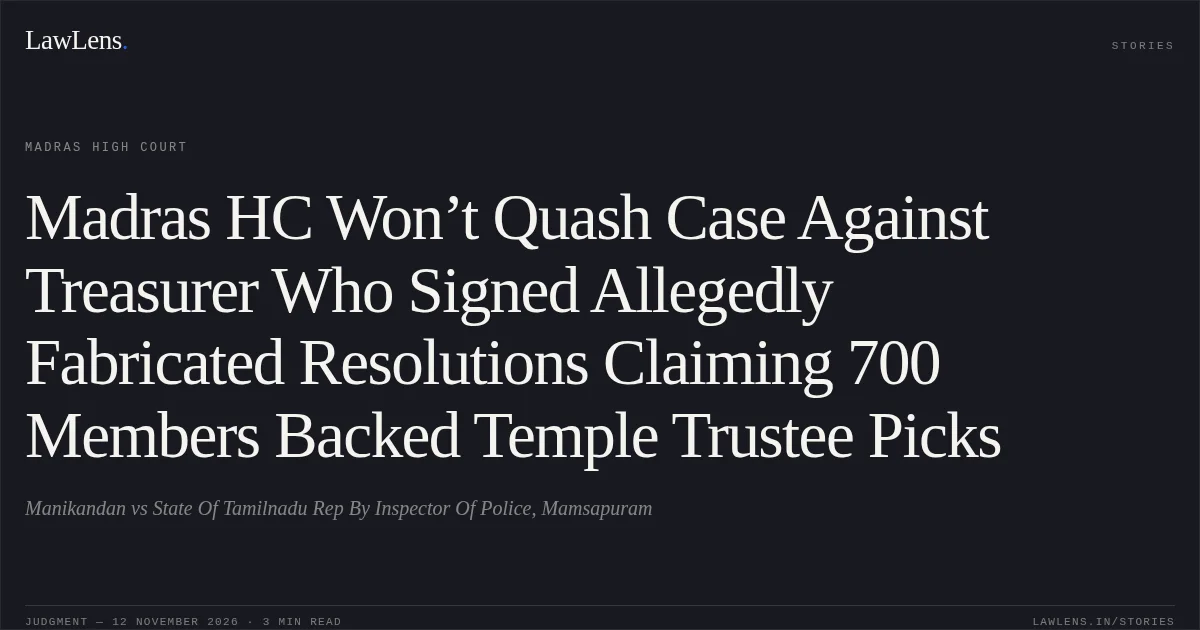
The petitioner, arrayed as A4, sought to quash proceedings in C.C.No.1023 of 2025, where he faced charges under Sections 147, 420, 465, 468 and 471 of the IPC.
pp. 2–4 · ¶ 2–5The prosecution alleged that he signed, as Treasurer, resolutions purporting to record the decision of a community body and the support of 700 eligible members for the appointment of two non-hereditary temple trustees.
pp. 2–4 · ¶ 2–5The resolutions were allegedly fabricated and submitted to the HR & CE Joint Commissioner, who appointed the proposed trustees.
pp. 2–4 · ¶ 2–5A subsequent statutory enquiry found the resolutions fabricated, and a police investigation followed.
pp. 2–4 · ¶ 2–5The petitioner argued that he had merely signed the resolutions, gained no benefit, and that the dispute was civil in nature; he also challenged the applicability of the forgery and cheating offences.
pp. 4–5 · ¶ 6–702Issues
i.Whether the allegations that the petitioner signed resolutions falsely claiming the authority and support of a community body and its members prima facie disclosed forgery-related offences under the IPC.
pp. 7–9 · ¶ 11–15ii.Whether the alleged use of those resolutions to obtain the appointment of trustees prima facie disclosed cheating under Section 420 IPC.
p. 9 · ¶ 16iii.Whether the petitioner’s grounds, including the civil nature of the dispute and the absence of force or violence, justified quashing the proceedings under Section 528 BNSS.
pp. 10–11 · ¶ 17–2103Law Applied
Section 464 IPC treats a document as false where a person dishonestly or fraudulently makes or signs it with the intention that it be believed to have been made or signed by, or under the authority of, someone who did not give that authority.
p. 7 · ¶ 11Sections 468 and 471 IPC concern, respectively, forgery for the purpose of cheating and using a forged document as genuine; Section 420 IPC applies where deception induces delivery of property or another legally cognisable consequence, and wrongful gain may satisfy the dishonest element under Section 24 IPC.
pp. 9–10 · ¶ 15–16Mohammed Ibrahim v. State of Bihar, (2009) 8 SCC 751, distinguishes a document executed by a person in their own name from one falsely claiming to be made by, or under the authority of, another.
p. 8 · ¶ 13At the quashing stage, disputed factual defences and questions of intention are ordinarily for trial where the allegations and investigation materials prima facie disclose offences.
pp. 10–11 · ¶ 18, 21Provisions in the judgment · 9 · Linked ones open on LawLens
Bharatiya Nagarik Suraksha Sanhita, 2023 Section 528
Indian Penal Code, 1860 Section 147Section 420Section 465Section 468Section 471Section 464Section 24
Code of Criminal Procedure, 1973 Section 161
04Reasoning
The Court held that the resolutions were not merely personal documents signed by the petitioner in his own name: they purported to record the collective decision of a community body and the consent of 700 eligible members.
pp. 7–9 · ¶ 12–14The allegations that two different bodies were shown as passing resolutions at the same time and place, that one resolution used the registration number of a dissolved society, and that supporting records included minors and ineligible persons were capable, if proved, of showing false claims of authority and consent.
pp. 7–9 · ¶ 12–14The resolutions were submitted to the Joint Commissioner and allegedly induced the appointment of A5 and A6, prima facie supporting the forgery, use and cheating allegations.
p. 9 · ¶ 15–16The petitioner’s signature on both resolutions, his claimed lack of benefit, and his asserted lack of intention raised matters for trial.
pp. 10–11 · ¶ 17–20The Court left the Section 147 charge to the trial court and found that uncertainty about that charge did not warrant quashing the remaining proceedings.
pp. 10–11 · ¶ 17–2005Holding
The Court found that the final-report allegations and investigation materials prima facie disclosed offences against the petitioner and that his grounds involved disputed questions of fact unsuitable for resolution in a quashing petition.
pp. 11–12 · ¶ 21–23It dismissed the petition, dispensed with the petitioner’s personal appearance before the trial court unless specifically directed, and closed the connected miscellaneous petition.
pp. 11–12 · ¶ 21–23Original Court PDF
ManikandanvsState Of Tamilnadu Rep By Inspector Of Police, Mamsapuram
Click to open original judgment
Original judgment, available to read, download and summarize on LawLens.in