Facts
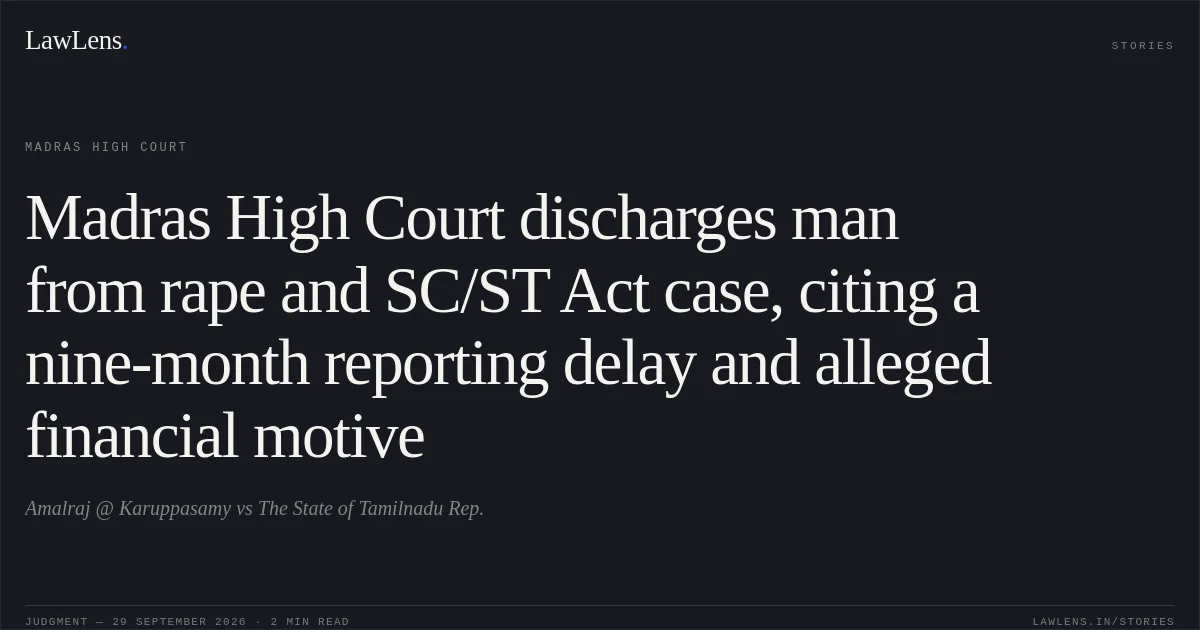
The complainant alleged that the appellant sexually assaulted and injured her at a grocery shop on 5 August 2023, threatened her, and subjected her to caste-based abuse.
Source reference: paras. 10–16, 18She lodged a complaint on 10 May 2024. The police filed a charge sheet for offences under Sections 376, 323 and 506(i) of the IPC and Sections 3(1)(r), 3(1)(w)(i), 3(2)(v) and 3(2)(va) of the SC/ST (Prevention of Atrocities) Act, 1989.
Source reference: paras. 10–16, 18The Special Court dismissed the appellant’s discharge application under Section 227 CrPC. He appealed under Section 14A(2) of the SC/ST Act.
Source reference: paras. 1–2Issues
Whether the Special Court’s refusal to discharge the appellant was sustainable on the prosecution materials.
Source reference: para. 4; paras. 18–25Whether the High Court could exercise its inherent jurisdiction under Section 482 CrPC while hearing an appeal under Section 14A(2) of the SC/ST Act.
Source reference: paras. 26–27Law Applied
Under Sections 227 and 228 CrPC, the court may sift and weigh the prosecution material for the limited purpose of deciding whether a prima facie case or grave suspicion exists, but must not conduct a full trial or assess the evidence as if deciding guilt; where the material raises only suspicion, rather than grave suspicion, discharge may be ordered (CBI v. Sajjan Kumar).
Source reference: paras. 19, 28The court also relied on Vijayan v. State of Kerala concerning the assessment of a delayed rape complaint supported by the prosecutrix’s testimony, and Vishnu Kumar Shukla v. State of Uttar Pradesh on protecting accused persons from vexatious prosecution.
Source reference: paras. 24–25Under Popular Muthiah v. State, the High Court may, in an appropriate case, exercise its inherent jurisdiction under Section 482 CrPC alongside its appellate jurisdiction.
Source reference: paras. 26–27Reasoning
The Court considered the complaint and the complainant’s statements under Sections 161 and 164 CrPC.
Source reference: paras. 19–24, 28It treated the approximately nine-month delay, the absence of medical or other corroborative material, and the complainant’s statement that she had complained at the instance of Baghavathi—who allegedly had a financial dispute with the appellant—as grounds for finding that the prosecution material raised only a limited suspicion, not grave suspicion.
Source reference: paras. 19–24, 28Applying Popular Muthiah, it held that it could exercise Section 482 jurisdiction in the appeal and, in light of the charges already framed, quash them and discharge the appellant.
Source reference: paras. 26–29Holding
The High Court answered the appeal in the appellant’s favour, set aside the Special Court’s order refusing discharge, and stated that the charges against the appellant were to be quashed and he discharged.
The connected miscellaneous petitions were closed.
Source reference: paras. 29–30Acts & Sections Cited
10 provisions across 3 statutes referred to in this judgment. Each provision opens on LawLens.
Scheduled Castes and the Scheduled Tribes (Prevention of Atrocities) Act, 19891
Indian Penal Code, 18603
Code of Criminal Procedure, 19736
Original Court PDF
Amalraj @ KaruppasamyvsThe State of Tamilnadu Rep.
Click to open original judgment
Original judgment, available to read, download and summarize on LawLens.in