Facts
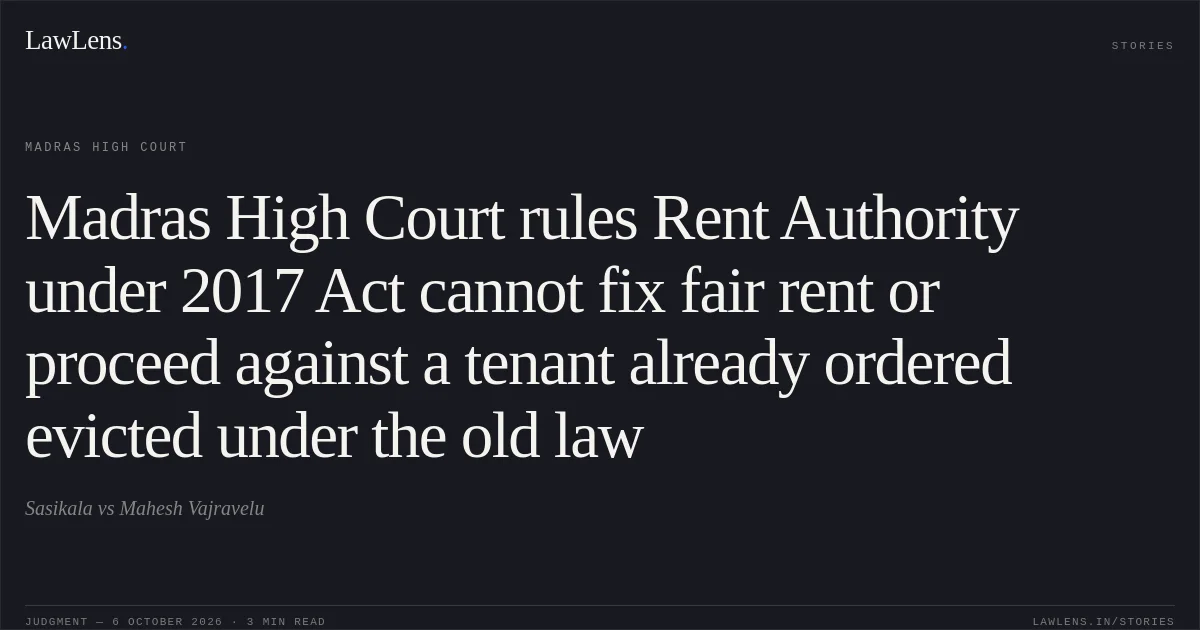
The landlord sought eviction of the tenant under Sections 10(2)(i), 10(3)(a)(iii) and 14(b) of the Tamil Nadu Buildings (Lease and Rent Control) Act, 1960. The Rent Controller dismissed the petition, but the Rent Control Appellate Authority reversed that decision and ordered eviction on the grounds of wilful default and owner’s occupation, while dismissing the ground of demolition and reconstruction.
Source reference: para. 4The tenant challenged the appellate order in revision. The Court was also informed that the landlord had obtained a fair-rent order from the Rent Authority under the Tamil Nadu Regulation of Rights and Responsibilities of Landlords and Tenants Act, 2017.
Source reference: paras. 5–6At the hearing, the tenant sought time to vacate and offered undertakings concerning rent, delivery of possession and non-subletting; the landlord agreed to the requested time and sought permission to clear vegetation and conduct soil tests on adjoining land.
Source reference: paras. 7–10Issues
Whether the Appellate Authority’s eviction order, based on wilful default and owner’s occupation, disclosed any illegality, perversity or other basis for interference in revision
Source reference: para. 5Whether the Rent Authority’s 28 March 2024 fair-rent order under the 2017 Act was sustainable
Source reference: para. 6Whether the tenant should be granted time to vacate subject to undertakings and payment of rent
Source reference: paras. 7–12Law Applied
The Court considered Sections 10(2)(i), 10(3)(a)(iii) and 14(b) of the Tamil Nadu Buildings (Lease and Rent Control) Act, 1960, which respectively provide grounds for eviction based on wilful default, the landlord’s requirement for own occupation, and demolition and reconstruction.
Source reference: para. 4It applied the revisional standard under Section 25 of that Act, holding that interference was not warranted absent illegality, perversity or misappreciation of evidence.
Source reference: para. 5Under the Tamil Nadu Regulation of Rights and Responsibilities of Landlords and Tenants Act, 2017, the Court held that the Rent Authority lacked power to fix fair rent and that Section 2(n)’s definition of “tenant” excludes a person against whom an eviction order has already been passed.
Source reference: para. 6Reasoning
The Court found no misappreciation of evidence or perversity in the Appellate Authority’s findings on wilful default and owner’s occupation, and therefore saw no basis to interfere under Section 25.
Source reference: para. 5It separately set aside the fair-rent order because, in its view, the Rent Authority had no authority to fix fair rent and the landlord could not invoke the 2017 Act against a tenant who had suffered an eviction order under the former Act.
Source reference: para. 6In balancing the tenant’s request for time against the landlord’s position, the Court accepted the proposed period to vacate, subject to payment of rent and undertakings, while permitting work on the adjoining area without disturbing the tenant’s occupied portion or bathroom.
Source reference: paras. 7–12Holding
The Court disposed of the revision, finding no ground to interfere with the eviction order on wilful default and owner’s occupation, and set aside the Rent Authority’s fair-rent order.
The tenant was required to file an undertaking within one week, pay rent as directed, refrain from subletting, and vacate and hand over possession by 31 January 2027. If the undertaking was not filed, the landlord could proceed with execution without the tenant receiving that additional time.
Source reference: para. 12No costs were awarded, and the connected C.M.P. was closed.
Source reference: para. 13Acts & Sections Cited
5 provisions across 2 statutes referred to in this judgment. Linked provisions open on LawLens.
Tamil Nadu Buildings (Lease and Rent Control) Act, 19604
Tamil Nadu Regulation of Rights and Responsibilities of Landlords and Tenants Act, 20171
Original Court PDF
SasikalavsMahesh Vajravelu
Click to open original judgment
Original judgment, available to read, download and summarize on LawLens.in