Facts
The State filed a criminal revision against an order dated 20.09.2025 passed by the Chief Judicial Magistrate (CJM), Kannauj, which declined to take cognizance of a charge-sheet filed under various sections of the Bharatiya Nyaya Sanhita, 2023 (BNS).
Source reference: para. 1The case arose from allegations that the accused, Nawab Singh Yadav, and his accomplices threatened and harassed a medical witness (PW-11) to suborn her testimony in a separate POCSO/rape trial.
Source reference: paras. 7-8Following an investigation, the police submitted a charge-sheet on 11.07.2025.
Source reference: para. 9The CJM refused to take cognizance, citing irregularities in the remand process, lack of forensic knowledge by the police, and a perceived lack of evidence in the FIR and witness statements.
Source reference: paras. 15-20Issues
1. Whether the Magistrate exceeded her jurisdiction at the stage of taking cognizance by conducting a "mini trial" and weighing the merits of the evidence.
Source reference: para. 132. Whether the Magistrate’s order was procedurally infirm for failing to issue notice to the informant before declining to take cognizance and terminating the proceedings.
Source reference: para. 24Law Applied
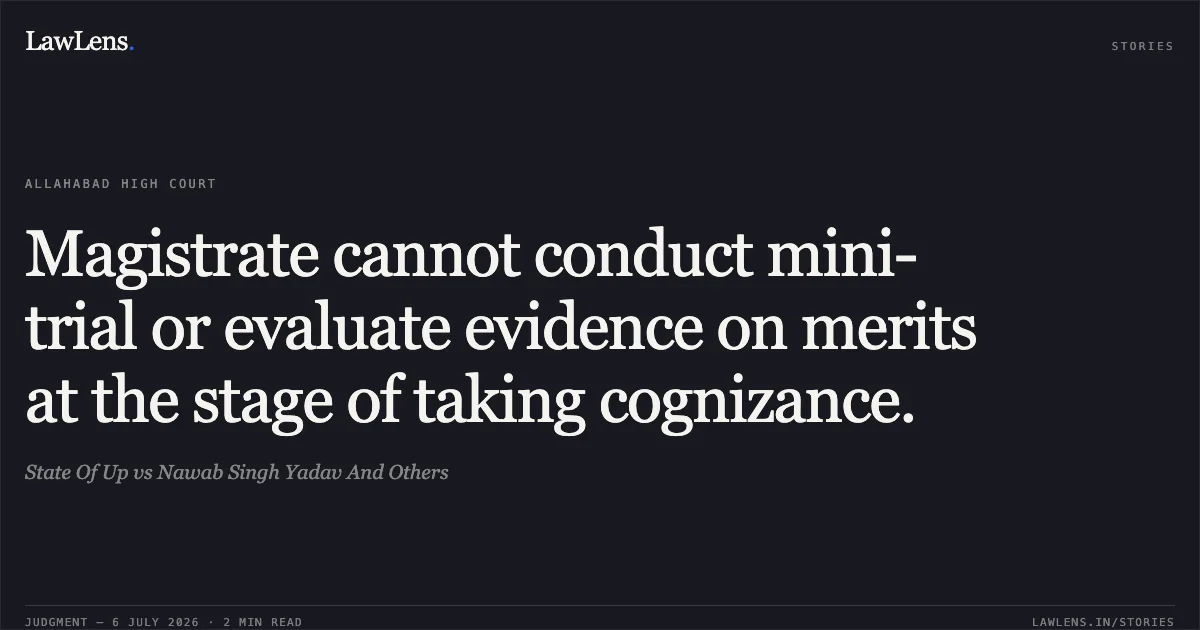
At the stage of taking cognizance under the Bharatiya Nagarik Suraksha Sanhita (BNSS), a Magistrate must only determine if a prima facie case exists and must not evaluate the merits of the evidence to predict conviction.
Source reference: para. 21The court applied the principle from Kamal Shivaji Pokarnekar v. State of Maharashtra, which prohibits sifting through evidence at this stage.
Source reference: para. 21The court relied on Sonu Gupta v. Deepak Gupta regarding the limited scope of the Magistrate's inquiry at the cognizance stage.
Source reference: para. 22The court relied on the three-judge bench decision in Bhagwant Singh v. Commissioner of Police, which mandates that when a Magistrate decides not to take cognizance on a police report, the informant must be given an opportunity to be heard.
Source reference: para. 25Reasoning
The High Court found that the CJM’s 31-page order erroneously treated the cognizance stage as a trial. Instead of merely checking for a prima facie case, the CJM extensively analyzed the addition of charges, criticized the police’s "forensic knowledge," and questioned the timeline of witness statements.
Source reference: paras. 18-20The Court held that such an appreciation of evidence is "not the province of the court at that stage".
Source reference: para. 23The High Court observed that the CJM terminated the proceedings without issuing notice to the informant, which is a mandatory requirement under Bhagwant Singh because the informant is prejudicially affected when a case is dropped.
Source reference: paras. 24-26Holding
The Court held that a prima facie case for proceeding was clearly made out and the Magistrate committed a manifest error of law by conducting a pre-trial analysis.
The Court allowed the revision and set aside the CJM’s order dated 20.09.2025.
Source reference: para. 28The matter was restored to the Chief Judicial Magistrate, Kannauj, with directions to pass fresh orders on the police report in light of the High Court's observations.
Source reference: para. 28Acts & Sections Cited
27 provisions across 5 statutes referred to in this judgment. Each provision opens on LawLens.
Bharatiya Nyaya Sanhita, 2023
Protection of Children from Sexual Offences Act, 20126
Bharatiya Nagarik Suraksha Sanhita, 20233
Code of Criminal Procedure, 19734
Indian Penal Code, 18601
Original Court PDF
State Of UpvsNawab Singh Yadav And Others
Click to open original judgment
Original judgment, available to read, download and summarize on LawLens.in