01Facts
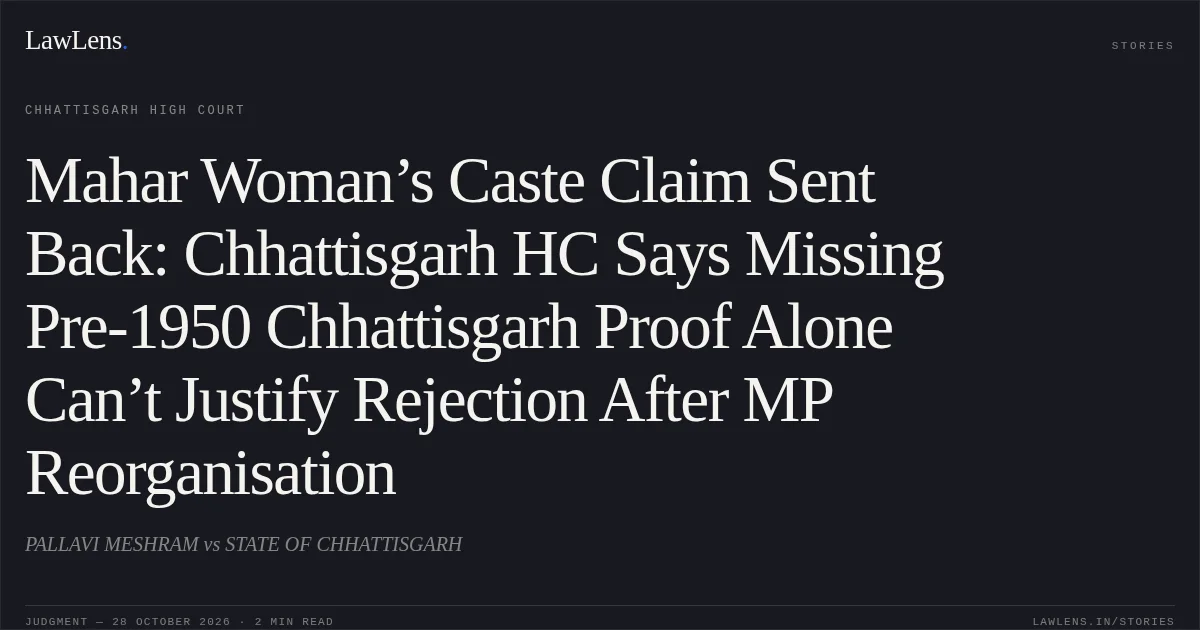
The petitioner sought a permanent social status certificate recognising her as belonging to the Mahar Scheduled Caste.
¶ 2–4, 8The Sub-Divisional Officer rejected her application, and the Additional Collector dismissed her appeal, principally because she had not established that she or her ancestors resided in the territory now forming Chhattisgarh before 10 August 1950.
¶ 2–4, 8The petitioner’s grandfather had resided in Balaghat, while her father settled in Dongargarh in 1987; both areas had formed part of undivided Madhya Pradesh before reorganisation, although they are now in different States.
¶ 2–4, 8The petitioner challenged both orders by writ petition.
¶ 1–202Issues
i.1. Whether the petitioner’s claim could be rejected solely because she had not produced pre-1950 residence documents relating specifically to present-day Chhattisgarh, without considering the territorial history and reorganisation of Madhya Pradesh.
¶ 8–11ii.2. Whether the authorities were required to reconsider the claim under the 2013 Rules and the principles in Pankaj Kumar and Akhilesh Prasad.
¶ 10–1103Law Applied
The Chhattisgarh Scheduled Castes, Scheduled Tribes and Other Backward Classes (Regulation of Issuance and Verification of Certificate) Rules, 2013 govern the issuance of social status certificates, including consideration of cases where prescribed documents cannot be produced.
¶ 10In Pankaj Kumar v. State of Jharkhand, (2021) 20 SCC 545, and Akhilesh Prasad v. Jharkhand Public Service Commission, 2022 SCC OnLine SC 510, the Supreme Court addressed the consequences of State reorganisation for reservation rights and held that relevant reorganisation provisions and protected rights must be considered in determining entitlement.
¶ 5–6, 11Those principles apply to the present claim only to the extent relevant to its facts.
¶ 11Provisions in the judgment · 3 · Linked ones open on LawLens
Bihar Reorganisation Act, 2000 Section 3Section 73Section 74
04Reasoning
Balaghat and Dongargarh were both within undivided Madhya Pradesh before reorganisation, although Dongargarh later became part of Chhattisgarh and Balaghat remained in Madhya Pradesh.
¶ 8The Court therefore considered that the case involved movement within the former State, rather than ordinary migration from one State to another.
¶ 8In that context, the authorities could not treat the absence of pre-1950 documents specific to present-day Chhattisgarh as conclusive.
¶ 9–11They were required to assess the petitioner’s records concerning undivided Madhya Pradesh, apply the relevant provisions of the 2013 Rules, and consider the reorganisation-related principles in the cited Supreme Court decisions.
¶ 9–1105Holding
The Court quashed the SDO’s order dated 12 August 2022 and the Additional Collector’s order dated 9 February 2024, and remitted the matter for fresh consideration.
¶ 12The competent authority must consider the relevant records, the 2013 Rules, the circumstances of reorganisation, and the cited precedents; it must not reject the claim solely for lack of pre-1950 documents specific to present-day Chhattisgarh.
¶ 13Reconsideration must be completed within 60 days after receipt of the order, following a reasonable opportunity of hearing, and the petitioner may submit further relevant documents.
¶ 14The writ petition was disposed of accordingly.
¶ 15Original Court PDF
PALLAVI MESHRAMvsSTATE OF CHHATTISGARH
Click to open original judgment
Original judgment, available to read, download and summarize on LawLens.in