Facts
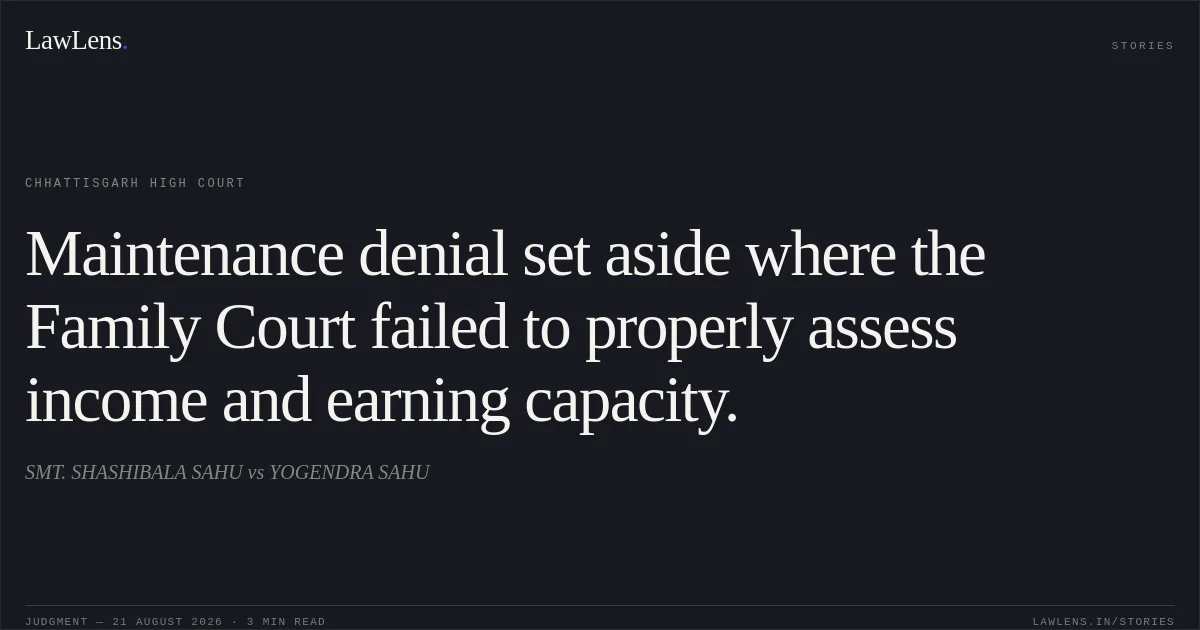
Applicant No. 1, the respondent’s wife, and Applicant No. 2, their minor son, filed an application under Section 125 CrPC before the Family Court, Durg, claiming maintenance. The parties’ marriage was solemnised on 8 March 2008. The applicants alleged cruelty, their ouster from the matrimonial home, and that the respondent earned approximately ₹30,000 per month from a fancy store and additional income from agricultural land. Applicant No. 1 claimed to be a homemaker without independent income, while Applicant No. 2 was a school-going child requiring educational, medical and daily-living expenses.
Source reference: para. 2; pp. 1–2The Family Court, by order dated 9 December 2025 in Misc. Criminal Case No. 1368/2022, rejected the maintenance application. It held, inter alia, that Applicant No. 1 was residing in the respondent’s house, possessed two shops generating approximately ₹30,000 per month, and was capable of maintaining herself and Applicant No. 2. The Court also considered the respondent’s alleged payment of school fees and medical expenses and his claim that he earned his livelihood through a paan stall and labour work.
Source reference: paras. 6–7; pp. 3–4The applicants challenged the dismissal in revision, contending that the Family Court had failed to properly assess the parties’ actual income, earning capacity, the respondent’s financial circumstances, and the needs of the minor child.
Source reference: para. 3; p. 2Issues
1. Whether the Family Court properly appreciated the evidence concerning the parties’ respective income and earning capacity while rejecting the applicants’ claim for maintenance under Section 125 CrPC?
Source reference: paras. 7–10; pp. 4–62. Whether the findings regarding Applicant No. 1’s alleged income from two shops, the respondent’s occupation and income, the parties’ residence and business arrangements, the sale of ancestral property, and payments allegedly made towards Applicant No. 2’s expenses required reconsideration?
Source reference: paras. 8–10; pp. 4–63. Whether the impugned order warranted interference in revisional jurisdiction and remand for fresh consideration?
Source reference: para. 9–11; pp. 5–7Law Applied
The Court applied Section 125 CrPC, which enables a wife and minor child unable to maintain themselves to claim maintenance from a person having sufficient means who neglects or refuses to maintain them.
Source reference: para. 9; p. 6The determination of entitlement requires proper assessment of the parties’ actual income, earning capacity, needs and financial circumstances.
Source reference: para. 9; p. 6The Court further applied the principle that although re-appreciation of evidence is ordinarily limited in revisional jurisdiction, interference is permissible where material evidence and relevant circumstances have not been properly considered and the resulting findings directly affect the claimant’s entitlement to maintenance.
Source reference: para. 9; p. 6Reasoning
The High Court found that the Family Court’s conclusion that Applicant No. 1 could maintain herself and her minor son was substantially based on disputed and insufficiently examined matters—namely, her alleged possession of two shops and monthly income of ₹30,000, the respondent’s asserted transition from running a paan stall to performing labour work, and the parties’ respective residence and business arrangements.
Source reference: paras. 6–8; pp. 3–5The Court held that the ownership and nature of the house and shops, the actual income derived from them, and the circumstances in which the respondent allegedly left the premises and business required comprehensive examination.
Source reference: para. 8; p. 5It also held that occasional payments towards the child’s school fees or medical expenses could not, without proper contextual assessment, conclusively discharge the respondent’s continuing maintenance obligation under Section 125 CrPC.
Source reference: para. 8; p. 5Further, the respondent’s possible share in the ₹16.70 lakh sale consideration from ancestral property and its effect on his financial capacity required consideration.
Source reference: paras. 8–10; pp. 5–6Since these material aspects had not been properly appreciated, revisional interference was justified notwithstanding the normally restricted scope of revision.
Source reference: paras. 8–10; pp. 5–6Holding
The High Court allowed the criminal revision, quashed and set aside the Family Court’s order dated 9 December 2025, and remanded the matter for fresh consideration of the Section 125 CrPC application in accordance with law.
The Family Court was directed specifically to reconsider the parties’ respective income and earning capacity, Applicant No. 1’s alleged income from the shops, the respondent’s actual occupation and income, the circumstances concerning the parties’ residence and business, the sale of ancestral property, and the alleged financial assistance provided for Applicant No. 2’s education and medical treatment.
Source reference: para. 11; p. 7The Registrar (Judicial) was directed to transmit the certified order to the concerned Family Court.
Source reference: para. 12; p. 7Acts & Sections Cited
1 provisions across 1 statute referred to in this judgment. Each provision opens on LawLens.
Code of Criminal Procedure, 19731
Original Court PDF
SMT. SHASHIBALA SAHUvsYOGENDRA SAHU
Click to open original judgment
Original judgment, available to read, download and summarize on LawLens.in