Facts
The applicant-husband and respondent No. 2-wife were married on 17 November 2005 according to Arya Samaj rites. They had a minor son, who was residing with the applicant. Following matrimonial disputes, the wife was taken to her parental home by a Mahila Police Officer on 8 December 2016 and thereafter lived separately from the husband.
Source reference: p.2, para. 4The wife alleged that the husband earned more than ₹2,00,000 per month through his gold and silver jewellery business, finance business, cattle ownership and other assets, while she had no sufficient means to maintain herself.
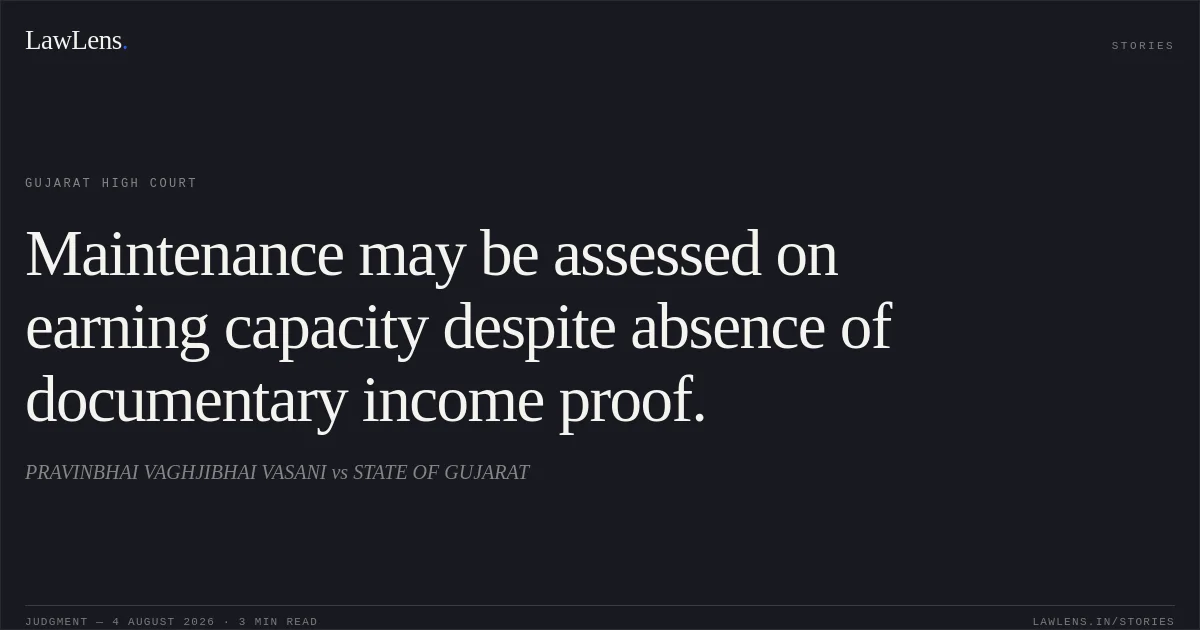
Source reference: p.2, para. 4She therefore filed a maintenance application before the Family Court, Rajkot. By order dated 24 August 2022, the Family Court directed the husband to pay ₹12,000 per month to the wife from 23 February 2018, the date of filing of the application.
Source reference: p.3, para. 4.1The husband challenged the order in revision, contending that his income had been assessed without documentary proof, that the wife had income reflected by deduction of TDS of ₹83,090, and that she was living separately without sufficient cause.
Source reference: pp.4–6, paras. 5, 7He also relied on his alleged liabilities, including expenses for family members and marriage-related expenditure.
Source reference: pp.4–6, paras. 5, 7The wife and the State supported the Family Court’s order.
Source reference: p.6, para. 8Issues
Whether the Family Court’s assessment of the husband’s earning capacity and award of ₹12,000 per month as maintenance suffered from perversity, illegality, material irregularity or jurisdictional error warranting interference in revisional jurisdiction?
Source reference: pp.6–8, paras. 9–12Whether the wife’s alleged income, the husband’s personal liabilities, and the allegation that the wife voluntarily lived separately disentitled her to maintenance or justified reduction or setting aside of the award?
Source reference: pp.4–6, 8–13, paras. 5, 7, 12–17Law Applied
The Court applied the limited scope of revisional jurisdiction under Section 397 CrPC, as explained in Amit Kapoor v. Ramesh Chander, (2012) 9 SCC 460, under which interference is justified only for palpable error, non-compliance with law, a completely erroneous decision, arbitrary exercise of discretion, perversity or material irregularity.
Source reference: p.7, para. 9It applied the social-justice purpose of maintenance proceedings under Section 125 CrPC, relying on Bhuwan Mohan Singh v. Meena, (2015) 6 SCC 353, which recognises maintenance as a speedy remedy intended to prevent destitution and vagrancy and to provide food, clothing and shelter to a neglected wife.
Source reference: pp.9–12, para. 14The Court further relied on Rajnesh v. Neha, (2021) 2 SCC 324, under which determination of maintenance requires consideration of the parties’ status, the wife’s reasonable needs, the parties’ income and assets, the husband’s actual income and earning capacity, liabilities, standard of living and other relevant circumstances; the Court may reasonably assess earning capacity where income is not fully disclosed.
Source reference: p.12, para. 15Reasoning
The High Court found that the Family Court had considered the oral and documentary evidence, the husband’s business activities, his earning capacity, standard of living and surrounding circumstances.
Source reference: p.8, para. 12The absence of formal documentary proof of income did not discharge the husband’s statutory obligation, particularly when the evidence established that he was engaged in business.
Source reference: p.8, para. 12The Court held that the husband’s alleged expenditure for his children, aged mother and other family obligations could not override his obligation to maintain his wife.
Source reference: p.9, para. 13Similarly, the absence of the wife’s income-tax returns and the reference to TDS did not establish that she had an independent and sufficient income, especially in view of the Family Court’s factual finding that she was not engaged in gainful employment.
Source reference: p.9, para. 13Applying the restricted revisional standard, the High Court concluded that the Family Court’s findings were neither perverse nor unsupported by evidence.
Source reference: pp.12–13, paras. 16–17The award of ₹12,000 per month was held to be reasonable and proportionate to the husband’s earning capacity and the prevailing cost of living.
Source reference: pp.12–13, paras. 16–17Holding
The High Court answered the issues against the applicant-husband.
It held that no patent illegality, perversity, jurisdictional error or material irregularity had been established and that the maintenance awarded by the Family Court was just and reasonable.
Source reference: pp.13–14, paras. 18–19The revision application was dismissed, and the Family Court’s order dated 24 August 2022 directing payment of ₹12,000 per month to the wife from 23 February 2018 was confirmed.
Source reference: p.14, paras. 20–21The rule was discharged, interim relief, if any, was vacated, and the connected stay application was disposed of as having become infructuous.
Source reference: p.14, paras. 21 and Order in Criminal Misc. ApplicationActs & Sections Cited
3 provisions across 1 statute referred to in this judgment. Each provision opens on LawLens.
Code of Criminal Procedure, 19733
Original Court PDF
PRAVINBHAI VAGHJIBHAI VASANIvsSTATE OF GUJARAT
Click to open original judgment
Original judgment, available to read, download and summarize on LawLens.in