Facts
The revisionist (wife) was granted maintenance of ₹5,000 per month via an order dated 04.03.2023 under Section 125 Cr.P.C.
Source reference: p.2A first execution application under Section 128 Cr.P.C. was disposed of on 10.03.2025 after the husband cleared arrears up to February 2025.
Source reference: p.3, 14On 09.04.2025, the revisionist filed a second execution application (Misc. Case No. 641 of 2025) under Section 147 BNSS/128 Cr.P.C. seeking arrears for March 2025 and continuous future maintenance.
Source reference: p.4, 14The Family Court, Jaunpur, initially issued a recovery warrant but subsequently withdrew it on 06.12.2025 after the husband deposited ₹5,000.
Source reference: p.6, 15On 27.01.2026, the Family Court dismissed the execution case and consigned it to the record room, reasoning that once the specific monthly arrear claimed was paid, the execution could not continue for future maintenance.
Source reference: p.7, 16Issues
1. Whether a wife is required to file successive execution applications for each month of default, or if the liability to pay maintenance is a continuing one.
Source reference: p.18 / para. 172. Whether the first proviso to Section 125(3) Cr.P.C. (Section 144(3) BNSS) creates a bar on claiming arrears beyond a period of one year or extinguishes the right to maintenance.
Source reference: p.19 / para. 18Law Applied
The court applied Section 125(3) and 128 of the Cr.P.C. (corresponding to Sections 144(3) and 147 of the BNSS) regarding the enforcement of maintenance orders.
Source reference: p.9, 16Maintenance is a continuing liability and requiring successive applications is unreasonable; Shantha Alias Ushadevi v. B.G. Shivananjappa.
Source reference: p.10, 18The one-year limitation in the proviso to Section 125(3) is a procedural restriction on issuing warrants, not a bar on the entitlement to arrears; Poongodi v. Thangavel.
Source reference: p.11, 19Direct transfer of maintenance to bank accounts and salary deductions; Aarti Rai v. Satish Rai and Dimpal v. Nishant Pravinbhai Soni.
Source reference: p.19, 20Reasoning
The Court found that the Additional Principal Judge-I, Family Court, Jaunpur, erroneously interpreted the proviso to Section 144(3) BNSS by dismissing the execution case once the immediate arrear was paid.
Source reference: p.18The Court reasoned that since the original maintenance order dated 04.03.2023 was still operative and had not been set aside, the husband remained under a "continuous legal obligation" to pay.
Source reference: p.17By consigning the file to the record room, the trial court effectively nullified the maintenance order and forced the wife into a cycle of repetitive litigation, which contradicts the social welfare purpose of the statute.
Source reference: p.16, 18The Court clarified that the limitation period mentioned in the law only restricts certain recovery procedures (like imprisonment or warrants) for stale claims but does not terminate the enforcement of a valid, ongoing order.
Source reference: p.19Holding
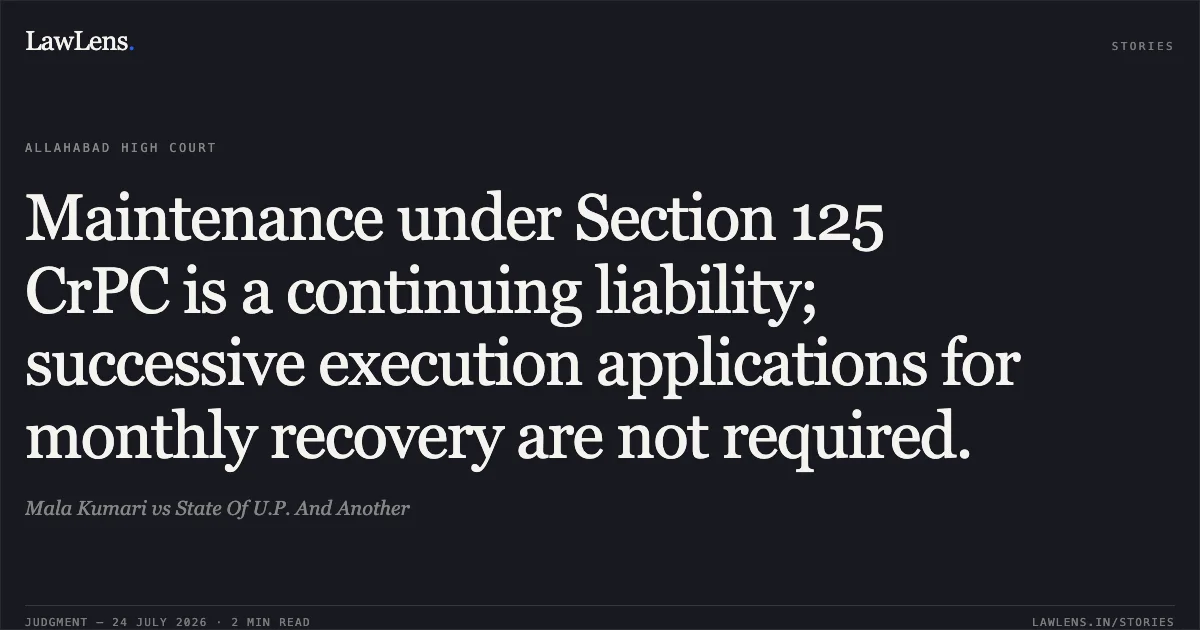
The Court held that maintenance is a continuing liability and successive applications are not required.
The High Court allowed the revision, setting aside the impugned orders of the Family Court and issued general directions to all Family Courts in U.P. to cease requiring successive execution filings, permit recovery of arrears beyond one year, mandate direct bank transfers, and direct salary deductions for defaulting employees.
Source reference: p.20, 21, 22Acts & Sections Cited
4 provisions across 2 statutes referred to in this judgment. Each provision opens on LawLens.
Code of Criminal Procedure, 19732
Bharatiya Nagarik Suraksha Sanhita, 20232
Original Court PDF
Mala KumarivsState Of U.P. And Another
Click to open original judgment
Original judgment, available to read, download and summarize on LawLens.in