Facts
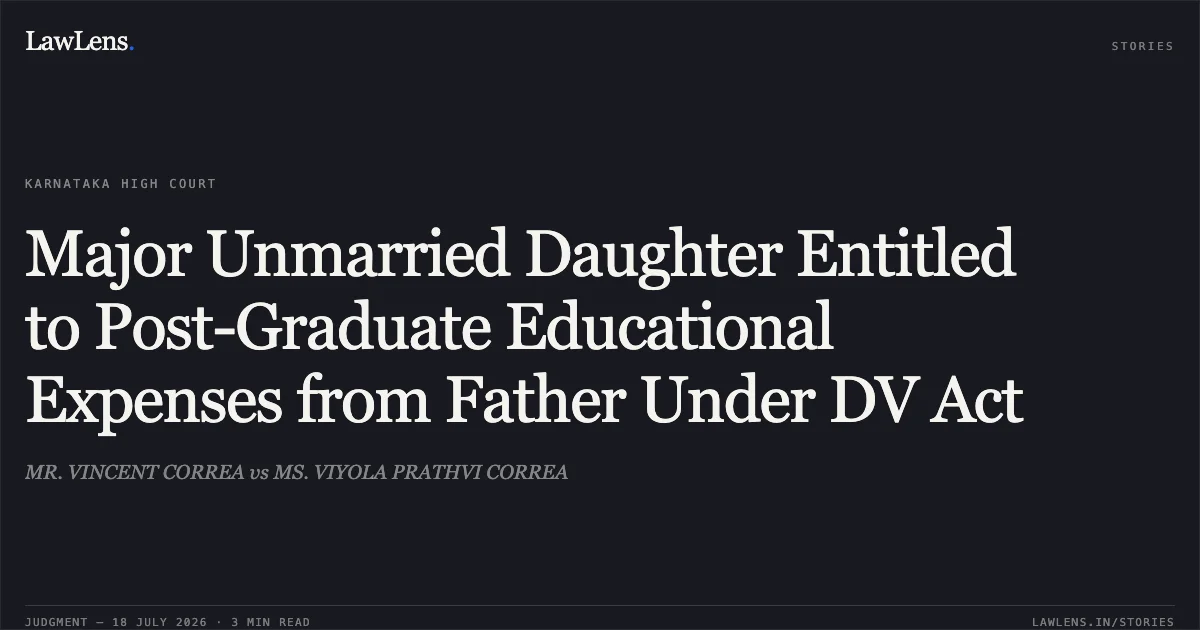
The Respondent, an unmarried daughter aged 23, filed an application under the Protection of Women from Domestic Violence Act, 2005 (DV Act) seeking ₹16,00,000 from her father (the Petitioner) to cover fees for her Post-Graduate medical course (M.D. Dermatology).
Source reference: p. 2She had secured a seat through NEET but lacked funds, eventually borrowing from her grandfather to meet the payment deadline.
Source reference: p. 3The Petitioner contested the claim, arguing that the daughter attained majority in 2018 and therefore does not fall under the definition of a "child" or "aggrieved person" under the DV Act.
Source reference: p. 8-9He further claimed financial distress and that she earns a stipend.
Source reference: p. 4, 8The Trial Court and Appellate Court both ruled in favor of the daughter, directing the father to pay.
Source reference: p. 6, 7Issues
1. Whether a major, unmarried daughter can invoke Section 20 of the DV Act for monetary relief to pursue post-graduation.
Source reference: p. 152. Whether the attainment of majority by an unmarried daughter disentitles her from receiving educational expenses/maintenance under the DV Act.
Source reference: p. 15Law Applied
The Court primarily applied Section 20 of the DV Act, specifically Section 20(1)(d), which provides for monetary relief and maintenance "in addition to" Section 125 Cr.P.C.
Source reference: p. 18-19It interpreted Section 2(a) ("aggrieved person") and Section 3(d)(iv) ("economic abuse") to include the deprivation of financial resources to which a woman is entitled by law or custom.
Source reference: p. 18, 21The Court relied on the Supreme Court’s holding in Neelima Choure v. Vijay Choure (2025), which established a daughter's fundamental right to education and the parents' enforceable obligation to provide funds within their financial means.
Source reference: p. 14, 17It further utilized the Madras High Court’s ruling in Jagadesan v. State of Tamil Nadu (2015), which held that a father's duty to provide for a child’s education does not extinguish upon the child attaining majority.
Source reference: p. 20, 27-28Reasoning
The Court rejected the Petitioner’s narrow interpretation that the term "child" in Section 2(b) (under 18 years) limits the scope of Section 20.
Source reference: p. 28It reasoned that Section 20(1) uses the phrase "but not limited to," granting Magistrates broad discretion to address economic abuse, which includes the deprivation of educational resources.
Source reference: p. 25-26, 30The Court observed that because the daughter is not currently earning and is pursuing a continuous path from MBBS to MD—a path the father supported while the parents were united—he cannot now evade this moral and legal obligation.
Source reference: p. 31Regarding financial capacity, the Court noted the Petitioner’s IT returns and substantial bank loans (over ₹1.27 Crores), proving he possessed the "financial resources" to facilitate his daughter's education.
Source reference: p. 7, 31-32The Court held that "economic abuse" remains a valid ground for an "aggrieved person" (the daughter living in a domestic relationship) to seek monetary relief for post-graduation.
Source reference: p. 13-14Holding
The Court answered the issues in the affirmative, holding that an unmarried daughter’s attainment of majority does not extinguish the father’s obligation to provide for her education under the DV Act.
The Court held that the reliefs under Section 20 have a wide connotation and are not strictly limited by the age of the child when applied as a form of monetary relief for an aggrieved person.
Source reference: p. 30Consequently, the Criminal Revision Petition was dismissed, upholding the prior orders directing the Petitioner to pay ₹16,00,000.
Source reference: p. 32Acts & Sections Cited
15 provisions across 4 statutes referred to in this judgment. Each provision opens on LawLens.
Protection of Women from Domestic Violence Act, 2005
Code of Criminal Procedure, 19733
Bharatiya Nagarik Suraksha Sanhita, 20232
Hindu Adoptions and Maintenance Act, 19561
Original Court PDF
MR. VINCENT CORREAvsMS. VIYOLA PRATHVI CORREA
Click to open original judgment
Original judgment, available to read, download and summarize on LawLens.in