Facts
Respondent No. 3 filed Vahivat Case No. 35 of 2015 under the Mamlatdars’ Courts Act, 1906, claiming that the Petitioners had obstructed an existing East–West customary road from Gat No. 415 towards a North–South village road.
Source reference: para. 2The Tahsildar allowed the claim and ordered removal of the obstruction; the Sub-Divisional Officer dismissed the Petitioners’ revision.
Source reference: para. 2–3In the writ petition, the Petitioners disputed the road’s existence and identity, contending that the road claimed in separate civil proceedings was different and that the spot panchnama did not adequately locate the alleged road.
Source reference: para. 4The record also contained inconsistent dates for the panchnama—14 January 2015 and 14 January 2016.
Source reference: para. 37, 41, 46Issues
Whether the authorities’ orders could stand without clearly identifying the particular existing road or customary way claimed and determining whether that road had been obstructed.
Source reference: para. 37, 48, 52Whether the record sufficiently established the road’s prior existence and use, the alleged obstruction, and when the obstruction first commenced for purposes of the statutory limitation period.
Source reference: para. 46–48, 53–56Law Applied
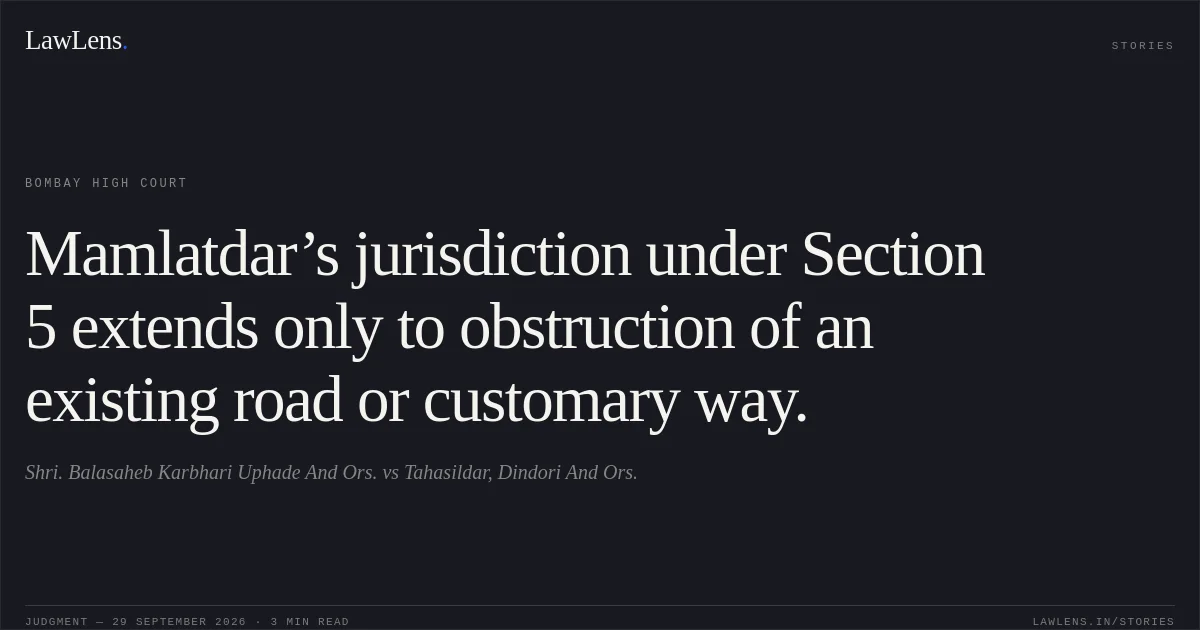
Section 5 of the Mamlatdars’ Courts Act, 1906, empowers the Mamlatdar to grant relief against obstruction to an existing road or customary way; it does not authorize creation of a new road.
Source reference: para. 7–9A claim must be brought within six months of the cause of action, and, in an obstruction case, the relevant date is when the obstruction or attempted obstruction first commenced.
Source reference: para. 7–9Sections 19(1)(c) and 19(2) require inquiry into the claimed use, the disturbance or obstruction, and when it began; the Mamlatdar may inspect the property, examine witnesses, call for documents, and record a memorandum of relevant facts.
Source reference: para. 35, 47Section 143 of the Maharashtra Land Revenue Code, 1966, concerns the grant of a new way over agricultural land boundaries, unlike Section 5’s remedy for obstruction to an existing way.
Source reference: para. 10, 56The Court also relied on Shrikrishna Sheshrao Dane v. Vasantrao Ramrao Tayde, Gopalrao Baliramji Deshmukh v. Sopan Gulabrao Deshmukh, and Vimal Bhausaheb Nabde v. Sub-Divisional Officer, among other authorities, for the principles that the claimed way must be identified and its existence assessed on the totality of relevant evidence, including maps, records, panchnamas, and oral evidence.
Source reference: para. 10, 13–18, 30–35Reasoning
The Court held that the central factual question was whether the particular East–West road described in the claim existed before the alleged obstruction, not merely whether Respondent No. 3 needed access to his land.
Source reference: para. 37–41, 48The authorities had not clearly connected the road described in the proceedings with the physical route observed at the site; the panchnama did not establish its precise location, and the competing claims about the route in the civil proceedings required examination.
Source reference: para. 37–41, 48The possession finding in the crop-inspection proceeding was relevant but did not, by itself, disprove use of a road by Respondent No. 3.
Source reference: para. 38, 49The panchnama’s conflicting dates also required verification because the date of first obstruction bears on limitation.
Source reference: para. 46, 54Since these matters required a fuller factual inquiry, the Court declined to decide whether the road existed or whether it had been obstructed and remanded the case for fresh consideration.
Source reference: para. 50–57Holding
The Court allowed the writ petition and quashed the Sub-Divisional Officer’s order dated 12 September 2017 and the Tahsildar’s order dated 18 March 2017.
It restored Vahivat Case No. 35 of 2015 to the Tahsildar for fresh inquiry, directing consideration of the road’s identity and prior existence, use, alleged obstruction, and the date obstruction first commenced; verification of the panchnama date; and, if needed, fresh inspection and competent land-records measurement.
Source reference: para. 60The Tahsildar was directed to decide independently, preferably within four months, with the parties’ merits contentions left open and no order as to costs.
Source reference: para. 60Acts & Sections Cited
1 provisions across 1 statute referred to in this judgment. Each provision opens on LawLens.
Maharashtra Land Revenue Code, 19661
Original Court PDF
Shri. Balasaheb Karbhari Uphade And Ors.vsTahasildar, Dindori And Ors.
Click to open original judgment
Original judgment, available to read, download and summarize on LawLens.in