01Facts
Smt. Devamma sued the petitioners and others for a permanent injunction concerning agricultural land.
The trial court granted her a temporary injunction restraining the defendants from interfering with the property
p. 5The petitioners alleged that Devamma, with police assistance, used the injunction to harvest their crop.
p. 5The police registered Crime No. 36/2020 against Devamma and others, but not against the police officers
p. 5The petitioners sought a writ of mandamus directing the police to register a crime against the officers, relying on their complaints and a later representation to the Superintendent of Police.
pp. 2–3, 6The State produced an enquiry report concluding that the officers had visited the site but had no role in the harvesting
p. 602Issues
i.1. Whether the Court should issue a writ of mandamus directing the police to register a crime against the police officers alleged to have assisted in harvesting the crop.
pp. 2–3, 6–7ii.2. Whether the material on record, including the enquiry report, established a basis for such a direction.
pp. 6–703Law Applied
The petition invoked Articles 226 and 227 of the Constitution, seeking mandamus against the police authorities.
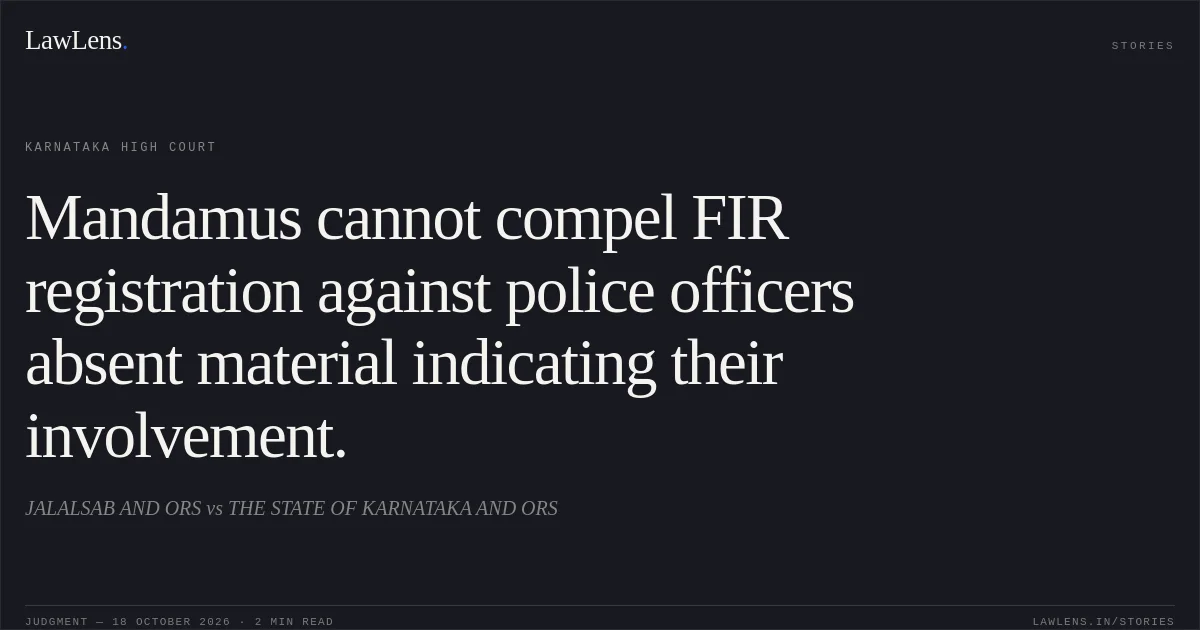
p. 2The Court held that it could not direct the police to register a crime against the officers on the record before it, particularly where the enquiry report found no role on their part; it left the petitioners free to pursue a private complaint in accordance with law.
p. 7The Court considered M/S. Godrej Sara Lee Ltd. v. Excise and Taxation Officer-cum-Assessing Authority and Whirlpool Corporation v. Registrar of Trade Marks, which address circumstances in which a writ petition may be entertained despite an alternative remedy, but held that those decisions did not assist the petitioners on these facts.
pp. 7–8Provisions in the judgment · 6 · Linked ones open on LawLens
Indian Penal Code, 1860 Section 506Section 341Section 504Section 143Section 149Section 147
04Reasoning
The petitioners’ allegation that the officers enabled the harvesting was not supported by material showing their involvement.
pp. 6–7The enquiry report found that the officers had no role in the incident, and the only item relied on by the petitioners was a photograph of a police jeep at the site.
pp. 6–7In those circumstances, the Court declined to compel registration of a crime against the officers.
pp. 6–7It also found the cited alternative-remedy precedents inapplicable, given the enquiry report’s findings.
p. 805Holding
The Court held that the petitioners had not established a basis for mandamus directing registration of a crime against the police officers.
pp. 7–8It rejected the writ petition as devoid of merit, while preserving the petitioners’ option to file a private complaint in accordance with law.
pp. 7–8Original Court PDF
JALALSAB AND ORSvsTHE STATE OF KARNATAKA AND ORS
Click to open original judgment
Original judgment, available to read, download and summarize on LawLens.in