Facts
The petitioners are proprietors of existing retail petroleum outlets in District Sakti, Chhattisgarh
Source reference: para. 1, 2They challenged the proposed establishment of a new retail outlet by Respondent No. 8, asserting that the site selection violates land diversion rules
Source reference: para. 2Specifically, the petitioners allege that the proposed outlet is within a 50-meter radius of underground pipelines, which is prohibited under Rule 14(5) of the Chhattisgarh Diversion of Land Rules, 1962
Source reference: para. 2, 3On February 12, 2026, the petitioners submitted a representation to the Collector raising these objections, but no decision was rendered
Source reference: para. 1, 2Consequently, they filed this writ petition under Article 226 of the Constitution seeking a direction for the authority to decide their representation
Source reference: para. 1, 3Issues
1. Whether the Court should exercise its extraordinary jurisdiction under Article 226 to direct the Collector to decide the pending representation regarding the legality of the proposed petrol pump allotment.
Source reference: para. 7, 8Law Applied
Rule 14(5) of the Chhattisgarh Diversion of Land Rules, 1962 (as amended on 23.12.2011), which prohibits the diversion of land for commercial purposes if located within a 50-meter radius of the right of way of underground pipelines
Source reference: para. 2, 3Article 226 of the Constitution of India, which empowers the High Court to issue directions to state authorities to ensure the performance of statutory duties
Source reference: para. 1principles of administrative law regarding the duty of statutory authorities to consider representations.
Source reference: no citationReasoning
The petitioners argued that the allotment to Respondent No. 8 bypassed due process and violated statutory safety distances from underground pipelines
Source reference: para. 4Rather than adjudicating the merits of the rule violation itself, the Court focused on the procedural lapse—the Collector's failure to address the petitioners' formal objection dated February 12, 2026
Source reference: para. 7The State counsel did not oppose a direction for timely disposal, provided the merits remained open for the authority’s determination
Source reference: para. 5The Court determined that the primary grievance was "non-consideration" and concluded that interests of justice would be served by requiring the competent authority to perform its administrative function without the Court prematurely intervening in the factual findings of the case
Source reference: para. 7, 9Holding
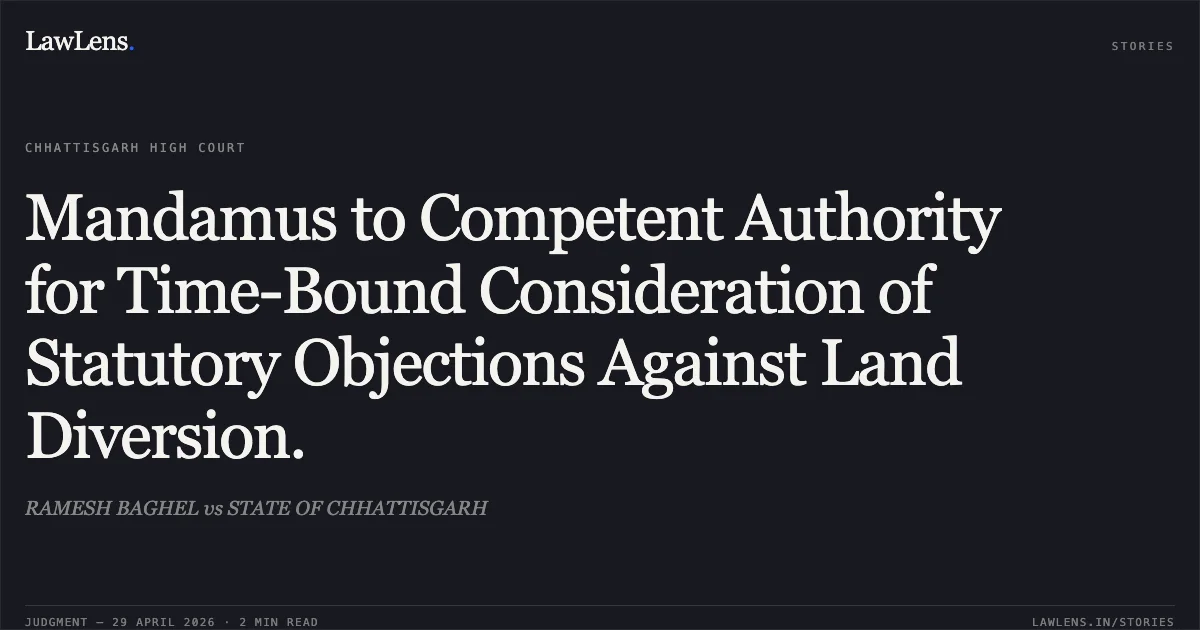
The Court held that the grievance centered on administrative inaction and directed the Collector, District Sakti (Respondent No. 1), to consider and decide the petitioners' representation dated February 12, 2026, in accordance with the law within a stipulated time period
The High Court disposed of the writ petition without expressing any opinion on the merits of the petitioners' objections
Source reference: para. 7, 9The authority was instructed to act independently of the court's order when evaluating the merits of the case
Source reference: para. 9Original Court PDF
RAMESH BAGHELvsSTATE OF CHHATTISGARH
Click to open original judgment
Original judgment, available to read, download and summarize on LawLens.in