Facts
The plaintiffs filed a civil suit against the defendants.
Source reference: no citationThe Registry served summons to defendant nos. 1 to 3 via email on March 20, 2025, and through ordinary mode on March 26, 2025.
Source reference: para. 2The defendants filed their written statement on July 24, 2025, which was initially returned under objection.
Source reference: para. 2On November 20, 2025, the Joint Registrar (Judicial) dismissed the defendants’ application for condonation of delay (I.A. 18293/2025), noting that the written statement was filed after the expiry of the maximum 120-day period.
Source reference: para. 2-3The defendants subsequently filed the present chamber appeal (O.A. 86/2026) under Rule 5, Chapter II of the Delhi High Court (Original Side) Rules, 2018, challenging the Joint Registrar’s refusal to condone the delay.
Source reference: para. 1Issues
1. Whether the Court possesses the power to condone a delay in filing a written statement beyond the outer limit of 120 days as prescribed by the Delhi High Court (Original Side) Rules, 2018.
Source reference: para. 6-72. Whether the phrase "but not thereafter" in Rule 4, Chapter VII of the Delhi High Court (Original Side) Rules, 2018, acts as a mandatory prohibition against extending the time for filing a written statement.
Source reference: para. 7-9Law Applied
Chapter VII, Rules 2 and 4 of the Delhi High Court (Original Side) Rules, 2018, which stipulate that a written statement must be filed within 30 days of service, extendable by a maximum of 90 days upon showing sufficient cause, "but not thereafter".
Source reference: para. 4-5The Court relied on the Supreme Court’s interpretation in P. Radha Bai v. P. Ashok Kumar (2019) 13 SCC 445, which held that the phrase "but not thereafter" signifies a mandatory outer boundary that excludes Section 5 of the Limitation Act.
Source reference: para. 8Division Bench rulings in Manhar Sabharwal v. High Court of Delhi (2024) and Delhi Gymkhana Club Limited v. Col. Ashish Khanna (2024), establishing that the High Court’s Original Side Rules prevail over the CPC and that the 120-day limit is mandatory for all suits, including non-commercial ones.
Source reference: para. 9-10Reasoning
The Court observed that Rule 4 of Chapter VII explicitly limits the Court’s authority to condone delays.
Source reference: para. 5-6It reasoned that the legislative intent behind the term "but not thereafter" is to fix a non-extendable deadline to prevent adjudication delays.
Source reference: para. 7, 10By applying the timeline to the facts, the Court noted the defendants were served in late March 2025, yet filed their written statement on July 24, 2025, which exceeded the total permissible 120-day window (30 days initial plus 90 days discretionary extension).
Source reference: para. 2, 12The Court emphasized that once the 120-day period expires, the right to file a written statement is extinguished, and the Court cannot invoke inherent powers to circumvent this express limitation.
Source reference: para. 9-10Holding
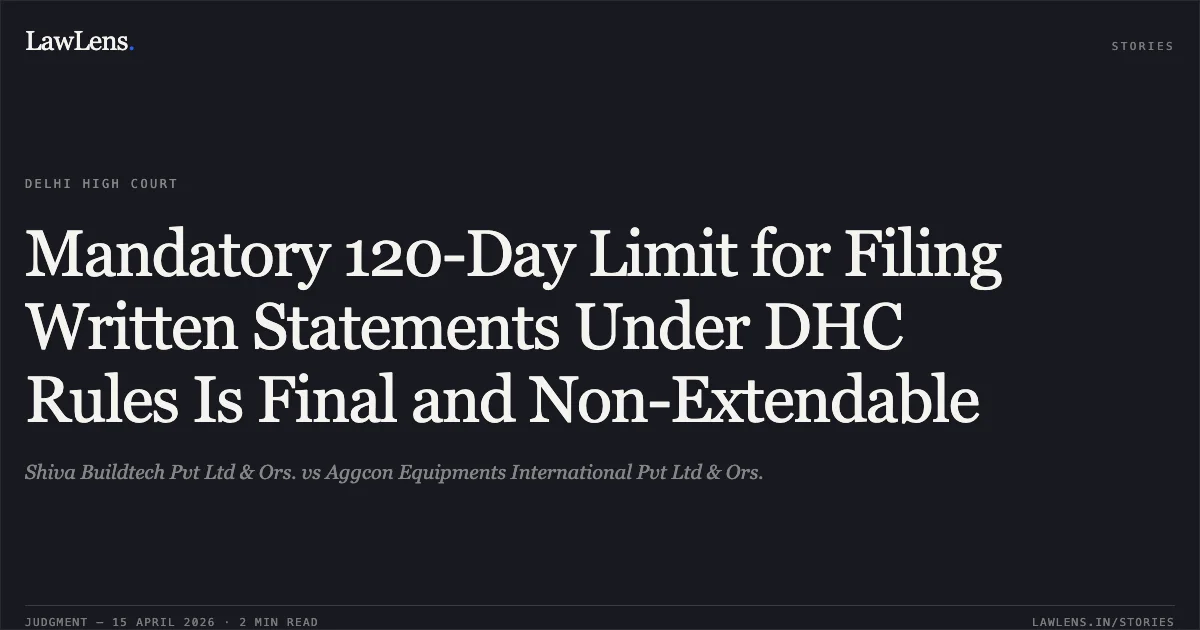
The Court dismissed the chamber appeal and the pending application, holding that it lacks the power to condone any delay beyond the 120-day outer limit prescribed by the Delhi High Court (Original Side) Rules, 2018.
It found no error in the Joint Registrar’s order dated November 20, 2025.
Source reference: para. 13The suit was directed to be listed before the Joint Registrar (Judicial) on July 31, 2026, for further proceedings.
Source reference: para. 15Acts & Sections Cited
9 provisions across 3 statutes referred to in this judgment. Each provision opens on LawLens.
Arbitration and Conciliation Act, 19963
Limitation Act, 19635
Central Excise Act, 19441
Original Court PDF
Shiva Buildtech Pvt Ltd & Ors.vsAggcon Equipments International Pvt Ltd & Ors.
Click to open original judgment
Original judgment, available to read, download and summarize on LawLens.in