Facts
The respondent applied for direct recruitment to the post of Combined Engineering Subordinate Services pursuant to the TNPSC notification dated 03.02.2023 and appeared for the examination.
Source reference: p.2The TNPSC instructions required candidates to sign the OMR answer sheet at two specified places. The respondent signed at only one place, resulting in rejection of her answer sheet and candidature under Paragraph 17-E(i)(g) of the common instructions.
Source reference: p.2The respondent challenged the rejection in W.P. No. 32516 of 2023. Although the writ court found that she had violated the TNPSC instructions, it allowed the petition on sympathetic and humanitarian grounds, relying on Dolly Chanda v. Chairman, JEE, and directed TNPSC to evaluate the answer sheet and obtain her signature if necessary.
Source reference: pp.2–3TNPSC preferred the present writ appeal against that order.
Source reference: no citationIssues
1. Whether the writ court could, on grounds of sympathy or humanitarian consideration, direct evaluation of an OMR answer sheet despite the candidate’s admitted violation of mandatory examination instructions.
Source reference: pp.2–3, 6–72. Whether the principle permitting condonation of minor or technical mistakes, recognised in Dolly Chanda v. Chairman, JEE, could be applied to invalidate or overlook a candidate’s non-compliance with TNPSC examination instructions.
Source reference: pp.3, 63. Whether such a direction would undermine the uniformity and fairness of the public recruitment process and prejudice other candidates who complied with the prescribed instructions.
Source reference: pp.3, 6–7Law Applied
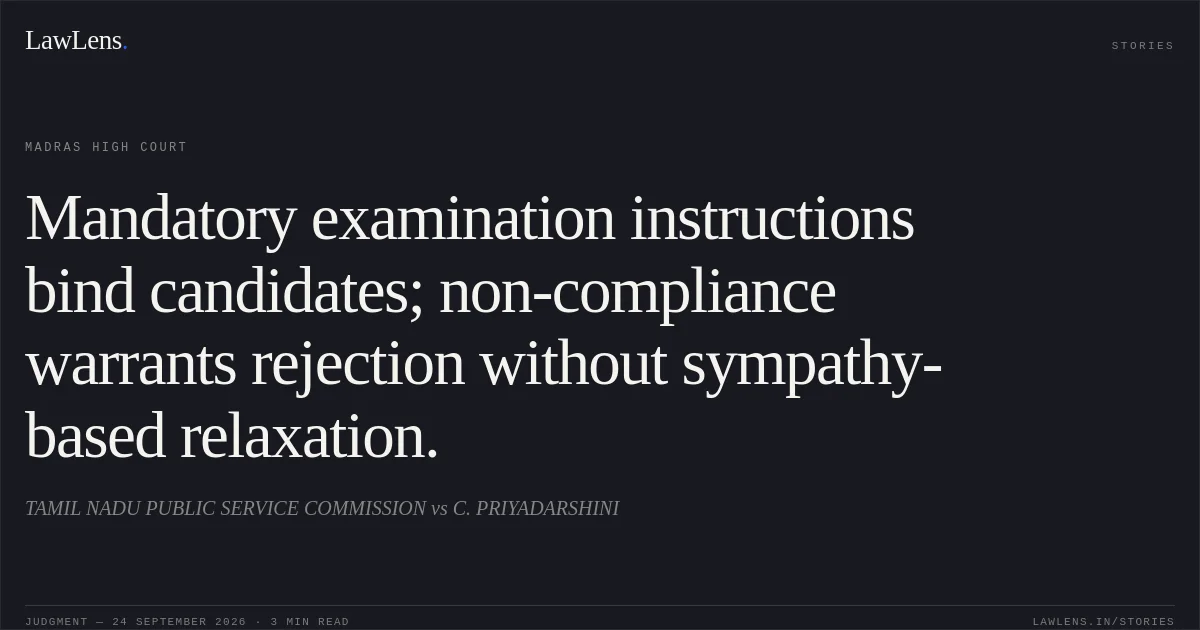
The Court held that examination instructions issued by a Public Service Commission have binding legal force and must be strictly complied with by candidates.
Source reference: p.6It relied principally on State of Tamil Nadu v. G. Hemalatha, 2019 INSC 975, which held that courts cannot grant relief contrary to mandatory examination instructions merely on humanitarian or sympathetic grounds.
Source reference: pp.3–6The Court also applied the principle in Umesh Chandra Shukla v. Union of India, (1985) 3 SCC 721, that “hard cases cannot be allowed to make bad law” and that relaxation of selection rules may cause arbitrariness and undermine equality in public appointments.
Source reference: p.5Dolly Chanda v. Chairman, JEE, (2005) 9 SCC 799, concerning condonable minor mistakes, was held incapable of universal application to competitive examinations conducted by Public Service Commissions.
Source reference: p.3The Court further relied on Rann Vijay Singh v. State of U.P., 2017 INSC 1209, for the principle that sympathy or compassion cannot justify interference with the examination process or re-evaluation of answer sheets.
Source reference: pp.6–7Reasoning
The respondent admittedly failed to sign the OMR answer sheet at both places prescribed by the TNPSC instructions, and the writ court itself recorded that violation.
Source reference: pp.2–3Since the instructions were mandatory and binding, the Court held that the writ court had no authority to direct evaluation of the answer sheet merely because the omission appeared minor or the resulting consequence was harsh.
Source reference: no citationApplying G. Hemalatha, the Court reasoned that granting an exception would be contrary to the instructions and would create an impermissible precedent for similarly situated candidates who had also failed to comply.
Source reference: pp.3–6The Court distinguished the limited principle in Dolly Chanda, observing that condonation of minor mistakes cannot be extended generally to public recruitment examinations, where uniform adherence to instructions is essential to preserve fairness, equality, and certainty in the selection process.
Source reference: p.3Sympathy-based relief would also prejudice candidates who complied with the prescribed requirements and could unsettle the recruitment process.
Source reference: p.6Holding
The Division Bench allowed the writ appeal and set aside the writ court’s order dated 07.12.2023 in W.P. No. 32516 of 2023.
It held that the respondent’s failure to sign the OMR sheet at both required places justified rejection of her answer sheet and candidature, and that no relief could be granted on sympathetic or humanitarian grounds.
Source reference: p.7No costs were imposed, and the connected miscellaneous petition was closed.
Source reference: p.7Original Court PDF
TAMIL NADU PUBLIC SERVICE COMMISSIONvsC. PRIYADARSHINI
Click to open original judgment
Original judgment, available to read, download and summarize on LawLens.in