Facts
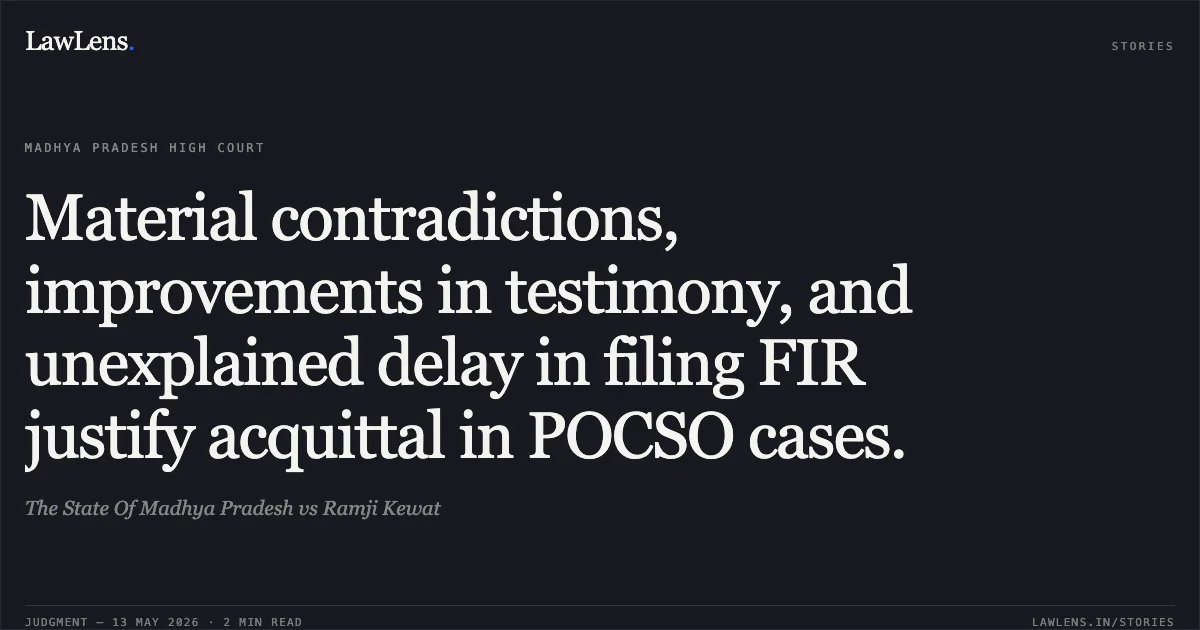
The State appealed an order dated 01.10.2022 passed by the Additional Sessions Judge, Lavkush Nagar, acquitting the respondent of charges under Sections 354, 323, and 506 of the IPC and Sections 7/8 and 9M/10 of the POCSO Act.
Source reference: para. 1, 3The prosecution alleged that on 22.11.2018, while the 9-year-old prosecutrix was attending the call of nature in a field, the respondent caught her, dragged her, attempted to remove her clothes, and threatened her.
Source reference: para. 2The prosecution examined 9 witnesses, including the prosecutrix (PW-1) and her parents (PW-2, PW-3).
Source reference: para. 4The trial court acquitted the respondent based on material contradictions and inconsistencies in the evidence.
Source reference: para. 5Issues
1. Whether the prosecutrix qualified as a "child" under Section 2(d) of the POCSO Act at the time of the incident.
Source reference: para. 82. Whether the testimony of the prosecution witnesses was reliable enough to overcome the presumption of innocence in an appeal against acquittal.
Source reference: para. 9-153. Whether the trial court’s judgment of acquittal was perverse or based on a misreading of evidence.
Source reference: para. 16-21Law Applied
The court applied Section 2(d) of the Protection of Children from Sexual Offences (POCSO) Act to define the age of a child.
Source reference: para. 8It relied on the evidentiary standards for criminal trials under the Indian Penal Code (IPC) and the Code of Criminal Procedure, 1973 (Section 378 regarding appeals against acquittal).
Source reference: para. 1Principles from H.D. Sundara v. State of Karnataka (2023) and Mallappa v. State of Karnataka (2024), which mandate that an appellate court should not interfere with an acquittal if the trial court’s view is a "legally plausible view," even if a contrary view is possible.
Source reference: para. 17, 21Reasoning
The High Court first confirmed the prosecutrix was roughly 9 years old based on school register Entry No. 214 (Ex. P/5).
Source reference: para. 8However, it found fatal contradictions regarding the occurrence: PW-2 (father) claimed he was irrigating the field and rushed to the spot, but later admitted he was at home when he heard screams.
Source reference: para. 9PW-1 (prosecutrix) provided a version in court—alleging the accused became naked and lay on her—which was missing from the initial written complaint (Ex. P/1) and police statements (Ex. D/1, D/2), indicating significant "exaggeration".
Source reference: para. 12There was an unexplained two-day delay in lodging the FIR, and medical evidence from Dr. A.K. Nagar (PW-5) failed to corroborate injuries consistent with the alleged "naked dragging" in an agricultural field.
Source reference: para. 13, 15The court noted that PW-6 (grandfather), who was not declared hostile, testified that the prosecutrix sustained injuries by falling while running towards her father, contradicting the claim that the accused caused them.
Source reference: para. 15Holding
The Court held that the trial court's appreciation of evidence was not faulty, perverse, or manifestly erroneous.
The High Court dismissed the State's appeal, holding that the prosecution failed to prove the guilt beyond reasonable doubt and that there was no ground to interfere with the trial court's findings.
Source reference: para. 22Acts & Sections Cited
11 provisions across 3 statutes referred to in this judgment. Each provision opens on LawLens.
Code of Criminal Procedure, 19732
Indian Penal Code, 18604
Protection of Children from Sexual Offences Act, 20125
Original Court PDF
The State Of Madhya PradeshvsRamji Kewat
Click to open original judgment
Original judgment, available to read, download and summarize on LawLens.in