Facts
The prosecution alleged that on 15 June 2015, while the victim was returning home after selling milk, the appellant caught hold of her near a jute field, touched her body and attempted to rape her. She allegedly raised an alarm, following which villagers arrived and the appellant could not complete the act.
Source reference: paras. 3–4; pp. 2–4After alleging that her approaches to the police and the Superintendent of Police had produced no result, the victim filed an application under Section 156(3) Cr.P.C. before the Chief Judicial Magistrate. An FIR was subsequently registered on 6 August 2015 under Sections 341/376/511 IPC, and a charge-sheet was filed on the same provisions.
Source reference: para. 4; p. 4The Trial Court framed charges under Sections 341/376/511 IPC, but ultimately convicted the appellant under Sections 341/354 IPC and sentenced him to two years’ simple imprisonment, a fine of Rs. 500, and one month’s simple imprisonment in default.
Source reference: paras. 1, 5; pp. 1, 4The prosecution examined six witnesses, including the victim as P.W.3; the defence adduced no evidence.
Source reference: para. 6; p. 4Issues
Whether the prosecution evidence, particularly the testimony of the victim, was sufficiently reliable and corroborated to sustain the appellant’s conviction beyond reasonable doubt.
Source reference: paras. 31–32, 43–45; pp. 15, 20–21Whether the material contradictions, omissions, improvements and hearsay elements in the evidence of P.Ws. 1, 2, 3 and 5 created a reasonable doubt regarding the alleged occurrence and the appellant’s involvement.
Source reference: paras. 36–41, 44–45; pp. 17–21Whether the conviction under Section 354 IPC was legally sustainable when the charge framed against the appellant was under Sections 341/376/511 IPC and the Trial Court did not adequately explain the basis for the altered conviction.
Source reference: paras. 5, 12–13; pp. 4, 7Whether the initiation of proceedings under Section 156(3) Cr.P.C. complied with the safeguards relating to prior approaches under Sections 154(1) and 154(3) Cr.P.C. and the filing of a supporting affidavit.
Source reference: paras. 47–49; pp. 22–25Whether the manner in which the appellant was examined under Section 313 Cr.P.C., including the putting of questions in a jumbled manner, caused prejudice to him.
Source reference: para. 42; p. 20Law Applied
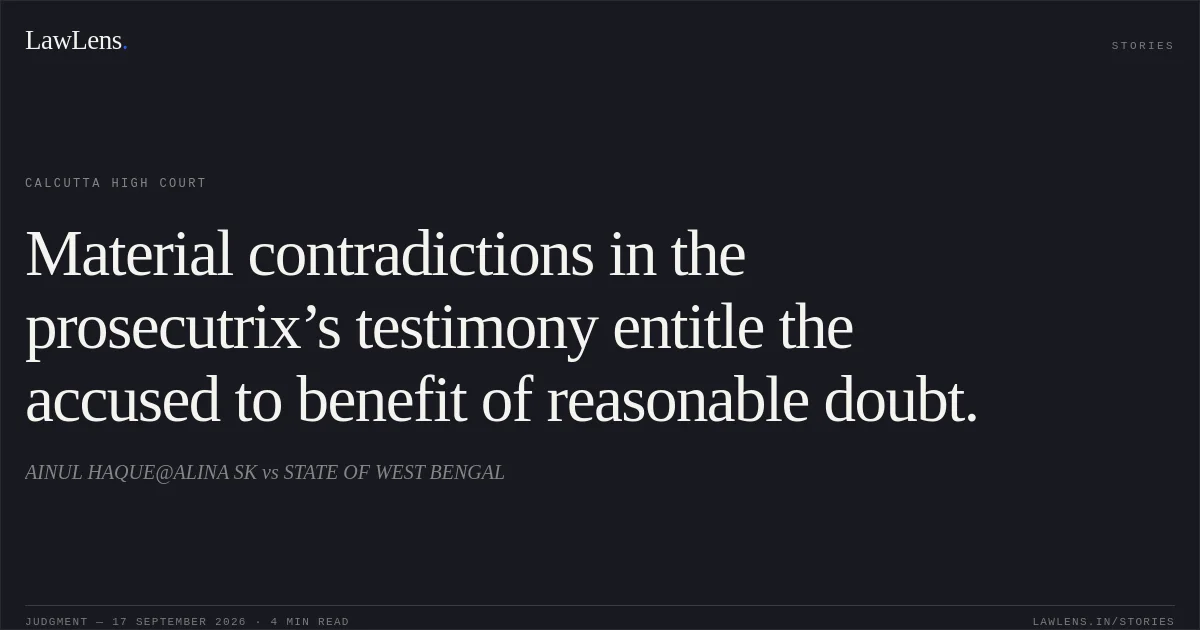
The Court applied the principle that an accused may be convicted on the sole testimony of the prosecutrix in an offence against a woman only when that testimony is wholly reliable, cogent and trustworthy; where it contains material contradictions, omissions or improvements, it must be scrutinised with greater caution.
Source reference: para. 32; p. 15The prosecution retains the burden of proving guilt beyond reasonable doubt, and the absence of defence evidence does not shift or lessen that burden.
Source reference: para. 46; p. 21The Court considered the requirements of Sections 341, 354 and 376/511 IPC, as well as the procedural requirements under Sections 211, 156(3), 154(1), 154(3) and 313 Cr.P.C.
Source reference: no citationIn Priyanka Srivastava v. State of U.P., as quoted and approved in Babu Venkatesh v. State of Karnataka, the Supreme Court held that an application under Section 156(3) should ordinarily disclose prior approaches under Sections 154(1) and 154(3) and be supported by a sworn affidavit.
Source reference: para. 47; pp. 22–24The Court also recognised that Section 313 Cr.P.C. requires clear and specific questions concerning the incriminating circumstances relied upon against the accused.
Source reference: para. 42; p. 20Reasoning
The Court found that the victim’s testimony could not safely sustain a conviction without reliable corroboration.
Source reference: no citationThe alleged occurrence took place on 15 June 2015, whereas the complaint was filed on 6 July 2015, and the asserted prior approaches to the police and Superintendent of Police were unsupported by documentary material.
Source reference: paras. 34–35; pp. 16–17P.W.2’s evidence was inconsistent with the written complaint regarding whether the Superintendent of Police had been approached, while the Investigating Officer testified that material circumstances—such as the accused calling the victim into the jute field and villagers apprehending and detaining him—had not been disclosed during investigation.
Source reference: paras. 36–37; pp. 17–18P.W.1 did not satisfactorily explain the source of his knowledge, and P.W.5 admitted that he had merely heard about the incident, making his evidence substantially hearsay.
Source reference: paras. 38–39; pp. 18–19The alleged apprehension and detention of the accused by villagers was also introduced by the victim for the first time at trial.
Source reference: para. 40; p. 19The prosecution further failed to establish the identity and connection of the place of occurrence with the appellant.
Source reference: para. 41; p. 20These discrepancies concerned the core narrative and were not minor variations capable of being disregarded.
Source reference: paras. 43–45; pp. 20–21The Court additionally found non-compliance with the Section 156(3) safeguards and criticised the jumbled manner of the Section 313 examination.
Source reference: paras. 42, 48–49; pp. 20, 24–25Taken cumulatively, these defects created reasonable doubt, and the prosecution could not obtain substantive support from the absence of defence evidence.
Source reference: paras. 46, 50–52; pp. 21, 25–26Holding
The Court held that the prosecution failed to prove the appellant’s guilt beyond reasonable doubt.
The testimony of P.W.3 was not sufficiently reliable to form the sole basis of conviction, and the remaining evidence did not provide the necessary corroborative assurance.
Source reference: paras. 52–53; p. 26The appeal was allowed, the judgment of conviction dated 12 June 2017 and order of sentence dated 16 June 2017 were set aside, and the appellant was acquitted.
Source reference: paras. 54–55; p. 26As the appellant was on bail, he was directed to stand discharged from the bail bond subject to Section 437A Cr.P.C.
Source reference: para. 56; p. 26Acts & Sections Cited
9 provisions across 2 statutes referred to in this judgment. Each provision opens on LawLens.
Indian Penal Code, 18604
Code of Criminal Procedure, 19735
Original Court PDF
AINUL HAQUE@ALINA SKvsSTATE OF WEST BENGAL
Click to open original judgment
Original judgment, available to read, download and summarize on LawLens.in