Facts
The victim, Atla Siva Govinda Reddy, had longstanding enmity with respondent No. 1 and his family arising from an earlier murder and related family disputes.
Source reference: p. 2; paras. 2, 12–14On the intervening night of 8/9 March 2006, the victim allegedly went to water his crops with PW1 and was attacked by the respondents with sickles and iron pipes. He sustained twenty-two injuries and was taken to the Government Hospital, where his statement was recorded before he died at approximately 7:30 a.m. on 9 March 2006.
Source reference: p. 2; paras. 2, 12–14The Sessions Court convicted all four respondents under Section 302 read with Section 34 IPC and sentenced each to life imprisonment with fine.
Source reference: pp. 3–4; para. 3The High Court altered the conviction to Section 304 Part II IPC and reduced the sentence to six years’ rigorous imprisonment with fine, principally reasoning that the assailants had not ensured the victim’s death before leaving the scene.
Source reference: pp. 3–4; para. 3Issues
Whether the evidence on record, including the victim’s alleged dying declaration and the medical evidence, established the respondents’ guilt for murder under Section 302 read with Section 34 IPC so as to warrant restoration of the Sessions Court’s conviction?
Source reference: pp. 11–15; paras. 11–16Whether the High Court’s alteration of the conviction to Section 304 Part II IPC could be sustained despite its reliance on speculative reasoning that the accused would have confirmed the victim’s death if they had intended to kill him?
Source reference: pp. 15–16; para. 17Whether the respondents’ conviction under Section 304 Part II IPC and the sentence imposed by the High Court should be disturbed when the respondents had served the sentence and had not challenged the modified conviction?
Source reference: p. 15; paras. 16–17Law Applied
The Court applied Sections 302 and 34 IPC, which respectively punish murder and liability for acts done by several persons in furtherance of their common intention, and Section 304 Part II IPC, which applies where death is caused with knowledge that the act is likely to cause death but without the intention required for murder.
Source reference: pp. 1–4The Court assessed the alleged dying declaration under the principle that a statement made by a deceased person regarding the cause or circumstances of death must be voluntary, reliable, and shown to have been made while the declarant was mentally fit; the medical and surrounding evidence are relevant to that assessment.
Source reference: pp. 11–14A criminal conviction must rest on reliable evidence and cannot be sustained on material inconsistencies, surmises, or conjectures.
Source reference: pp. 15–16At the same time, an appellate court may decline to restore a graver conviction where the evidence is insufficient to establish the higher offence beyond reasonable doubt, particularly where the lesser conviction has not been challenged by the accused.
Source reference: pp. 15–16Reasoning
The Supreme Court found substantial inconsistencies regarding the place of occurrence, the presence of the respondents, and the manner in which the victim was transported.
Source reference: pp. 10–11; para. 11PW1 stated that the assault occurred in the fields and that he carried the victim to the graveyard, whereas PW3 and PW4 placed the assault at the graveyard and claimed that the victim was taken directly to hospital in a jeep; PW2’s account also conflicted with PW1’s version.
Source reference: pp. 10–11; para. 11The alleged dying declaration was likewise treated with caution because of uncertainty regarding the time of the police intimation, overwriting in the relevant document, the victim’s twenty-two serious injuries, and the possibility of unconsciousness, slurred speech, or the effects of tranquilizers.
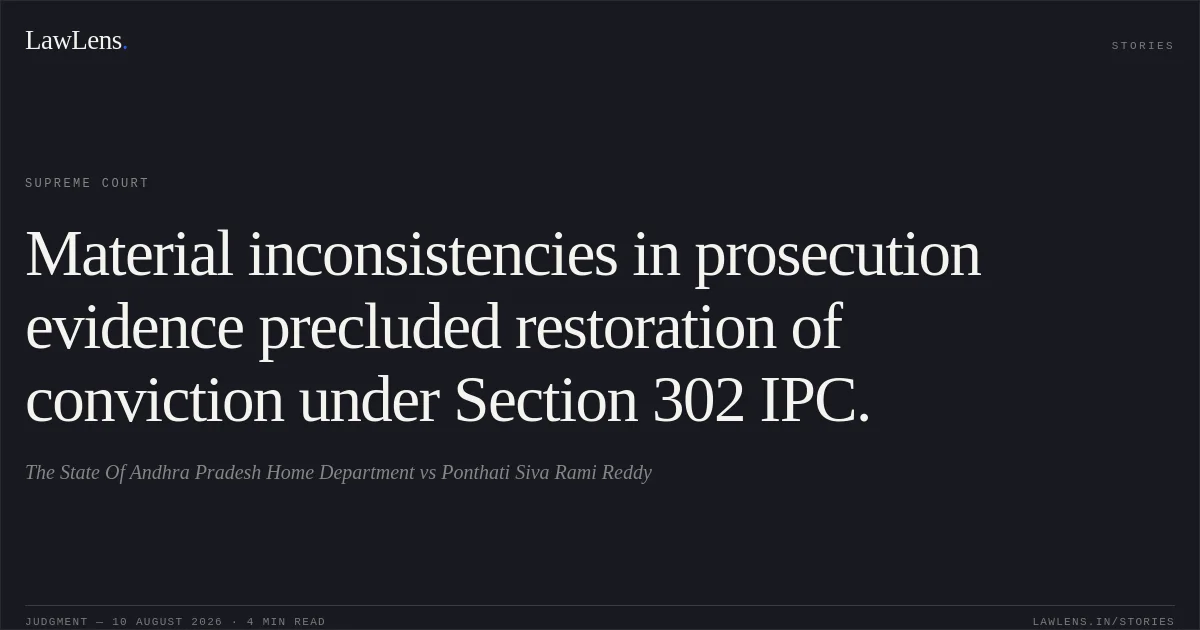
Source reference: pp. 11–14; paras. 12–14These deficiencies prevented restoration of the Section 302 conviction.
Source reference: pp. 11–14; paras. 12–14However, the Court expressly disapproved the High Court’s reasoning that an intention to kill could be inferred from the accused’s failure to remain at the scene until the victim died, holding that those observations were based on surmises and conjectures and were unsupported by witness testimony.
Source reference: pp. 15–16; para. 17Nevertheless, since the respondents had served the six-year sentence and had not challenged the Section 304 Part II conviction, the Court declined to disturb the modified conviction.
Source reference: pp. 15–16; paras. 16–18Holding
The Supreme Court dismissed the State’s appeal.
It refused to restore the respondents’ conviction under Section 302 read with Section 34 IPC because the prosecution evidence contained material inconsistencies and did not sufficiently establish murder beyond reasonable doubt.
Source reference: p. 15; paras. 16–17Although the Court disapproved the High Court’s speculative reasoning, it allowed the respondents’ conviction under Section 304 Part II IPC and the sentence of six years’ rigorous imprisonment with fine to stand, noting that the respondents had already undergone the sentence and had not challenged the modified conviction.
Source reference: pp. 15–16; paras. 16–18Acts & Sections Cited
3 provisions across 1 statute referred to in this judgment. Each provision opens on LawLens.
Indian Penal Code, 18603
Original Court PDF
The State Of Andhra Pradesh Home DepartmentvsPonthati Siva Rami Reddy
Click to open original judgment
Original judgment, available to read, download and summarize on LawLens.in