Facts
The appellants challenged the Railway Claims Tribunal’s dismissal of their claim arising from Shiv Singh’s death on 7 November 2021.
Source reference: no citationThey alleged that Singh had purchased a valid ticket, boarded a Passenger MEMU at Kanchausi, and accidentally fallen from the train while travelling towards Phaphund.
Source reference: pp. 1–2, para. 3The Tribunal rejected the claim, including on the ground that no ticket was recovered.
Source reference: pp. 2–3, paras. 4–5In the appeal, the appellants relied on the Station Master’s memo and Panchnama, while the respondent’s evidence included an RPF Head Constable’s account that Singh’s brother, who identified the body at the scene, had said Singh had gone to visit the fields.
Source reference: pp. 2–3, paras. 4–5Issues
Whether the deceased was established to have been a bona fide passenger, notwithstanding that no journey ticket was recovered.
Source reference: p. 3, para. 7Whether the deceased’s death was established to have resulted from an “untoward incident” within the meaning of the Railways Act, 1989.
Source reference: pp. 3–4, paras. 6–7Law Applied
Section 124-A of the Railways Act, 1989 concerns compensation for death or injury resulting from an “untoward incident”; a claimant must establish that the deceased was a bona fide passenger and that the death resulted from such an incident.
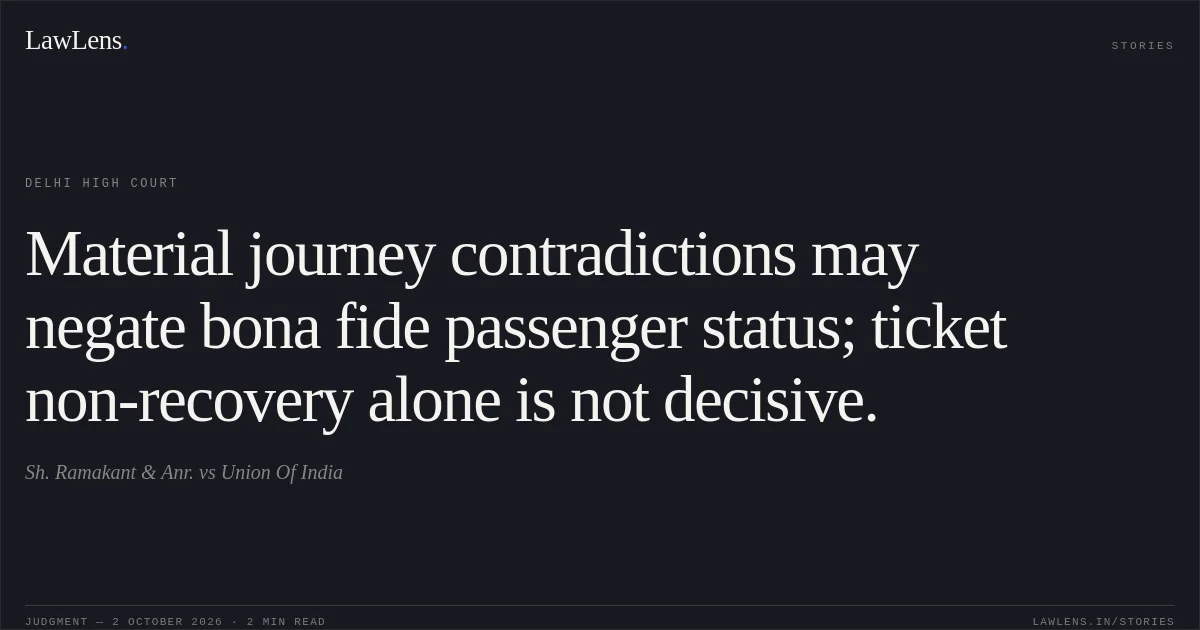
Source reference: pp. 3–4, paras. 7, 10The Court accepted the principle in Union of India v. Rina Devi, (2019) 3 SCC 572, that non-recovery of a ticket, by itself, does not defeat a claim and that the claimant’s affidavit may discharge the initial burden.
Source reference: p. 2, para. 4; p. 3, para. 7The absence of a ticket is therefore not conclusive, but the claim must be assessed against the evidence as a whole.
Source reference: p. 3, para. 7Reasoning
The Court held that the Tribunal’s decision did not rest solely on the missing ticket.
Source reference: p. 3, para. 8The father’s evidence placed Singh’s boarding at about 21:00, whereas the Station Master’s memo had recorded information about the body at 19:48; the Court considered this a material inconsistency undermining the pleaded journey.
Source reference: p. 3, para. 8It also considered the RPF Head Constable’s evidence that Singh’s brother had said Singh had gone towards the fields, noting that the brother identified the body and was a Panchnama witness.
Source reference: pp. 3–4, paras. 8–9The fact that Singh died after coming into contact with a train did not, without further evidence, establish that he had been travelling as a passenger and accidentally fallen from it.
Source reference: p. 4, para. 9Taken together, the evidence did not establish either the claimed passenger journey or an untoward incident.
Source reference: p. 4, para. 10Holding
The Court answered the issues against the appellants, finding that the evidence did not establish that Singh was a bona fide passenger who died in an untoward incident under Section 124-A of the Railways Act, 1989.
It found no basis to interfere with the Tribunal’s judgment and dismissed the appeal.
Source reference: p. 5, paras. 11–12Acts & Sections Cited
1 provisions across 1 statute referred to in this judgment. Each provision opens on LawLens.
Railway Claims Tribunal Act, 19871
Original Court PDF
Sh. Ramakant & Anr.vsUnion Of India
Click to open original judgment
Original judgment, available to read, download and summarize on LawLens.in