Facts
The appeals challenged a Single Judge’s order rejecting the Union of India’s preliminary objection that the Rajasthan High Court lacked territorial jurisdiction over writ petitions concerning recruitment to central armed police forces.
Source reference: para. 1–2The recruitment was conducted on an all-India basis. The petitioners were Rajasthan residents; PET/PST and computer tests took place in Rajasthan, while trade tests were held in Bihar and detailed medical examinations in New Delhi.
Source reference: paras. 2(i), 2(v), 6–8The writ petitions sought consideration of medical fitness certificates or review medical examinations, and consequential appointment. The appellants maintained that no part of the cause of action arose in Rajasthan.
Source reference: para. 2(ii)–(iii)Issues
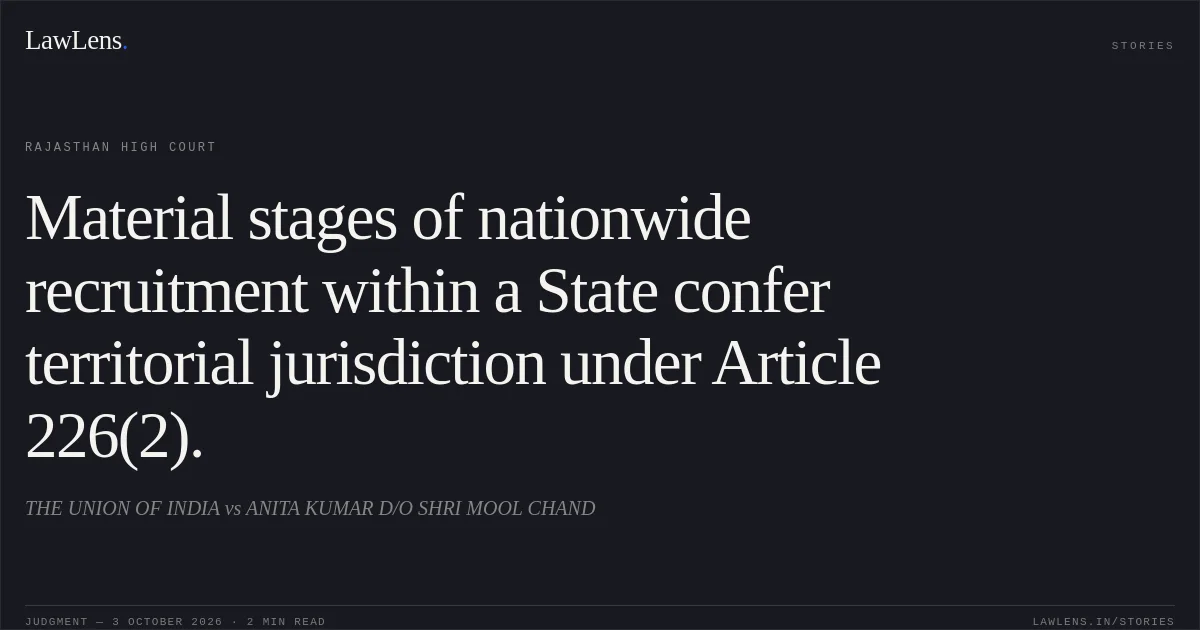
Whether the Rajasthan High Court had territorial jurisdiction under Article 226(2) when material stages of the nationwide recruitment process were conducted in Rajasthan, although the challenged medical decisions were made outside the State.
Source reference: para. 2(iv); paras. 14–16Whether Rajasthan was a convenient and appropriate forum for adjudicating the writ petitions.
Source reference: paras. 15–18Law Applied
Article 226(2) of the Constitution permits a High Court to exercise writ jurisdiction where the cause of action arises wholly or in part within its territory, even if the authority is situated elsewhere.
Source reference: para. 9“Cause of action” means the bundle of material or integral facts that must be proved to obtain relief; pleaded facts confer jurisdiction only where they have a nexus or relevance to the dispute, not merely because they occurred within the State.
Source reference: paras. 10–11The Court relied on Nawal Kishore Sharma v. Union of India, (2014) 9 SCC 329; Kusum Ingots & Alloys Ltd. v. Union of India, (2004) 6 SCC 254; and Union of India v. Adani Exports Ltd., (2002) 1 SCC 567, among other authorities, for these principles.
Source reference: paras. 10–13Even where part of the cause of action arises within a High Court’s territory, that fact does not compel the Court to hear the matter on the merits; it may consider forum conveniens.
Source reference: para. 12The Court also relied on Shanti Devi alias Shanti Mishra v. Union of India, (2020) 10 SCC 766, and Bakshish Ahmad v. Union of India, 2026 SCC OnLine SC 1098, concerning territorial jurisdiction and the suitability of the forum.
Source reference: paras. 13, 17–18Reasoning
The Court found that Rajasthan’s connection to the dispute was not limited to the petitioners’ residence or online application activity: PET/PST and computer tests—substantive stages of an indivisible recruitment process—were conducted in Rajasthan at centres designated by the respondents.
Source reference: paras. 7–8, 15–16Because candidates had to clear the recruitment stages to qualify for appointment, those Rajasthan-based events formed an integral part of the pleaded cause of action. The Court therefore held that part of the cause of action arose within Rajasthan.
Source reference: paras. 15–16It further considered Rajasthan a convenient and appropriate forum, given the petitioners’ residence and participation in material recruitment stages there.
Source reference: paras. 15–18Holding
The Court held that the Rajasthan High Court had territorial jurisdiction under Article 226(2) and that the Single Judge had correctly overruled the preliminary objection.
The appeals were dismissed, with parties directed to bear their own costs; pending applications, if any, were also dismissed.
Source reference: para. 20Acts & Sections Cited
2 provisions across 1 statute referred to in this judgment. Each provision opens on LawLens.
Code of Civil Procedure, 19082
Original Court PDF
THE UNION OF INDIAvsANITA KUMAR D/O SHRI MOOL CHAND
Click to open original judgment
Original judgment, available to read, download and summarize on LawLens.in