01Facts
The deceased, Smt. Sudha, married Doreswamy on 25.05.2008 and had a three-year-old son.
¶ 3, 6The prosecution alleged that her mother-in-law (A1), and sisters-in-law (A2 and A3), subjected her to cruelty and quarrels.
¶ 3, 6On 23.11.2012 at about 12:30 p.m., when she was alone in the house, the accused allegedly quarrelled with her, poured kerosene and set her on fire.
¶ 3, 6She was taken to the Government Hospital, Chamarajanagara, where her statement (Ex.P14) was recorded by PW-19, ASI, after an endorsement by PW-16, the Doctor.
¶ 4, 9, 13, 17She was later shifted to K.R. Hospital, Mysuru, and died the same evening.
¶ 4On the basis of Ex.P14, a case was registered under Sections 498-A and 302 r/w 34 IPC. Her brother's statement (Ex.P7) was then recorded, and Section 302 was incorporated.
¶ 5The prosecution examined 20 witnesses and marked 21 documents.
¶ 7The Sessions Court convicted A1 to A3 under Section 498-A (two years' simple imprisonment and ₹5,000 fine each) and Section 302 r/w 34 IPC (life imprisonment and ₹10,000 fine each).
¶ 2, 8The accused appealed. The appellants are the three accused.
¶ 102Issues
i.1. Whether the multiple dying declarations (Ex.P14, Ex.P12, and the alleged oral declarations to PW-8, PW-9, PW-10 and PW-14) are consistent, reliable, and fit to sustain conviction.
¶ 11–20ii.2. Whether the prosecution established cruelty and harassment within the meaning of Section 498-A IPC beyond reasonable doubt.
¶ 21iii.3. Whether the prosecution established common intention under Section 34 IPC and the accused's guilt under Section 302 IPC beyond reasonable doubt.
¶ 8, 18–2103Law Applied
The court relied on Sections 302, 498-A and 34 of the IPC, which respectively govern murder, cruelty by husband or relatives, and common intention.
¶ 2, 8It applied the principles laid down in Abhishek Sharma v. State (NCT of Delhi), 2023 INSC 924, which hold that dying declarations must be voluntary, reliable and made in a fit state of mind, and must be mutually consistent; only material inconsistencies affect credibility.
¶ 9, 19Where inconsistencies exist, other evidence may corroborate the declarations, each declaration must be scrutinised on its own merits, a statement recorded by a Magistrate or higher officer may be preferred subject to truthfulness, and the declarant's medical fitness and the possibility of tutoring by relatives assume importance.
¶ 19The prosecution must prove each charge beyond reasonable doubt.
¶ 21Provisions in the judgment · 3 · Linked ones open on LawLens
Code of Criminal Procedure, 1973 Section 374
Indian Penal Code, 1860 Section 302Section 34
04Reasoning
The court compared the three versions of the dying declaration. Ex.P14 attributes the act solely to A2, with A1 and A3 pouring water on the deceased, and records that the husband had gone to a shop.
¶ 18Ex.P12, the PW-16 endorsement record, attributes the act to all three accused and also to the husband.
¶ 17–18The oral declarations to PW-8, PW-9, PW-10 and PW-14 name only the three accused and say nothing about the husband.
¶ 18The court held these discrepancies material, since they went to the root of the prosecution case, and it therefore could not corroborate Ex.P14 by the other versions.
¶ 19–20The court also found that the oral declarations lacked support in the record. PW-9 did not state that PW-8 or PW-10 were present at the Chamarajanagara hospital, and the medical evidence did not show the deceased was able to speak at K.R. Hospital, where PW-14 claimed to have received the disclosure.
¶ 11Ex.P7 gave no reason for the attack, and Ex.P14 made no allegation against A1 and A3.
¶ 13–14On cruelty, the allegations were general and omnibus. PW-14's claim of dowry demands was not corroborated by PW-8 to PW-10, and the neighbours (PW-4 and PW-5) turned hostile.
¶ 21Applying the Abhishek Sharma test, the court concluded that the dying declarations were surrounded by doubt and were not corroborated, and that the prosecution had failed to prove the charges.
¶ 20–21Because the declarations failed, the court did not separately analyse the common intention requirement under Section 34 IPC, which rested on the same evidence.
¶ 8, 2105Holding
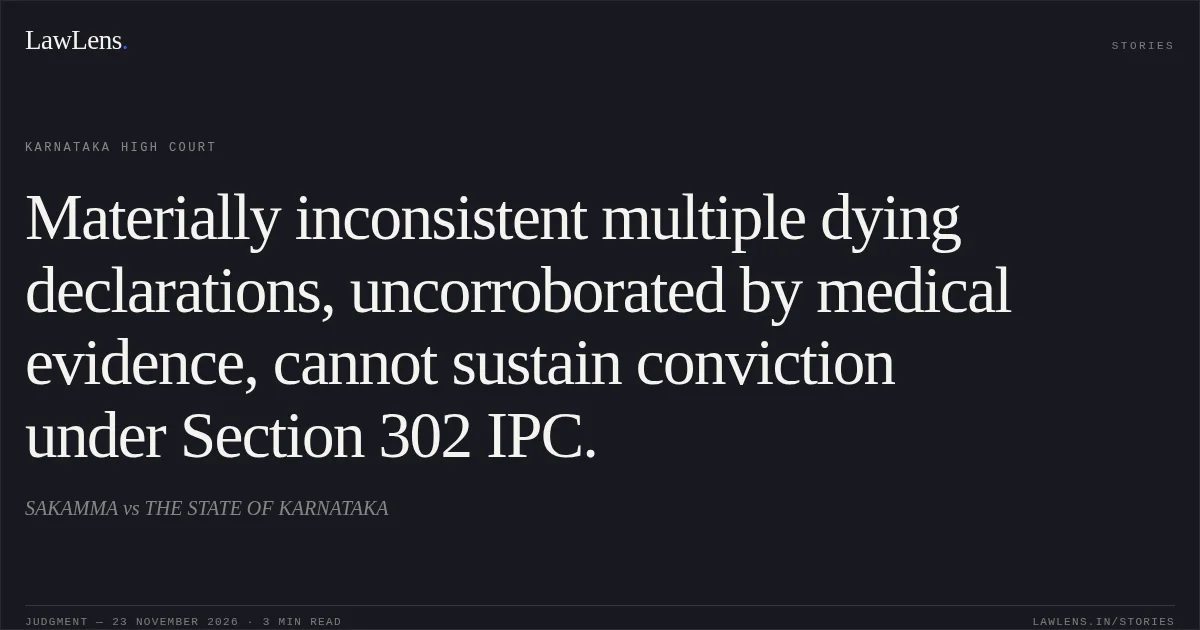
The court held that the prosecution failed to establish the charges under Sections 498-A and 302 r/w 34 IPC beyond reasonable doubt. The dying declarations (Ex.P14, Ex.P12, and the oral declarations) were inconsistent, uncorroborated and not reliable enough to sustain conviction.
¶ 20–21The appeal is allowed. The judgment and order of conviction dated 16.10.2019 in S.C. No. 23 of 2013 are set aside, and A1 to A3 are acquitted. Their bail bonds stand cancelled, and any fine deposited is to be refunded.
order, cl. (i)–(v)Original Court PDF
SAKAMMAvsTHE STATE OF KARNATAKA
Click to open original judgment
Original judgment, available to read, download and summarize on LawLens.in