Facts
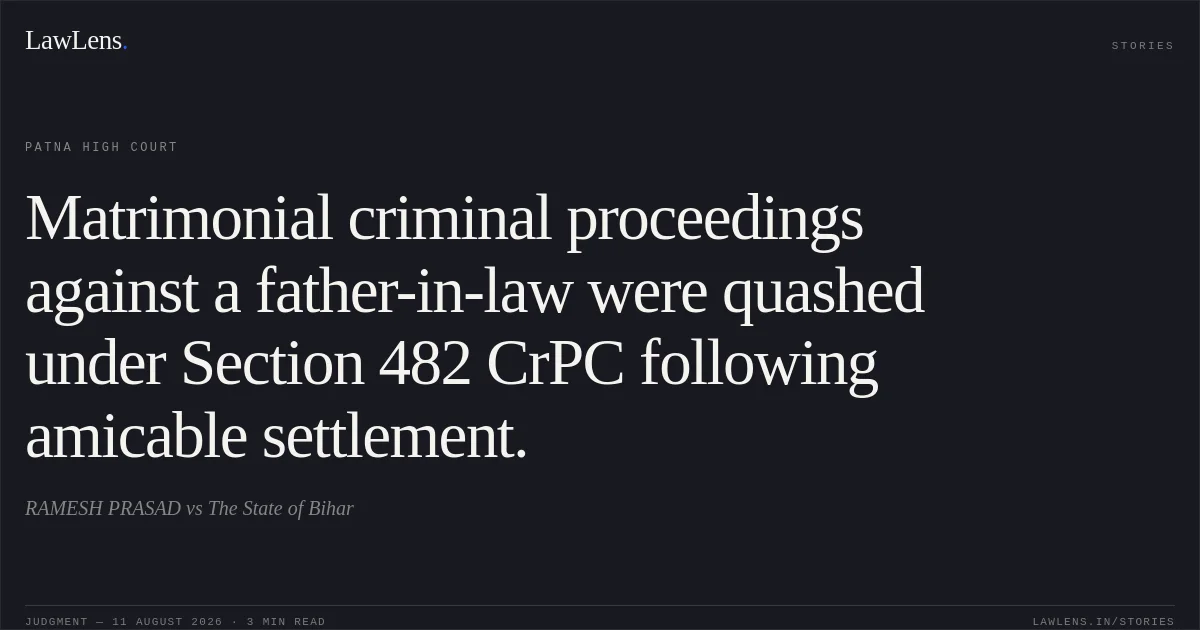
The petitioner, the father-in-law of opposite party no. 2, challenged the order dated 27 May 2022 by which the Sub-Divisional Judicial Magistrate, Gaya rejected his discharge application, as well as the revisional order dated 1 April 2023 affirming that decision.
Source reference: p.1, para. 2The prosecution arose from an FIR alleging cruelty and dowry-related harassment against opposite party no. 2 by the petitioner and other family members.
Source reference: p.2, para. 3The petitioner contended that the allegations arose from ordinary marital discord and that the husband, who was allegedly unable to provide a peaceful conjugal life, had not been made an accused.
Source reference: p.2, para. 4After submission of the charge-sheet and taking of cognizance, the parties entered into a settlement.
Source reference: p.2, para. 5Under the memorandum of settlement dated 3 December 2025 and joint compromise petition dated 9 February 2026, a one-time settlement of ₹25,00,000 was agreed, with the amount deposited before the Family Court in proceedings for mutual-consent divorce under Section 13B of the Hindu Marriage Act.
Source reference: pp.2–3, paras. 5–6Opposite party no. 2 did not dispute the settlement and did not oppose the quashing application.
Source reference: p.3, para. 7Issues
Whether, in view of the amicable settlement of the matrimonial dispute, the High Court should exercise its inherent jurisdiction under Section 482 Cr.P.C. to quash the orders refusing discharge and affirming that refusal.
Source reference: pp.3–4, paras. 7–10Whether continuation of the criminal proceedings against the petitioner, who was the father-in-law and a relative of the husband, would amount to an abuse of process and defeat the ends of justice after settlement of the matrimonial dispute.
Source reference: p.4, paras. 8–10Law Applied
The Court applied the inherent jurisdiction under Section 482 Cr.P.C. to prevent abuse of the process of court and secure the ends of justice, particularly where a matrimonial dispute has been amicably settled and continuation of criminal proceedings would serve no useful purpose.
Source reference: pp.3–5, paras. 8–10It relied on Kahkashan Kausar @ Sonam v. State of Bihar, (2022) 6 SCC 599, for the principle that relatives of the husband should not be indiscriminately implicated in matrimonial prosecutions for the purpose of harassment.
Source reference: p.4, para. 8It also relied on Mange Ram v. State of Madhya Pradesh & Anr., 2025 SCC OnLine SC 1681, which recognises that, in appropriate matrimonial-dispute cases involving a genuine compromise, the High Court should exercise its inherent powers to bring finality to the dispute.
Source reference: p.4, para. 9The settlement was connected with dissolution of marriage by mutual consent under Section 13B of the Hindu Marriage Act.
Source reference: p.3, para. 6Reasoning
The Court noted that the dispute was matrimonial in nature and that the parties had voluntarily resolved it through a written settlement involving payment of ₹25,00,000 and contemplated mutual-consent divorce.
Source reference: pp.2–3, paras. 5–6Since opposite party no. 2 accepted the settlement and expressly did not oppose the application, the continuation of the prosecution would not advance the interests of either party.
Source reference: p.3, para. 7Applying the principles against the indiscriminate prosecution of matrimonial relatives stated in Kahkashan Kausar, the Court considered the petitioner’s status as the father-in-law and the surrounding circumstances of the compromise.
Source reference: p.4, para. 8Following Mange Ram, it held that continuation of the proceedings would be futile, consume judicial time, and defeat the ends of justice.
Source reference: pp.4–5, paras. 9–10Holding
The Court answered the issues in favour of the petitioner.
It held that, in light of the amicable settlement and the matrimonial nature of the dispute, continuation of the criminal proceedings was unwarranted and contrary to the ends of justice.
Source reference: p.5, para. 10The application was allowed, and the orders dated 1 April 2023 of the Sessions Judge, Gaya, and 27 May 2022 of the Sub-Divisional Judicial Magistrate, Gaya, were quashed.
Source reference: p.5, paras. 10–11Acts & Sections Cited
1 provisions across 1 statute referred to in this judgment. Each provision opens on LawLens.
Code of Criminal Procedure, 19731
Original Court PDF
RAMESH PRASADvsThe State of Bihar
Click to open original judgment
Original judgment, available to read, download and summarize on LawLens.in