Facts
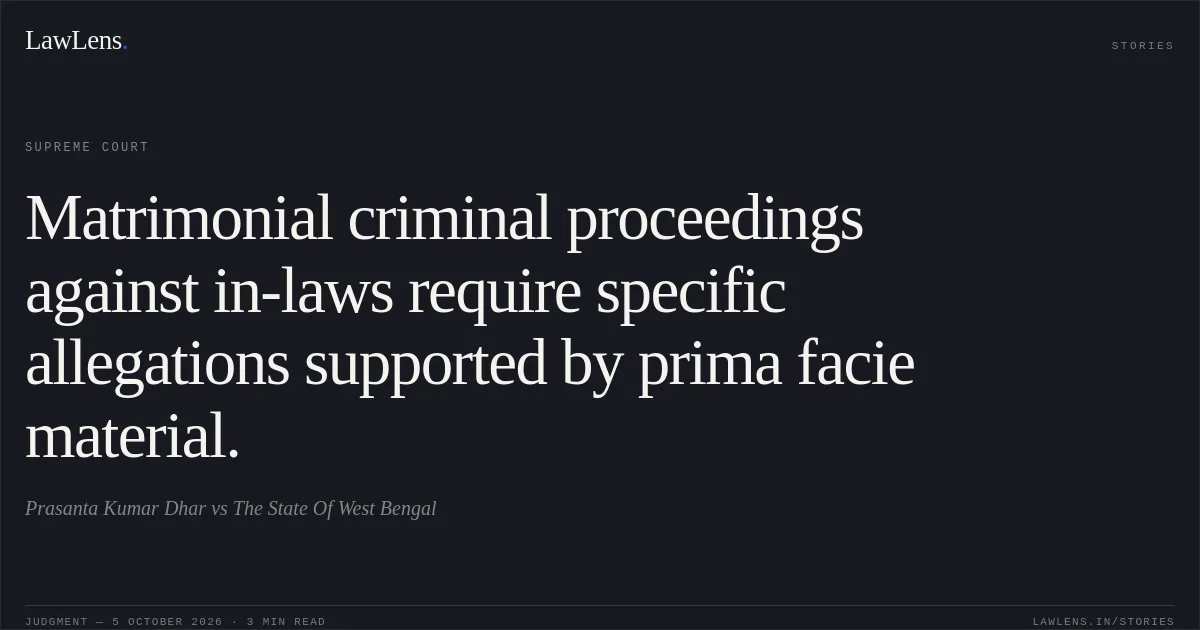
The appellants, the complainant’s parents-in-law, were named with her husband in an FIR alleging dowry demands, cruelty, criminal breach of trust, intimidation and assault.
Source reference: pp. 2–4After investigation, a chargesheet was filed under Sections 498A, 406, 506 and 323 of the Indian Penal Code, 1860 (IPC), and Sections 3 and 4 of the Dowry Prohibition Act, 1961.
Source reference: pp. 2–4The High Court, exercising jurisdiction under Section 482 of the Code of Criminal Procedure, 1973 (CrPC), quashed only the Section 323 IPC charge and declined to quash the rest.
Source reference: pp. 2–4The proceedings were pending at the stage of framing charges.
Source reference: pp. 2–4Issues
1. Whether the allegations and investigation disclosed sufficient prima facie material to continue proceedings against the appellants under Sections 498A, 406 and 506 IPC and Sections 3 and 4 of the Dowry Prohibition Act.
Source reference: pp. 10–142. Whether the High Court should have exercised its inherent jurisdiction under Section 482 CrPC to quash those proceedings against the appellants.
Source reference: pp. 14–15Law Applied
Section 482 CrPC permits quashing to prevent abuse of process or secure the ends of justice, including where allegations, even taken at face value, do not make out an offence, or where proceedings are unsupported by sufficient material; the illustrative categories in State of Haryana v. Bhajan Lal, 1992 Supp (1) SCC 335, guided the Court.
Source reference: pp. 6–8In matrimonial prosecutions, allegations against each relative must be specific and supported by prima facie material showing involvement; courts should guard against omnibus implication, while recognising that relatives may be prosecuted where specific acts and supporting material exist, as discussed in Arti Mehta v. State of Madhya Pradesh and Geddam Jhansi v. State of Telangana.
Source reference: pp. 8–10Section 498A IPC addresses defined forms of cruelty and harassment; Sections 405–406 IPC require entrustment and dishonest misappropriation or conversion; and Sections 503–506 IPC require a threat made with the requisite intent to cause alarm or compel or prevent conduct.
Source reference: pp. 10–13Sections 3 and 4 of the Dowry Prohibition Act concern giving, taking or demanding dowry.
Source reference: p. 11Reasoning
The Court examined the allegations and investigative material against the appellants separately.
Source reference: pp. 10–14It found no material showing that they had caused grave injury or danger to the complainant’s health, or independently harassed her to meet an unlawful demand, as required to sustain the Section 498A allegations.
Source reference: pp. 10–14The dowry allegations lacked particulars of the appellants’ demands and supporting material; the Section 406 allegations did not identify property entrusted to them or any misappropriation; and the Section 506 allegations lacked details of threats and supporting evidence beyond the complaint and the complainant’s parents’ statements.
Source reference: pp. 10–14Applying Bhajan Lal and the principles concerning specific allegations in domestic-dispute cases, the Court held that the allegations against the appellants were general and unsupported by sufficient investigative material.
Source reference: pp. 14–15Holding
The Court allowed the appeal and set aside the High Court’s order insofar as it refused to quash the remaining charges.
All proceedings arising from the FIR were quashed against the appellants under Sections 498A, 406 and 506 IPC and Sections 3 and 4 of the Dowry Prohibition Act, in addition to the Section 323 IPC charge already quashed by the High Court.
Source reference: p. 15The Court expressly made no determination on the allegations against the husband or on any other civil proceeding or remedy.
Source reference: p. 16Acts & Sections Cited
11 provisions across 3 statutes referred to in this judgment. Each provision opens on LawLens.
Code of Criminal Procedure, 19734
Indian Penal Code, 18605
Original Court PDF
Prasanta Kumar DharvsThe State Of West Bengal
Click to open original judgment
Original judgment, available to read, download and summarize on LawLens.in