Facts
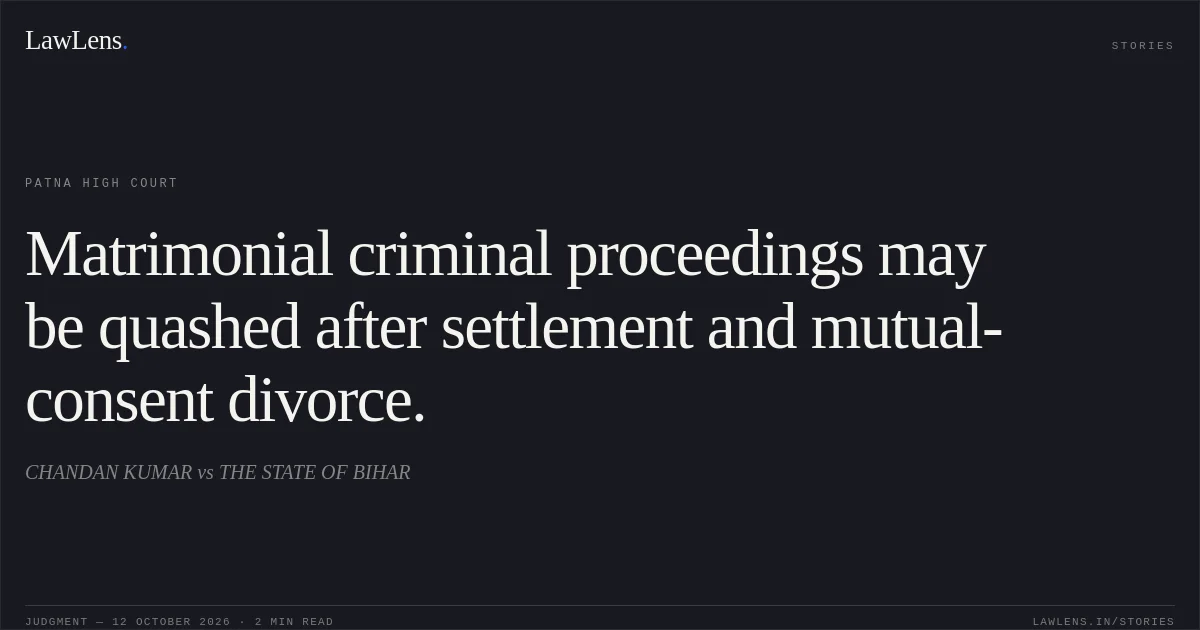
The petitioner, the husband of opposite party no. 2, sought to quash the Magistrate’s order dated 8 September 2022 taking cognizance under Sections 341, 323, 325, 498A and 34 of the Indian Penal Code and Sections 3/4 of the Dowry Prohibition Act in Beur P.S. Case No. 135 of 2020.
Source reference: para. 2, p. 1The petitioner alleged that the parties had settled their matrimonial dispute, obtained a divorce by mutual consent under Section 13-B of the Hindu Marriage Act, and that the wife had received final alimony and had no remaining grievance.
Source reference: paras. 5–7, pp. 2–3Despite attempts at service, opposite party no. 2 was not served, and the Court proceeded to hear the matter.
Source reference: para. 4, p. 2Issues
1. Whether the High Court should exercise its inherent jurisdiction to quash the cognizance order and ensuing criminal proceedings in light of the parties’ settlement and divorce by mutual consent.
Source reference: paras. 8–10, pp. 3–42. Whether continuation of the prosecution, in these circumstances, would amount to an abuse of the process of the Court.
Source reference: para. 10, p. 4Law Applied
The Court relied on the High Court’s inherent power under Section 482 of the Code of Criminal Procedure to quash criminal proceedings in the interest of justice.
Source reference: para. 9, p. 3Citing Gian Singh v. State of Punjab, (2012) 10 SCC 303, and Mange Ram v. State of Madhya Pradesh & Anr., [2025 INSC 962], the Court stated that in cases arising from matrimonial disputes that have been settled, courts should seek to bring the litigation to a peaceful end and may exercise Section 482 powers to do so.
Source reference: para. 9, p. 3The Court also considered the decree dissolving the marriage under Section 13-B of the Hindu Marriage Act.
Source reference: paras. 6, 8, pp. 2–3Reasoning
The Court found that the parties had amicably resolved their differences, obtained a decree of divorce by mutual consent, and that the wife had filed a compromise petition stating that she had received final alimony and had no remaining grievance.
Source reference: paras. 7–8, p. 3Applying the principles in Gian Singh and Mange Ram, it concluded that, in the circumstances of this matrimonial dispute, continuing the prosecution would serve no legitimate purpose and would amount to an abuse of the process of the Court.
Source reference: paras. 9–10, pp. 3–4Holding
The Court allowed the application and quashed the Magistrate’s cognizance order dated 8 September 2022 in Beur P.S. Case No. 135 of 2020, together with all prosecution arising from that case.
Acts & Sections Cited
7 provisions across 3 statutes referred to in this judgment. Each provision opens on LawLens.
Indian Penal Code, 18604
Code of Criminal Procedure, 19731
Original Court PDF
CHANDAN KUMARvsTHE STATE OF BIHAR
Click to open original judgment
Original judgment, available to read, download and summarize on LawLens.in