Facts
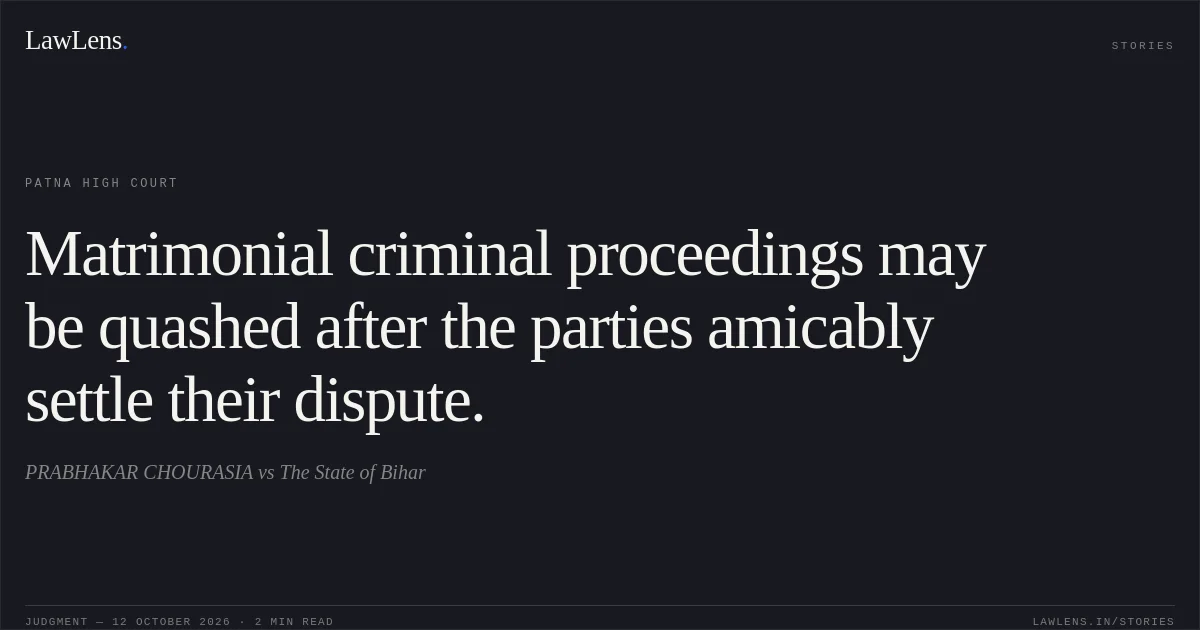
The petitioners sought to quash the order dated 14 February 2019 in Criminal Revision No. 572 of 2013, which arose from proceedings in Laheriasarai P.S. Case No. 47 of 2007 under Sections 498A and 323 IPC and Sections 3 and 4 of the Dowry Prohibition Act
Source reference: para. 2, p. 1The complainant alleged mental and physical cruelty connected with dowry demands
Source reference: para. 3, p. 2The petitioners relied on a mutual-consent divorce decree dated 21 January 2010 under Section 13B of the Hindu Marriage Act, 1955, and an agreement that the complainant would withdraw the criminal case
Source reference: paras. 4–5, pp. 2–3The complainant did not appear despite service; the State opposed the petition but did not dispute the compromise
Source reference: paras. 8–9, p. 3Issues
1. Whether the High Court should exercise its inherent jurisdiction to quash the criminal proceedings against the petitioners in light of the parties’ settlement and mutual-consent divorce
Source reference: paras. 4–5, 11, pp. 2–3, 72. Whether the allegations concerning the petitioners’ roles, including those of the husband’s relatives, warranted continuation of the proceedings notwithstanding the settlement
Source reference: paras. 8, 10–11, pp. 3–7Law Applied
Section 482 CrPC preserves the High Court’s inherent power to prevent abuse of process and secure the ends of justice; that power is to be exercised sparingly and with circumspection, and the Court ordinarily must not assess the reliability of allegations at the quashing stage
Source reference: para. 10, pp. 4–5The judgment also reproduces the illustrative categories in State of Haryana v. Bhajan Lal, including proceedings that are manifestly mala fide or amount to abuse of process
Source reference: para. 10, pp. 5–7It refers to authorities cautioning against general or omnibus allegations against a husband’s relatives and requiring attention to the specific role attributed to each accused
Source reference: para. 10, pp. 4–6The Court exercised its inherent jurisdiction in view of the parties’ amicable settlement; it did not identify a separate statutory basis for compounding the charged offences
Source reference: para. 11, p. 7Reasoning
The Court considered the mutual-consent divorce decree and the terms recorded in that proceeding, including the complainant’s stated intention to withdraw the criminal case
Source reference: paras. 4–5, pp. 2–3Although the State maintained that the in-laws had actively participated in the alleged cruelty, it did not dispute that the parties had settled
Source reference: para. 8, p. 3The complainant’s absence was noted
Source reference: para. 9, p. 3In light of the settlement and the principles on quashing under Section 482 CrPC, the Court concluded that the impugned order and consequential proceedings should not continue against any of the petitioners
Source reference: paras. 10–11, pp. 4–7Holding
The High Court allowed the petition and quashed the order dated 14 February 2019, together with all consequential proceedings, insofar as they concerned the five petitioners
It directed that the trial court record, if any, be returned with a copy of the judgment
Source reference: para. 13, p. 7Acts & Sections Cited
6 provisions across 3 statutes referred to in this judgment. Each provision opens on LawLens.
Indian Penal Code, 18601
Code of Criminal Procedure, 19733
Original Court PDF
PRABHAKAR CHOURASIAvsThe State of Bihar
Click to open original judgment
Original judgment, available to read, download and summarize on LawLens.in