01Facts
The marriage between Petitioner No. 1 and Respondent No. 2 (complainant) was solemnized on February 6, 2022, and resulted in the birth of a son
¶ 2Following matrimonial discord, Respondent No. 2 lodged a complaint leading to the registration of FIR No. 839/2024 at P.S. Shahbad Dairy under Sections 85, 316(2), 74(1), and 3(5) of the Bharatiya Nyaya Sanhita (BNS), 2023
¶ 1, 3While a charge-sheet was filed, charges had not yet been framed
¶ 4During the proceedings, the parties were referred to mediation and executed a settlement agreement on January 17, 2026, under the Delhi Mediation Centre
¶ 5Subsequently, the parties obtained a divorce by mutual consent on March 13, 2026
¶ 7The Respondent No. 2 appeared in court, confirmed the receipt of the full settlement amount of Rs. 14,50,000, and expressed her "no objection" to the quashing of the FIR
¶ 7, 802Issues
i.1. Whether the High Court should exercise its inherent powers to quash criminal proceedings arising from matrimonial disputes when the parties have reached an amicable settlement.
¶ 9, 1203Law Applied
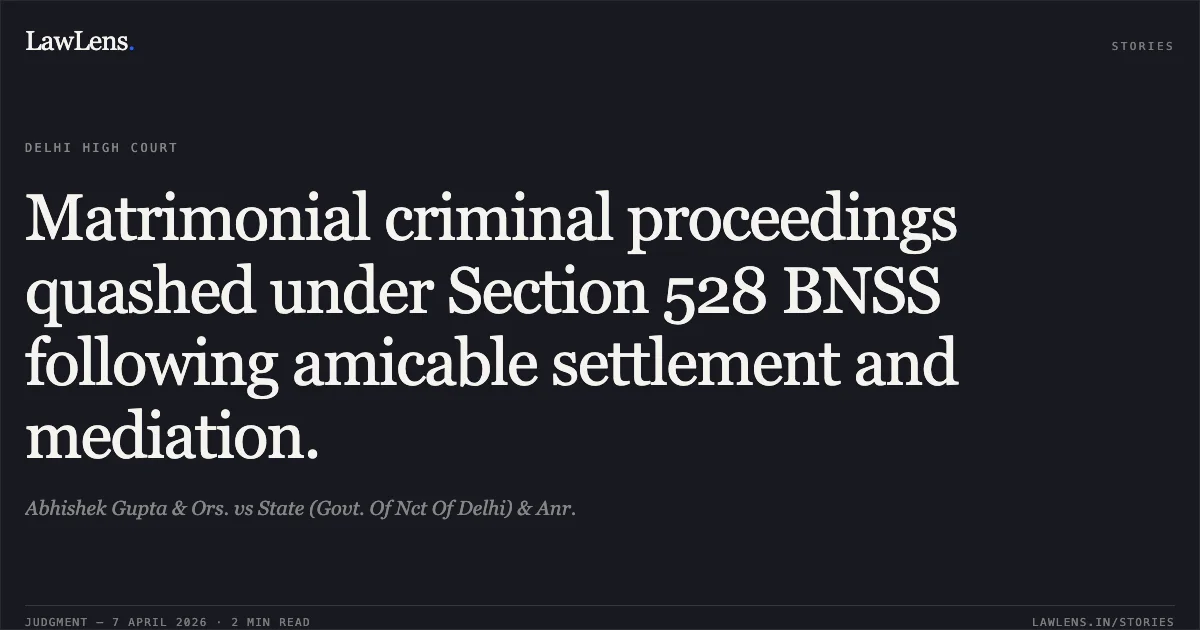
The court primarily exercised its inherent powers under Section 528 of the Bharatiya Nagarik Suraksha Sanhita (BNSS), 2023 (which corresponds to Section 482 of the CrPC) to secure the ends of justice
¶ 12It relied on the legal principles established in Gian Singh v. State of Punjab & Anr. (2012) and Narinder Singh & Ors. vs. State of Punjab & Anr. (2014), which specify that proceedings in non-compoundable cases can be quashed if the dispute is private/matrimonial in nature, a settlement is reached, and continuing the trial would serve no meaningful purpose as the scope of conviction remains remote and bleak
¶ 10Provisions in the judgment · 8 · Linked ones open on LawLens
Bharatiya Nyaya Sanhita, 2023 Section 85Section 316Section 74Section 3
Indian Penal Code, 1860 Section 406Section 354Section 34
Bharatiya Nagarik Suraksha Sanhita, 2023 Section 528
04Reasoning
The court observed that the dispute between the parties was primarily private and matrimonial, involving no significant public interest
¶ 9The court noted that the parties had already dissolved their marriage by mutual consent and resolved all financial claims including alimony and stridhan
¶ 7By recording the statement of Respondent No. 2, the court satisfied itself that the settlement was entered into voluntarily, without coercion
¶ 8Applying the ratio from Narinder Singh, the court reasoned that since the complainant no longer wished to press charges, the likelihood of conviction was virtually non-existent
¶ 10Consequently, the court determined that continuing with the criminal proceedings would be a futile exercise and an abuse of the process of law, justifying the use of inherent powers to quash the FIR
¶ 11, 1205Holding
The court allowed the petition and quashed FIR No. 839/2024 and all consequential proceedings
¶ 13The holding was made subject to the petitioners depositing a cost of Rs. 20,000 to the Delhi District Courts Employees Welfare fund within two weeks
¶ 13The court directed that proof of deposit and original affidavits be submitted to the Trial Court to finalize the disposal
¶ 13Original Court PDF
Abhishek Gupta & Ors.vsState (Govt. Of Nct Of Delhi) & Anr.
Click to open original judgment
Original judgment, available to read, download and summarize on LawLens.in