Facts
A raid was conducted at premises jointly occupied by the petitioners on the basis of secret information.
Source reference: no citationThe prosecution alleged that, despite disconnection of the electricity supply for non-payment of dues, the petitioners were illegally abstracting electricity through three PVC wires, constituting theft under Section 135 of the Electricity Act, 2003.
Source reference: p. 2During investigation, the Investigating Officer found that the premises comprised three flats with separate electricity meters, including one meter in the name of petitioner no. 1 and two in the names of third parties.
Source reference: pp. 2–3The outstanding dues of Rs. 96,227/- allegedly payable in the name of the petitioners’ father had already been paid on 17 July 2013, and the electricity-related documents produced by the petitioners were verified as genuine.
Source reference: pp. 2–3The police submitted a final form finding insufficient evidence and did not send the petitioners for trial.
Source reference: pp. 1, 3–4Nevertheless, the Chief Judicial Magistrate, Araria, by order dated 2 November 2015, differed from the final form and took cognizance against the petitioners under Section 135 of the Electricity Act.
Source reference: pp. 1, 3–4The petitioners challenged the cognizance order under Section 482 of the Code of Criminal Procedure, 1973.
Source reference: no citationIssues
Whether the Chief Judicial Magistrate was justified in differing from the police final form and taking cognizance against the petitioners under Section 135 of the Electricity Act.
Source reference: pp. 3–5Whether the continuation of the criminal proceedings, in the circumstances disclosed by the investigation, amounted to an abuse of the process of the court.
Source reference: pp. 3–5Law Applied
Section 135 of the Electricity Act, 2003 criminalises dishonest abstraction, consumption or use of electricity.
Source reference: pp. 4–5At the stage of taking cognizance, a Magistrate may differ from a police final form if the case diary discloses sufficient material indicating a prima facie offence; however, such departure must reflect an application of judicial mind and cannot be mechanical.
Source reference: pp. 4–5Proceedings may be quashed under the inherent jurisdiction of the High Court where the materials collected during investigation do not disclose a prima facie case and continuation of the prosecution would constitute an abuse of the process of the court.
Source reference: pp. 4–5Reasoning
The High Court found that the investigation had produced material favourable to the petitioners: the premises contained separately metered flats, the relevant electricity documents were verified as genuine, and the alleged outstanding dues had already been paid.
Source reference: pp. 2–3The police, after investigation, therefore submitted a final form for want of evidence.
Source reference: pp. 2–3Although the Magistrate was legally entitled to disagree with the police report, the cognizance order merely stated that a prima facie case was made out on perusal of the case diary and failed to address the exculpatory material collected during investigation.
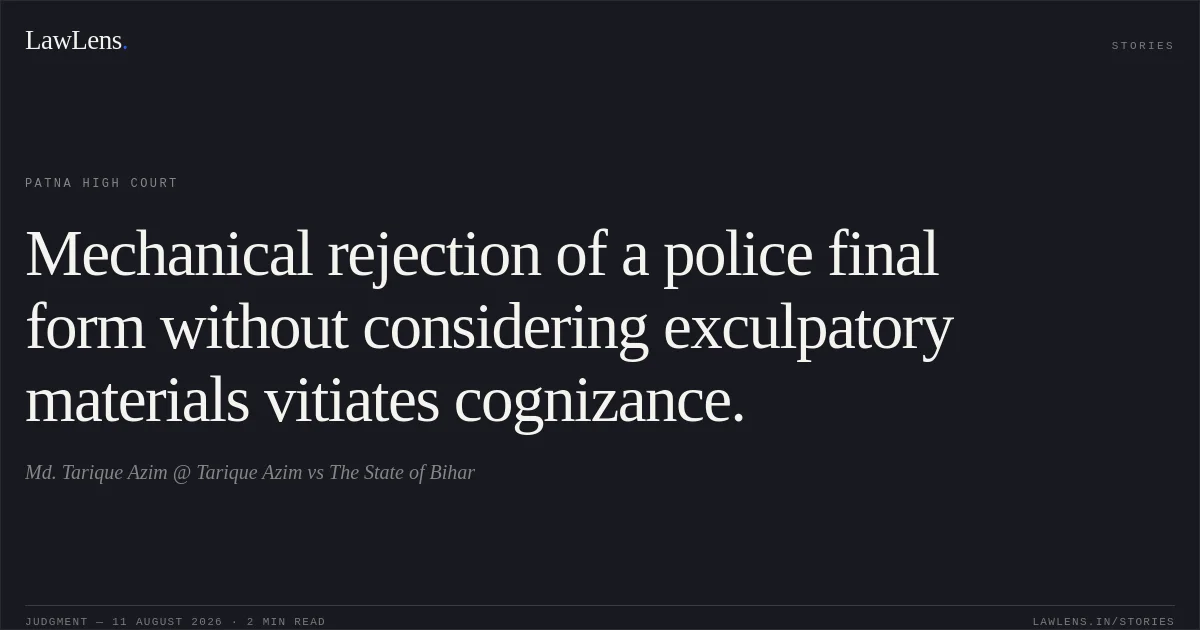
Source reference: pp. 3–5The High Court consequently held that the Magistrate had differed from the final form mechanically and without proper application of judicial mind.
Source reference: para. 7; p. 5Holding
The Court held that the order dated 2 November 2015 taking cognizance under Section 135 of the Electricity Act was unsustainable because it ignored the material collected during investigation and was passed mechanically.
The cognizance order in Araria P.S. Case No. 349 of 2013 was quashed, and the criminal miscellaneous application was allowed.
Source reference: paras. 8–9Acts & Sections Cited
1 provisions across 1 statute referred to in this judgment. Each provision opens on LawLens.
Electricity Act, 20031
Original Court PDF
Md. Tarique Azim @ Tarique AzimvsThe State of Bihar
Click to open original judgment
Original judgment, available to read, download and summarize on LawLens.in