01Facts
The petitioner was selected and appointed as a trainee Driver-cum-Conductor by the respondent Corporation on 07.04.2006 under Regulation 12 of the Karnataka State Road Transport Corporation (Cadre and Recruitment) Regulations, 1982.
pp. 2-3 · ¶ 2During training, disciplinary proceedings for misbehaviour with officers led to his removal from the select list by order dated 05.12.2009.
pp. 3-4 · ¶ 3The Labour Court set aside that removal, but the Corporation's writ petition (W.P. No. 16965/2012) was resolved by a joint memo, and on 16.01.2014 this Court modified the punishment, directing reinstatement with continuity of service but without back wages.
p. 4 · ¶ 3 · p. 11 · ¶ 10The petitioner was then absent from duty from 10.12.2012 without sanctioned leave, and a charge memo alleged 29 days of unauthorised absence.
pp. 4-5 · ¶ 4 · p. 11 · ¶ 11The Enquiry Officer held the charge proved, and the disciplinary authority removed his name from the select list by order dated 28.01.2015.
p. 5 · ¶ 4The petitioner's industrial dispute (I.I.D. No. 5/2015) was dismissed by the Labour Court (Principal District and Sessions Judge, Chamarajanagar) by award dated 23.05.2022.
p. 5 · ¶ 5The petitioner contended that he was willing to work but was not permitted to report, that he was ill and produced medical certificates, that similarly placed employees received minor punishments, and that removal was disproportionate.
pp. 6-8 · ¶ 6The Corporation relied on his trainee status, prior misconduct, more than 14 NINC cases, and the absence of any contemporaneous medical record before the Enquiry Officer.
pp. 8-9 · ¶ 7The medical documents pertained to 26.10.2012, 31.07.2013 and 29.08.2013 only.
pp. 12-13 · ¶ 1202Issues
i.1. Whether the Labour Court was justified in upholding the disciplinary authority's order dated 28.01.2015 removing the petitioner's name from the select list for unauthorised absence.
p. 10 · ¶ 9 · pp. 23-24 · ¶ 21-22ii.2. Whether the award warrants interference under Articles 226 and 227 of the Constitution of India.
p. 10 · ¶ 9 · pp. 24-25 · ¶ 23-2403Law Applied
The Court relied on Regulation 12 of the 1982 Regulations, which governs training and probation of selected candidates.
p. 3 · ¶ 2The Court applied the settled principles of judicial review over disciplinary proceedings, as restated in State Bank of India v. Ajai Kumar Srivastava (2021) 2 SCC 612, which in turn draws on B.C. Chaturvedi v. Union of India (1995) 6 SCC 749 and Union of India v. H.C. Goel (1964) 4 SCR 718.
pp. 18-21 · ¶ 20Under these authorities, the writ court examines only whether the enquiry was held by a competent authority, whether natural justice was observed, and whether findings rest on some evidence; it does not reappreciate evidence or act as an appellate authority on the merits.
pp. 18-21 · ¶ 20Interference with quantum of punishment is warranted only where it is shockingly disproportionate or otherwise legally infirm.
pp. 15-16 · ¶ 16The Court applied the principle that discrimination arises only where persons similarly situated in all material respects are treated differently without reasonable justification.
pp. 14-15 · ¶ 15The Court recognised that the public transport nature of the employer makes discipline and regular attendance of conductors significant.
p. 17 · ¶ 1804Reasoning
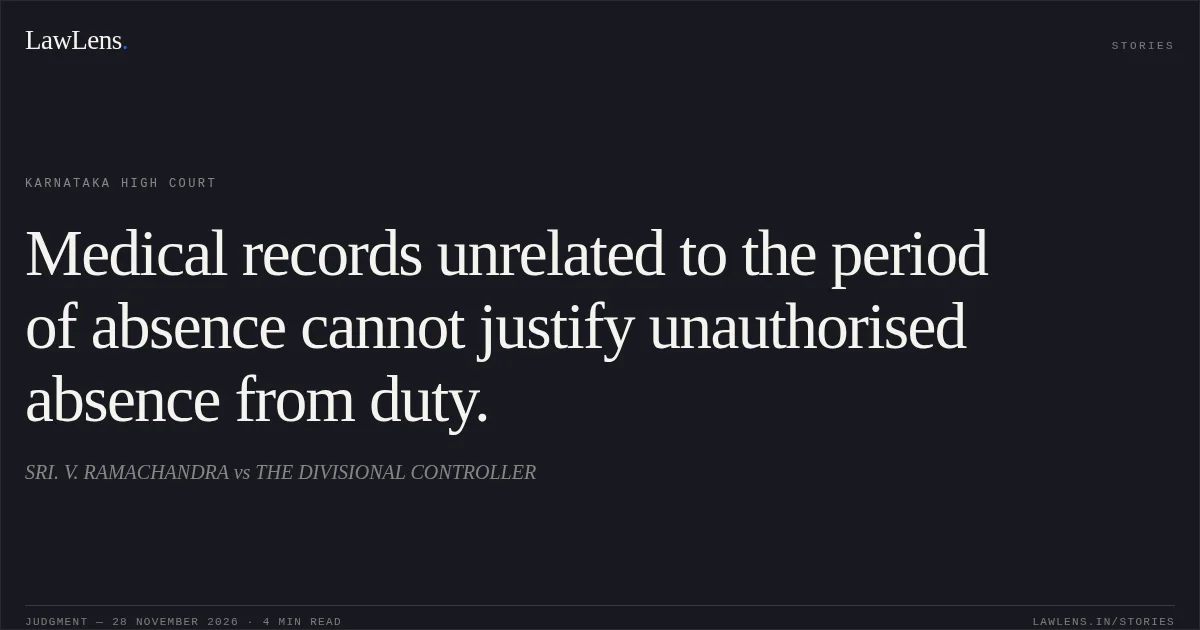
The medical records produced by the petitioner related to dates (26.10.2012, 31.07.2013, 29.08.2013) outside the charge period of absence from 10.12.2012, so they did not establish incapacity during the relevant period.
pp. 12-13 · ¶ 12-13Mere production of unconnected medical records, without nexus to inability to attend, was held insufficient.
p. 13 · ¶ 13The Court also found the petitioner's representations of 29.12.2012 internally inconsistent: one asserted illness, the other asserted willingness to work but denial of permission. This inconsistency cast doubt on the explanation.
p. 14 · ¶ 14On parity, the Labour Court had found that the comparator employees had produced satisfactory explanations, so the petitioner could not claim parity on the mere similarity of charge.
pp. 14-15 · ¶ 15On proportionality, the disciplinary authority was entitled to consider the petitioner's record of 14 NINC cases and periods of absence of 326 days (16.03.2013 to 04.02.2014) and 19 days (06.04.2014 to 24.04.2014), along with his prior misconduct and the earlier settlement, which indicated a pattern of irregular attendance.
pp. 16-17 · ¶ 17, 19The Court found the Labour Court's conclusion neither perverse nor contrary to the evidence, and the petitioner had not shown a violation of natural justice, absence of evidence, or shocking disproportionality.
pp. 17-18 · ¶ 19 · pp. 23-24 · ¶ 2305Holding
The Court answered both issues against the petitioner. It held that the Labour Court properly appreciated the record and rightly upheld the removal of the petitioner's name from the select list, and that the award does not warrant interference under Articles 226 and 227.
p. 24 · ¶ 24 · p. 25 · ¶ 25The writ petition was dismissed as devoid of merits, and the order of removal dated 28.01.2015, as affirmed by the Labour Court award dated 23.05.2022 in I.I.D. No. 5/2015, stands.
p. 25 · ¶ 25Original Court PDF
SRI. V. RAMACHANDRAvsTHE DIVISIONAL CONTROLLER
Click to open original judgment
Original judgment, available to read, download and summarize on LawLens.in