Facts
The petitioners and twelve other persons were elected to the 25 seats of Zila Parishad, Shimla, in elections held in May 2026, with results declared on 31 May 2026.
Source reference: p.2The Deputy Commissioner convened a meeting on 6 June 2026 for administering the oath/affirmation of allegiance; the elected members, including the petitioners, took the oath, but no election for Chairman and Vice-Chairman was held immediately thereafter.
Source reference: p.2A further meeting was notified for 27 June 2026 without specifying its purpose; only eleven elected members attended, and the meeting was presided over by the Additional Deputy Commissioner rather than the Deputy Commissioner.
Source reference: p.3On 20 July 2026, a meeting specifically for election of the Chairman and Vice-Chairman was fixed for 3 August 2026, but it was adjourned for want of quorum.
Source reference: p.4The petitioners approached the High Court on 10 August 2026 alleging failure by the Deputy Commissioner to perform his statutory duty of convening the election meeting.
Source reference: p.4During the proceedings, the Deputy Commissioner proposed to convene the next meeting on 10 September 2026.
Source reference: pp.7–9Issues
1. Whether the Deputy Commissioner had failed to discharge the statutory duty to promptly convene a meeting for election of the Chairman and Vice-Chairman of Zila Parishad, Shimla, after administration of oath to the elected members.
Source reference: pp.10–182. Whether the meeting scheduled for 3 August 2026 constituted the first election meeting despite want of quorum, and whether the proposed meeting on 10 September 2026 was therefore the second meeting attracting the simple-majority quorum under Rule 86(4).
Source reference: pp.20–28Law Applied
The Court applied Section 90(1) of the Himachal Pradesh Panchayati Raj Act, 1994, requiring the Deputy Commissioner to convene, as soon as possible and within one week of declaration of results, a meeting for administering oath; Section 90(2), requiring the elected members to elect the Chairman and Vice-Chairman immediately after the oath; and Section 127, under which an elected office-bearer cannot enter office without taking the prescribed oath or affirmation.
Source reference: pp.10–12Rule 86(1) and Rule 86(1-A) of the Himachal Pradesh Panchayati Raj (Election) Rules, 1994 require separate notices for the oath meeting and the election meeting, with the latter to be convened under the Deputy Commissioner’s presidentship.
Source reference: pp.12–13Under Rule 86(4), the quorum for the first election meeting is two-thirds of the total elected members; if that meeting is adjourned for want of quorum, the second and subsequent meetings require only a simple majority, and action under Section 146(1)(b) of the Act may be taken against members who fail to attend subsequent meetings, provided the notices specifically mention the consequence.
Source reference: pp.18–20, 24–26Rule 86(5) requires at least five days’ notice specifying the date, time, place and purpose of the meeting.
Source reference: p.19The Court also relied on Ladhuram v. Chief Panchayat Officer, Jaipur, holding that absence of quorum does not mean that no meeting took place; a duly summoned meeting remains a meeting even though no business can be transacted for want of quorum.
Source reference: pp.27–28Reasoning
The Court held that the Deputy Commissioner complied with the requirement to convene the oath meeting within the prescribed period by fixing it for 6 June 2026, but failed to comply with Section 90(2) and Rule 86(1-A), which required the election meeting to be called immediately after the oath.
Source reference: pp.13–15The explanations based on simultaneous elections to other local bodies, Independence Day arrangements and the Assembly’s monsoon session were held to be inadequate. Administrative preoccupation could not override the State’s statutory and constitutional obligation to ensure the timely functioning of democratic institutions; necessary arrangements ought to have been made instead.
Source reference: pp.14–18The meetings of 6 June and 27 June could not be treated as election meetings because the former was expressly convened only for administering oath and the latter did not state any purpose.
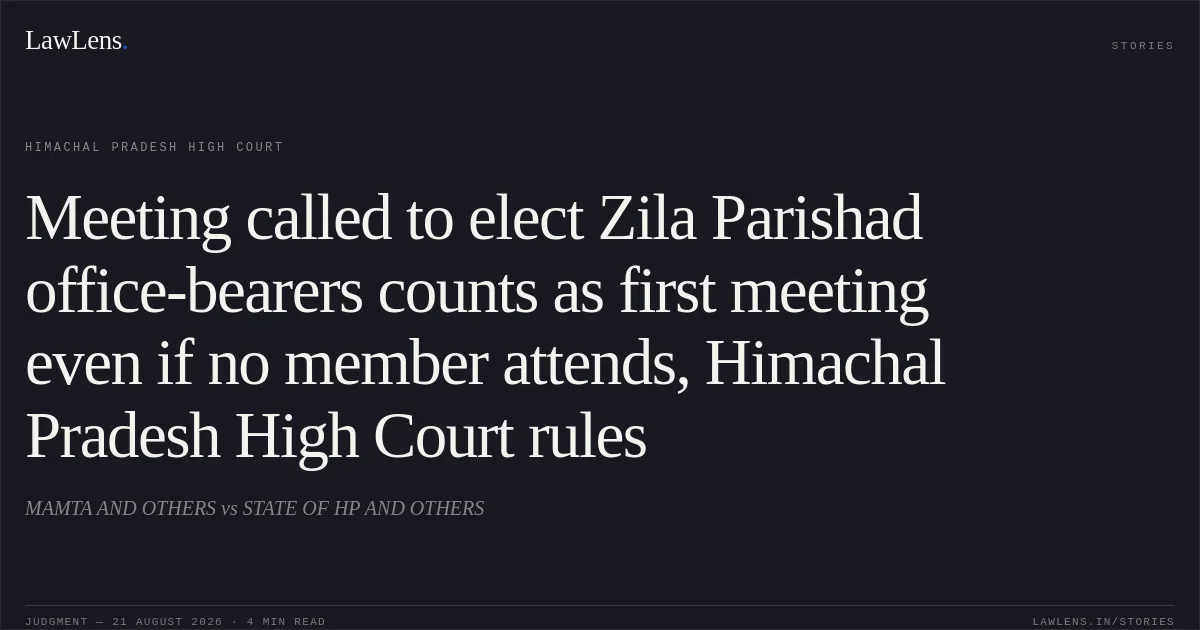
Source reference: pp.22–23However, the meeting fixed for 3 August was expressly notified for election of the Chairman and Vice-Chairman. Its adjournment, or even the absence of elected members, did not destroy its character as the first election meeting. Rule 86(4) contemplated precisely such a situation and prescribed the procedure for the second meeting after adjournment for want of quorum.
Source reference: pp.23–28Accordingly, the 10 September meeting was the second meeting and was governed by the simple-majority quorum requirement.
Source reference: pp.23–28Holding
The writ petition was disposed of with a direction to the Deputy Commissioner, Shimla, to issue the requisite notice and convene the meeting for election of the Chairman and Vice-Chairman of Zila Parishad, Shimla, on 10 September 2026.
The Court declared that the meeting scheduled for 3 August 2026 was the first election meeting and that the 10 September meeting was the second meeting; consequently, Rule 86(4) applied and the quorum for the latter was a simple majority of the total elected members.
Source reference: p.29The Deputy Commissioner was also authorized to take appropriate action under the Rules against members who failed to attend subsequent meetings, with the statutory consequences specifically mentioned in the notices.
Source reference: p.29The Court further directed circulation of the judgment to concerned authorities, emphasizing that failure to perform statutory duties could entail fixation of accountability.
Source reference: pp.29–30Acts & Sections Cited
16 provisions across 2 statutes referred to in this judgment. Linked provisions open on LawLens.
Himachal Pradesh Panchayati Raj Act, 1994
Oaths Act, 19691
Original Court PDF
MAMTA AND OTHERSvsSTATE OF HP AND OTHERS
Click to open original judgment
Original judgment, available to read, download and summarize on LawLens.in