Facts
The appellant claimed that on 30 January 2015 he was travelling from Bavla to Dhandhuka by Train No. 52939, holding a valid journey ticket, which was lost during the incident.
Source reference: pp. 1–2, paras. 3–3.1Near Lilapur-Serdi, he allegedly fell from the running train due to a jerk and jolt and sustained serious injuries.
Source reference: pp. 1–2, paras. 3–3.1He was taken by his family members to Karnavati Hospital, Ahmedabad, for treatment.
Source reference: pp. 1–2, paras. 3–3.1He claimed compensation of ₹4 lakhs under the Railways Act, 1989, relying on his affidavit and documentary evidence indicating that he had fallen from the train.
Source reference: pp. 1–2, paras. 3–3.1The Railway Claims Tribunal dismissed the claim on the ground that no railway ticket had been recovered from the appellant and that he had failed to establish that he was a bona fide passenger.
Source reference: pp. 2–3, para. 3.2The appellant challenged that decision before the Gujarat High Court.
Source reference: no citationIssues
1. Whether the mere absence or non-recovery of a railway ticket was sufficient to hold that the appellant was not a bona fide passenger under Sections 2(29) and 124A of the Railways Act, 1989?
Source reference: pp. 3–5, paras. 4–92. Whether the appellant’s fall from the running train constituted an “untoward incident” under Section 123(c)(2) of the Railways Act, 1989, giving rise to a claim for compensation?
Source reference: p. 5, para. 103. Whether the matter should be remanded to the Railway Claims Tribunal for determination of the just and fair compensation payable?
Source reference: pp. 5–6, paras. 9–13Law Applied
Section 124A of the Railways Act, 1989 imposes strict or no-fault liability on the Railway Administration for specified untoward incidents, subject to statutory exceptions, and the compensation provisions must receive a beneficial and liberal interpretation, as held in Union of India v. Prabhakaran Vijaya Kumar, (2008) 9 SCC 527.
Source reference: p. 5, para. 7Under Union of India v. Rina Devi, (2019) 3 SCC 572, the initial burden lies on the claimant to establish the relevant facts, which may be discharged by an affidavit; thereafter, the burden shifts to the Railways.
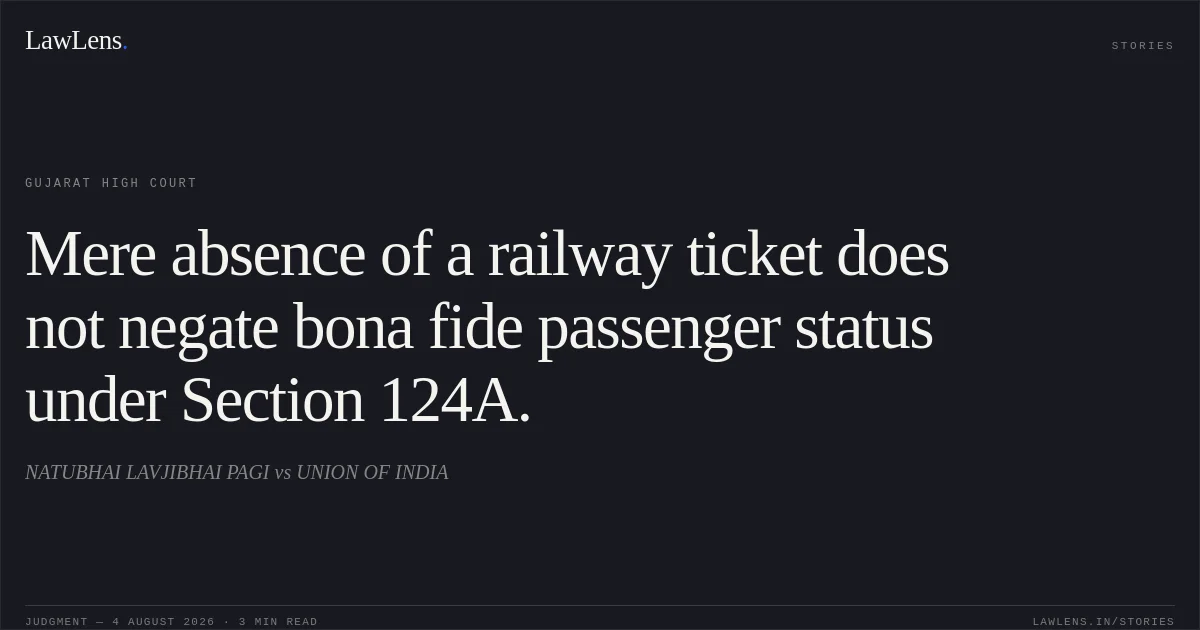
Source reference: pp. 3–4, para. 4Mere absence of a ticket does not, by itself, negate bona fide passenger status.
Source reference: p. 4, para. 5The same principle was reaffirmed in Doli Rani Saha v. Union of India, 2024 SCC 656, and Rajni v. Union of India, 2025 LiveLaw (SC) 986, which also held that proceedings under Section 124A are governed by the preponderance-of-probabilities standard and that hyper-technical reasoning should be avoided.
Source reference: pp. 4–5, paras. 5–6The appellant’s status as a bona fide passenger was considered in the context of Sections 2(29), 123(c)(2), and 124A of the Railways Act.
Source reference: pp. 3–5, paras. 3.2, 8–10Reasoning
The High Court held that the Tribunal had adopted an impermissibly hyper-technical approach by treating the non-recovery of the ticket as conclusive against the appellant.
Source reference: pp. 3–5, paras. 4–9The appellant had stated on oath that he was travelling with a valid ticket and had lost it in the accident; this discharged the initial evidentiary burden under Rina Devi.
Source reference: pp. 3–5, paras. 4–9The burden consequently shifted to the Railways to rebut his assertion through the facts and surrounding circumstances.
Source reference: pp. 3–5, paras. 4–9The Tribunal’s reliance on the absence of a ticket, without properly applying the Supreme Court’s binding principles, was therefore legally erroneous.
Source reference: pp. 3–5, paras. 4–9The Court further accepted that the appellant had established that he fell from the running train and that the incident fell within Section 123(c)(2) as an untoward incident.
Source reference: p. 5, paras. 7–10Applying the beneficial-object and strict-liability principles governing Section 124A, the Court concluded that the finding that the appellant was not a bona fide passenger could not stand.
Source reference: p. 5, paras. 7–10Since the Tribunal had dismissed the claim without assessing the quantum of compensation, the appropriate course was to remand the matter for that limited purpose.
Source reference: pp. 5–6, paras. 11–12Holding
The appeal was allowed.
The High Court quashed the Tribunal’s finding that the appellant was not a bona fide passenger and held that the incident was covered under Section 123(c)(2) of the Railways Act, 1989.
Source reference: p. 5, paras. 8–10The matter was remanded to the Railway Claims Tribunal, Ahmedabad Bench, for determination of the just and fair compensation payable to the appellant.
Source reference: pp. 5–6, paras. 11–14The Tribunal was directed to complete the exercise within eight weeks from receipt of the order, and the record and proceedings were ordered to be returned.
Source reference: pp. 5–6, paras. 11–14Acts & Sections Cited
2 provisions across 1 statute referred to in this judgment. Each provision opens on LawLens.
Railways Act, 19892
Original Court PDF
NATUBHAI LAVJIBHAI PAGIvsUNION OF INDIA
Click to open original judgment
Original judgment, available to read, download and summarize on LawLens.in