Facts
The defendant, a government contractor, executed a subcontract with the plaintiff on January 6, 1992, for the construction of police staff quarters in Mandvi, Kachchh.
Source reference: p. 2Upon completion, the plaintiff filed a civil suit (Special Civil Suit No. 27 of 1997) for recovery of ₹5,06,029/-, alleging outstanding principal on security deposits, unpaid running bills, and interest at 30% per annum.
Source reference: p. 2-3The defendant contested the interest claims and alleged outstanding sales tax dues but admitted in its written statement that ₹35,096/- was payable from the security deposit.
Source reference: p. 3The Trial Court (7th Additional Senior Civil Judge, Kachchh) partly decreed the suit for the admitted amount of ₹35,096/- with 6% interest.
Source reference: p. 4Issues
1. Whether the plaintiff proved the total suit claim of ₹5,06,029/- through cogent evidence and books of accounts.
Source reference: p. 5-6 / para. 92. Whether the documentary evidence at Exh. 106 (photocopy of accounts) was sufficient to establish legal liability.
Source reference: p. 7 / para. 10; p. 12 / para. 153. Whether the plaintiff was entitled to interest at the rate of 30% per annum in the absence of a contractual provision.
Source reference: p. 6-7 / para. 10Law Applied
The Court applied Sections 101 and 102 of the Indian Evidence Act, 1872, asserting that the burden of proof lies on the person who desires the court to give judgment on any legal right.
Source reference: p. 8-9 / para. 21It relied on Rangammal v. Kuppuswami (AIR 2011 SC 2344), which held that a plaintiff must establish their case on the strength of their own material and cannot rely on the weakness of the defense.
Source reference: p. 9 / para. 22-23The Court applied Section 34 of the Indian Evidence Act and the principle from Alumal Tahelram v. Mehthram Basarmal (1968 GLR 1078), stating that entries in books of account require independent corroboration (vouchers, receipts, or oral evidence) to hold a person liable.
Source reference: p. 13 / para. 16Reasoning
The High Court observed that the plaintiff failed to produce original books of account, bills, or vouchers to corroborate the claims for outstanding dues.
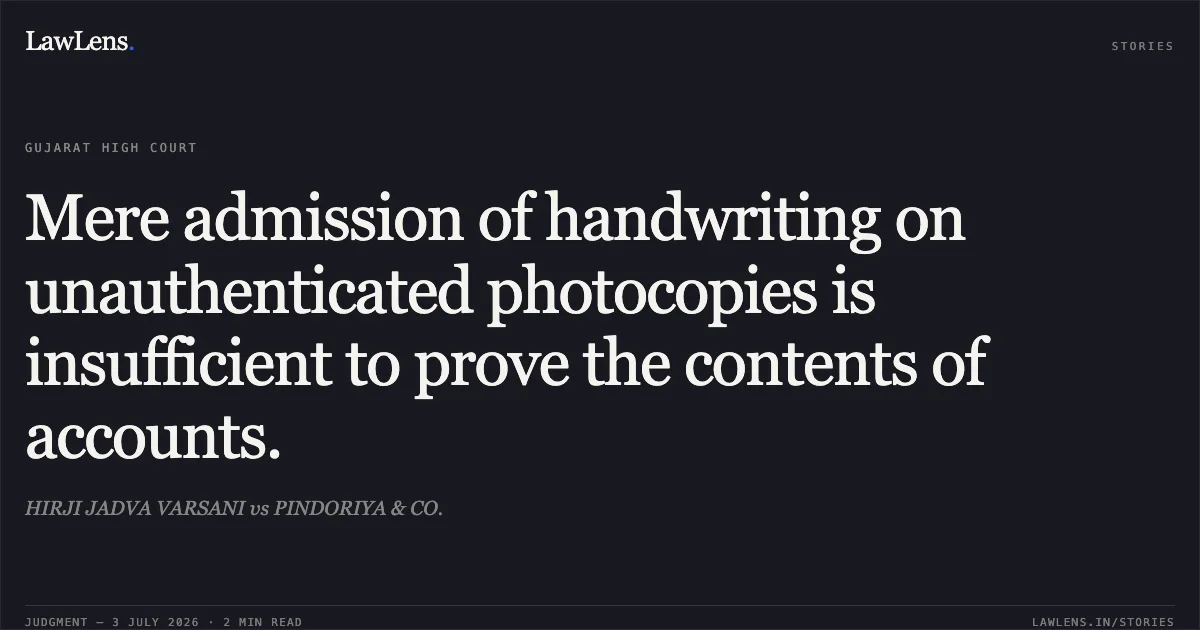
Source reference: p. 6 / para. 10Regarding Exh. 106—a photocopy of accounts allegedly in the handwriting of the defendant’s son—the Court held that mere admission of handwriting does not equate to an admission of the correctness of the contents.
Source reference: p. 12 / para. 15As a photocopy, it lacked the evidentiary value required under the "best evidence" rule.
Source reference: p. 12 / para. 15The Court highlighted a critical tactical error where the plaintiff's own counsel suggested to the defense witness that only ₹35,096/- was outstanding, which the witness admitted.
Source reference: p. 12 / para. 14The Court found no contractual basis for the 30% interest claim in the subcontract (Exh. 56).
Source reference: p. 13 / para. 17Holding
It held that the plaintiff failed to discharge the burden of proof for any amount exceeding the admitted liability.
The Court dismissed the appeal and upheld the Trial Court’s judgment directing the defendant to pay only ₹35,096/- with 6% interest per annum from the date of the suit till realization.
Source reference: p. 4 / para. 3.9; p. 14 / para. 18The R&P was ordered to be returned to the Trial Court.
Source reference: p. 14 / para. 19Acts & Sections Cited
1 provisions across 1 statute referred to in this judgment. Each provision opens on LawLens.
Code of Civil Procedure, 19081
Original Court PDF
HIRJI JADVA VARSANIvsPINDORIYA & CO.
Click to open original judgment
Original judgment, available to read, download and summarize on LawLens.in