Facts
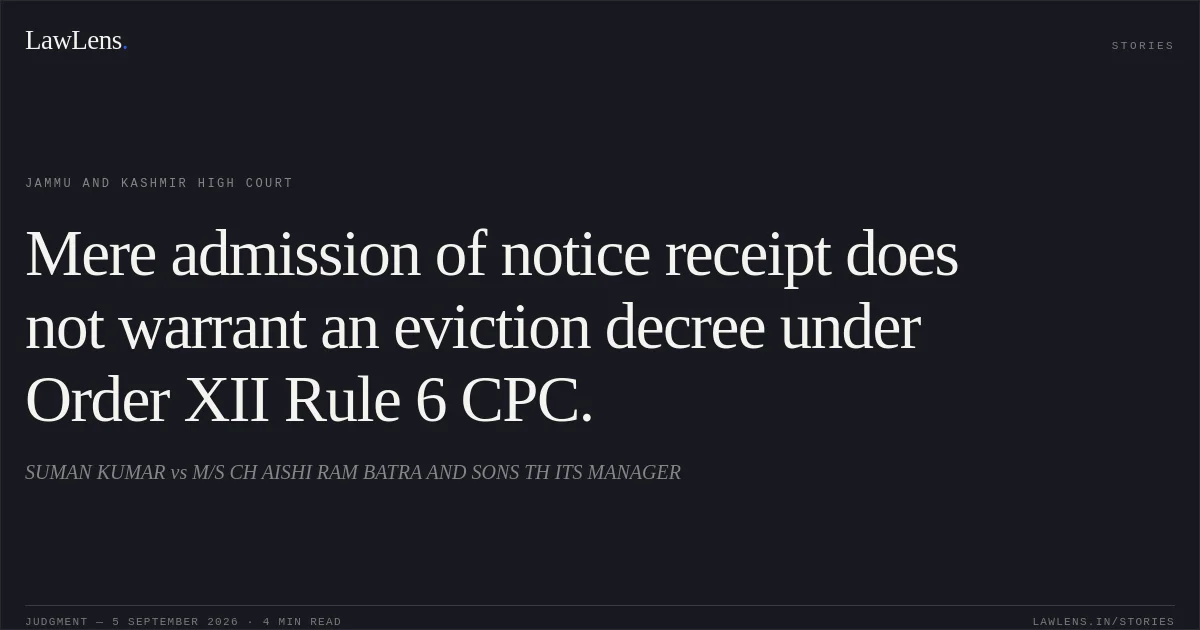
Suman Kumar, husband of the petitioner, instituted a suit for ejectment against the respondent from a shop at Exchange Road, Jammu, claiming that the premises were required to commence a business in association with his unemployed son and that the respondent was not carrying on any business therefrom.
Source reference: para. 2A notice dated 11 May 2017 was served upon the respondent requiring it to vacate the premises within thirty days; the respondent replied but did not hand over possession.
Source reference: para. 3The respondent contested the suit, asserting that the premises were licensed premises from which it operated a wholesale kerosene dealership under a licence issued by the Department of Consumer Affairs and Public Distribution.
Source reference: para. 4It also disputed the plaintiff’s alleged personal requirement and asserted that its own need for the premises was greater.
Source reference: para. 5The petitioner thereafter applied under Order XII Rule 6 CPC, contending that the respondent had admitted the landlord–tenant relationship and receipt of the notice under Section 106 of the Transfer of Property Act.
Source reference: para. 6The trial court rejected the application on 31 May 2025, holding that the alleged admissions were not sufficiently clear and unequivocal.
Source reference: para. 8The petitioner challenged that order in revision under Section 115 CPC.
Source reference: no citationIssues
Whether the respondent’s alleged admissions regarding the landlord–tenant relationship and receipt of the termination notice were clear, categorical and unconditional so as to justify a decree for eviction under Order XII Rule 6 CPC?
Source reference: paras. 12–15Whether the trial court’s refusal to pass a decree on admissions suffered from jurisdictional error, material irregularity or perversity warranting interference under Section 115 CPC?
Source reference: paras. 19–21Law Applied
Order XII Rule 6 CPC empowers the court, at any stage of a suit, to pronounce judgment on admissions of fact made in pleadings or otherwise, but the power is discretionary and is to be exercised only where the admission is clear, specific, unequivocal, unconditional and sufficient to entitle the party to judgment.
Source reference: para. 13In an ordinary suit for possession against a tenant not protected by rent-control legislation, the landlord ordinarily must establish the jural relationship of landlord and tenant and termination of the tenancy by efflux of time or a valid notice under Section 106 of the Transfer of Property Act.
Source reference: para. 14The Court relied on Karan Kapoor v. Madhuri Kumar , (2022) 10 SCC 496, and S.M. Asif v. Virendar Kumar Bajaj , (2015) 9 SCC 287, for the cautious and discretionary application of Order XII Rule 6 CPC; M/s Payal Vision Ltd. v. Radhika Choudhary , (2012) 11 SCC 405, concerning clear admissions of tenancy and termination; and Bhuvneshwar Prasad v. United Commercial Bank , AIR 2000 SC 2796.
Source reference: paras. 8–9, 14The Court also relied on Rajiv Ghosh v. Satya Narayan Jaiswal , 2025 INSC 467, holding that Order XII Rule 6 CPC is enabling and permissive, not mandatory, and that a court may insist on proof where it is unsafe to decide the matter solely on admissions.
Source reference: para. 22Under Section 115 CPC, revisional interference is limited to jurisdictional error, material irregularity or perversity; the revisional court cannot substitute its own view merely because another view is possible.
Source reference: paras. 20, 23Reasoning
The Court held that the respondent’s acknowledgment of receipt of the notice did not amount to an admission that the tenancy had been validly and lawfully terminated.
Source reference: para. 17Receipt of a notice and admission of its legal efficacy are distinct matters.
Source reference: para. 17The respondent had raised substantive defences concerning the nature and licensed use of the premises, the alleged absence of business activity, the plaintiff’s personal requirement, and the comparative requirement of the parties.
Source reference: paras. 16–18These pleas created disputed factual and legal questions requiring evidence and could not be treated as sham or ignored at the stage of an application under Order XII Rule 6 CPC.
Source reference: para. 18Since the trial court had applied the correct principles and concluded that the admissions were not unequivocal, its order did not disclose any jurisdictional error, material irregularity or perversity warranting revision.
Source reference: paras. 19–21Holding
The Court answered the issues against the petitioner.
The respondent’s alleged admissions were not sufficiently clear, categorical or unconditional to justify an immediate decree for eviction under Order XII Rule 6 CPC, and the trial court’s order did not warrant interference under Section 115 CPC.
Source reference: paras. 21, 24The revision petition was accordingly dismissed.
Source reference: no citationThe Court clarified that its observations were not an expression of opinion on the merits of the parties’ claims or defences and directed the trial court to decide the suit independently on the basis of the evidence led by the parties.
Source reference: para. 25Acts & Sections Cited
4 provisions across 2 statutes referred to in this judgment. Each provision opens on LawLens.
Code of Civil Procedure, 19082
Transfer of Property Act, 18822
Original Court PDF
SUMAN KUMARvsM/S CH AISHI RAM BATRA AND SONS TH ITS MANAGER
Click to open original judgment
Original judgment, available to read, download and summarize on LawLens.in