Facts
An audit found that the Appellant had not paid service tax on income from testing, calibration and certification services for October 2007 to January 2009.
Source reference: p.2A show-cause notice dated 8 September 2010 proposed a demand of ₹27,82,537 under the extended-period proviso to Section 73(1) of the Finance Act, 1994, along with interest and appropriation of amounts already paid.
Source reference: p.2The Appellant contended that it had paid the tax quantified by the Audit Superintendent, that the computation included services to SEZ units, and that the demand was based on its books and records, without suppression or intent to evade tax.
Source reference: pp. 3–5The adjudicating authority confirmed the demand, and the Commissioner (Appeals) upheld it.
Source reference: p.5The Appellant appealed to the Tribunal.
Source reference: p.5Issues
1. Whether the Revenue was justified in alleging suppression and invoking the extended period of limitation.
Source reference: p.62. Whether the tax demand was sustainable.
Source reference: p.6Law Applied
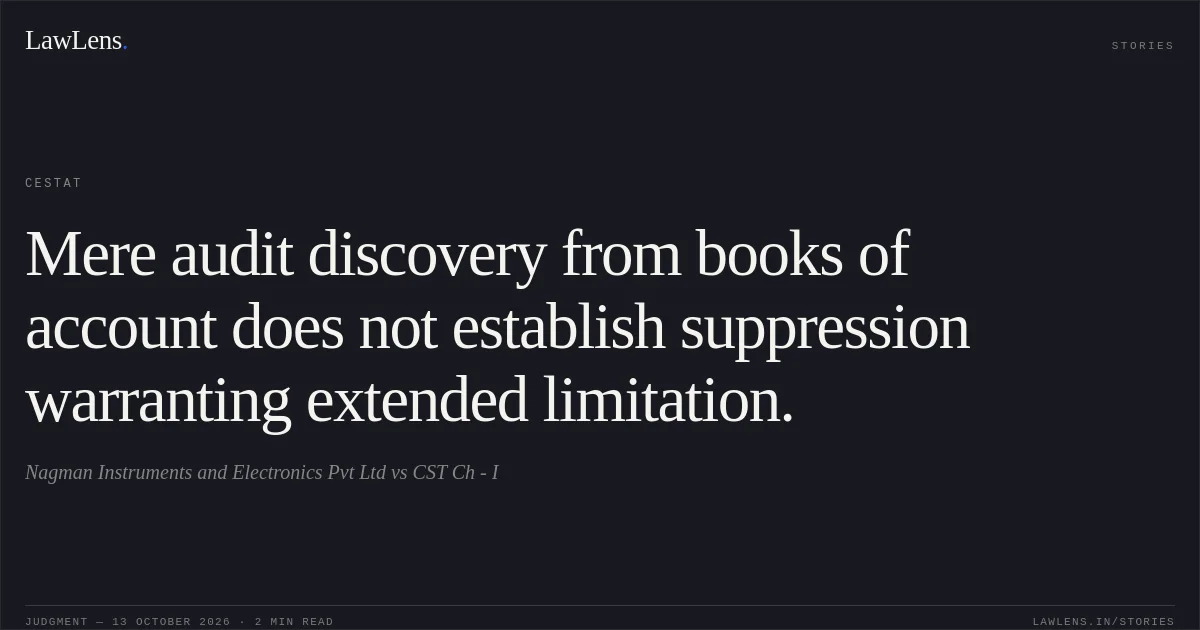
Under the proviso to Section 73(1) of the Finance Act, 1994, the extended period may be invoked where the statutory conditions, including suppression with intent to evade payment of tax, are established.
Source reference: pp. 7–8The Tribunal held that suppression must be established by the Revenue; mere non-payment or an allegation of suppression is insufficient to justify the extended period.
Source reference: pp. 7–8It relied on *Padmini Products v. Collector of Central Excise*, 1989 (43) ELT 195 (SC); *Uniworth Textiles Ltd. v. CCE, Raipur*, 2013 (288) ELT 161 (SC); and *CCE v. H.M.M. Ltd.*, 1995 (76) ELT 497 (SC), as supporting the requirement that the basis for invoking the extended period be justified.
Source reference: p.8Reasoning
The Tribunal noted that the Superintendent’s communication quantifying the liability pre-dated the show-cause notice and that the differential demand had been worked out through an audit and verification of the Appellant’s books and invoices.
Source reference: p.7The authorities had treated the late payment and the fact that the liability emerged on detailed audit verification as sufficient to infer deliberate suppression.
Source reference: pp. 7–8The Tribunal found that those circumstances did not establish factual suppression with intent to evade tax; the Revenue had not justified invoking the extended period.
Source reference: pp. 7–8Since the notice was issued beyond the normal period, the Tribunal did not separately determine the tax computation on its merits.
Source reference: p.8Holding
The Tribunal held that the demand could not be sustained because the show-cause notice was issued beyond the normal limitation period and the extended period had not been validly invoked.
It set aside the impugned order and allowed the appeal with consequential benefits, if any, in accordance with law.
Source reference: p.8Acts & Sections Cited
3 provisions across 1 statute referred to in this judgment. Linked provisions open on LawLens.
Finance Act, 19943
Original Court PDF
Nagman Instruments and Electronics Pvt LtdvsCST Ch - I
Click to open original judgment
Original judgment, available to read, download and summarize on LawLens.in