Facts
The petitioner, then Revenue Officer, Darbhanga Circle, was implicated along with a typist on the allegation that the petitioner’s service book had become untraceable and that an FIR should accordingly be registered against both officials.
Source reference: p.2, para. 4The petitioner contended that the service book was an official departmental record, that he was not its custodian, and that four service books had been duly handed over to the Circle Office through the concerned clerk.
Source reference: p.2–3, para. 5The Chief Judicial Magistrate, Darbhanga, took cognizance on 16 July 2018 of offences under Sections 406 and 409 of the Indian Penal Code.
Source reference: p.1, para. 2The petitioner consequently sought quashing of the cognizance order and the consequential criminal proceedings.
Source reference: p.1, para. 2Issues
Whether the materials on record disclosed the essential ingredients of criminal breach of trust under Sections 406 and 409 IPC, particularly entrustment or dominion over the service book and its dishonest misappropriation or conversion.
Source reference: p.4, paras. 7–8Whether continuation of the criminal proceedings and the cognizance order amounted to an abuse of the process of the Court warranting exercise of the High Court’s quashing jurisdiction.
Source reference: p.6–7, paras. 11–12Law Applied
Criminal breach of trust requires proof that the accused was entrusted with property or dominion over it, dishonestly misappropriated, converted, used, or disposed of it, and did so in violation of a legal direction or contract governing the trust.
Source reference: p.4–5, paras. 8, 10Section 409 IPC additionally requires that the entrustment or dominion arose in the accused’s capacity as a public servant, banker, merchant, agent, or other specified person.
Source reference: p.4, para. 8Relying on Deepak Gaba v. State of Uttar Pradesh, (2023) 3 SCC 423, the Court held that criminal proceedings cannot continue where the allegations, even if accepted as true, fail to disclose the basic ingredients of the alleged offence.
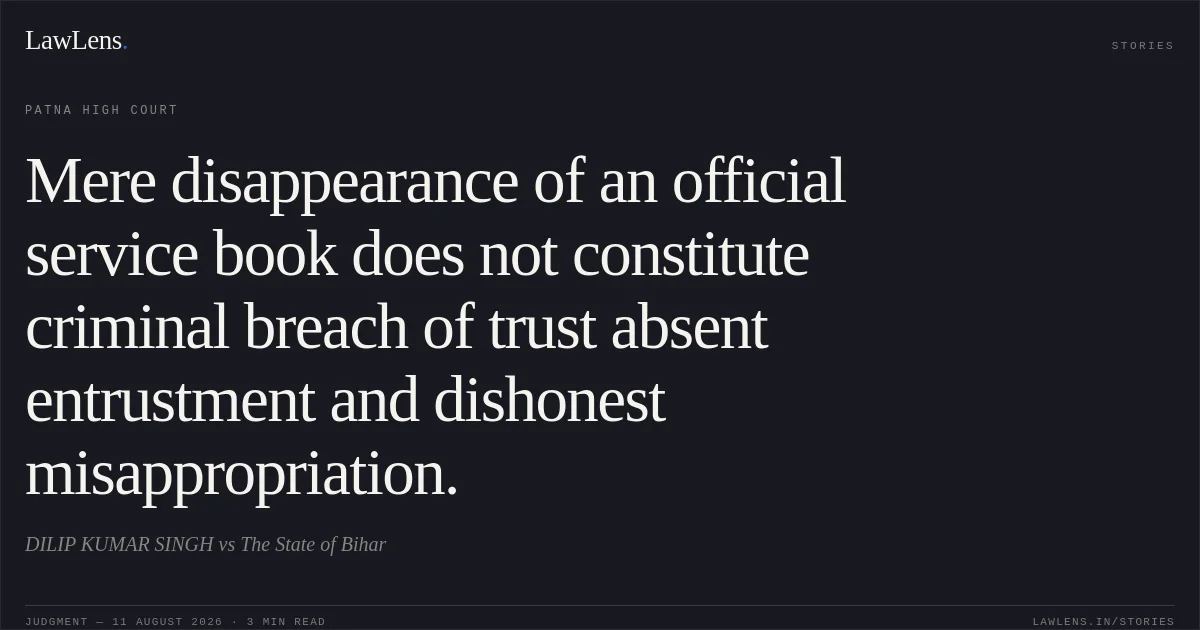
Source reference: p.4–6, paras. 9–10A mere missing official record, without material showing dishonest entrustment, misappropriation, conversion, use, or disposal, does not constitute criminal breach of trust.
Source reference: p.4, para. 7; p.6, para. 11Reasoning
The allegation against the petitioner was confined to the fact that his service book could not be traced.
Source reference: p.4, para. 7The record did not show that the petitioner had exclusive responsibility for its safe custody, or that he had dishonestly retained, misappropriated, converted, or used it for his own benefit.
Source reference: p.4, para. 7; p.6, para. 11On the contrary, the documents indicated that the service books had been received in the Circle Office and handed over through the concerned clerk, supporting the position that the record was maintained by the department rather than entrusted exclusively to the petitioner.
Source reference: p.3–4, para. 7Applying the requirements of Sections 405, 406, and 409 IPC as explained in Deepak Gaba, the Court found that the foundational elements of entrustment and dishonest misappropriation were absent.
Source reference: p.4–6, paras. 9–10The Magistrate had therefore taken cognizance without examining whether the collected materials disclosed the alleged offences, demonstrating non-application of mind.
Source reference: p.6, para. 11Holding
The Court held that the disappearance of the service book, without evidence of dishonest misappropriation or conversion by the petitioner, did not establish offences under Sections 406 or 409 IPC.
It consequently quashed and set aside the cognizance order dated 16 July 2018 and all consequential criminal proceedings against the petitioner in Sadar P.S. Case No. 198 of 2017, holding that their continuation would amount to an abuse of the process of the Court.
Source reference: p.6–7, para. 12The application was accordingly allowed.
Source reference: p.7, para. 13Acts & Sections Cited
3 provisions across 1 statute referred to in this judgment. Each provision opens on LawLens.
Indian Penal Code, 18603
Original Court PDF
DILIP KUMAR SINGHvsThe State of Bihar
Click to open original judgment
Original judgment, available to read, download and summarize on LawLens.in