Facts
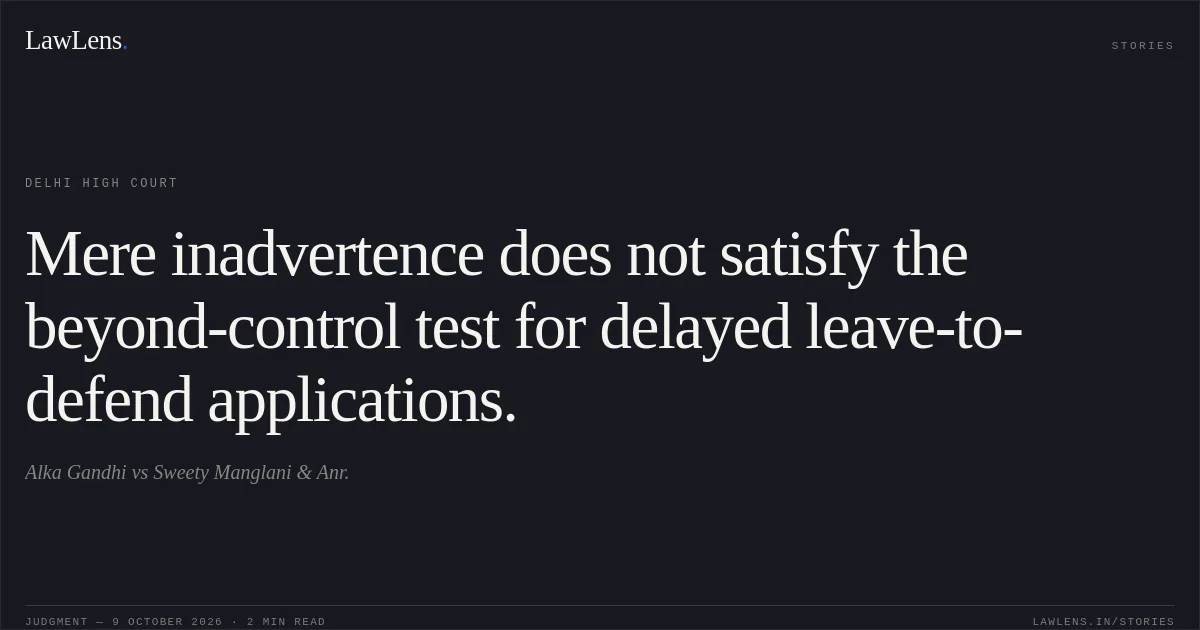
The Petitioner challenged orders of the Additional Rent Controller that declined to entertain her application for leave to defend, filed on 9 December 2025, and allowed the eviction petition.
Source reference: pp. 1–3; paras. 1–4She stated that summons were served on 10 November 2025 but were misplaced in her shop and discovered around 7 December 2025; she then contacted counsel and filed the application.
Source reference: pp. 1–3, 9–10; paras. 1–4, 15, 18–20The High Court considered whether her explanation for the delay warranted interference in revision.
Source reference: pp. 1–3, 9–10; paras. 1–4, 15, 18–20Issues
1. Whether the Petitioner showed circumstances beyond her control that prevented her from filing the leave-to-defend application within the prescribed period
Source reference: p. 9; paras. 15, 172. Whether the ARC’s orders disclosed an error warranting interference under the proviso to Section 25-B(8) of the Delhi Rent Control Act, 1958
Source reference: pp. 4–6, 10–11; paras. 9–14, 25–28Law Applied
Section 25-B of the Delhi Rent Control Act prescribes a summary procedure for eviction proceedings, including a limited period for filing an application for leave to defend; under Section 25-B(4), failure to apply within that period may result in eviction.
Source reference: pp. 4–6; paras. 9–14The proviso to Section 25-B(8) confers supervisory and revisional, not appellate, jurisdiction on the High Court: interference is limited to defects such as jurisdictional error, manifest illegality, material irregularity, perversity, or an error apparent on the record (*Abid-Ul-Islam v. Inder Sain Dua*; *Hindustan Petroleum Corporation Ltd. v. Dilbahar Singh*).
Source reference: pp. 4–6; paras. 9–14Under *Directorate of Education & Anr. v. Mohd. Shamim & Ors.*, a tenant seeking such interference after failing to apply for leave within time must satisfy a dual test: circumstances beyond the tenant’s control prevented timely filing, and the proposed defence presents a substantial case warranting consideration.
Source reference: pp. 6–9; paras. 16–17Reasoning
The Court found that the Petitioner admitted receipt of summons on 10 November 2025 and filed her application only on 9 December 2025.
Source reference: p. 9; para. 18Her account—that the summons were misplaced among garments and later discovered, after which she sought advice and collected documents—showed carelessness, inadvertence, or lack of awareness, rather than circumstances beyond her control.
Source reference: pp. 9–10; paras. 19–22The first limb of the *Directorate of Education* test was therefore not met.
Source reference: pp. 9–10; paras. 19–22The Court also found that the ARC had considered the service date, filing date, and applicable law; its decision-making process disclosed no reviewable error or perversity.
Source reference: pp. 10–11; paras. 23–27Because the first limb failed, the Petitioner’s proposed defence did not independently justify reopening the matter.
Source reference: p. 11; para. 27Holding
The Court held that the Petitioner had not shown circumstances beyond her control that prevented timely filing and that no ground for revisional interference was established.
It dismissed the revision petition and disposed of the pending applications.
Source reference: p. 12; paras. 28–30Acts & Sections Cited
1 provisions across 1 statute referred to in this judgment. Each provision opens on LawLens.
delhi rent control act, 19581
Original Court PDF
Alka GandhivsSweety Manglani & Anr.
Click to open original judgment
Original judgment, available to read, download and summarize on LawLens.in