Facts
The deceased, Rajeev, allegedly purchased a valid journey ticket from Dankaur to Ghaziabad and travelled by Train No. 64107, later corrected to Train No. 64152, on 14 November 2018.
Source reference: p.2, para. 1–3He allegedly fell from the running train between Boraki Halt and Dadri Railway Station, sustained fatal injuries, and died.
Source reference: p.2, para. 1–3The appellants pleaded that the journey ticket was lost during the accident.
Source reference: p.2, para. 1–3The Railway Claims Tribunal dismissed the claim, holding that the deceased was not proved to be a bona fide passenger and that the occurrence did not constitute an “untoward incident” under the Railways Act, 1989.
Source reference: p.2, para. 1–3The appellants challenged that decision under Section 23 of the Railway Claims Tribunal Act, 1987.
Source reference: p.2, para. 1–3The High Court also considered and condoned a 120-day delay in filing the appeal, having regard to the appellants’ economic circumstances and the beneficial nature of the legislation.
Source reference: p.1–2, paras. 1–6Issues
Whether the deceased was a bona fide passenger despite non-recovery of the journey ticket and amendments to the train number and direction of travel in the claim application.
Source reference: p.4, paras. 7–10Whether the deceased’s death resulted from an “untoward incident” within the meaning of Sections 123(c) and 124-A of the Railways Act, 1989, or whether he had been run over by an unknown train after coming upon the railway track.
Source reference: p.5–6, paras. 11–15Whether the appellants had shown sufficient cause for condonation of the 120-day delay in filing the appeal.
Source reference: p.1–2, paras. 1–6Law Applied
The Court applied Section 23 of the Railway Claims Tribunal Act, 1987, governing appeals from orders of the Railway Claims Tribunal, and Sections 123(c) and 124-A of the Railways Act, 1989, concerning “untoward incidents” and the resulting railway liability.
Source reference: no citationRelying on Union of India v. Rina Devi, (2019) 3 SCC 572, and Lata v. Union of India, 2026 SCC OnLine SC 1350, the Court held that the initial burden on claimants to establish bona fide passenger status is not onerous and may be discharged through attendant facts and circumstances; the burden then shifts to the Railways to rebut the claim by cogent evidence.
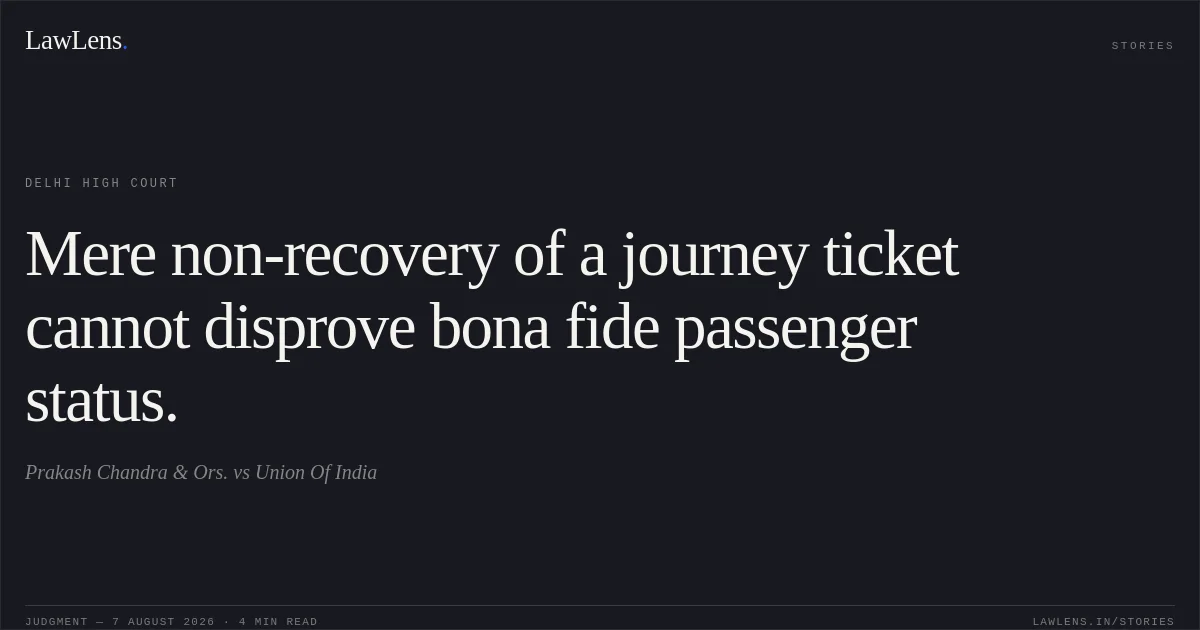
Source reference: p.4, para. 9Mere non-recovery of a ticket is insufficient, by itself, to disprove bona fide passenger status.
Source reference: no citationThe Court further relied on Sh. Surendra Prasad Verma v. Union of India, 2014 SCC OnLine Del 2917, for the principle that delayed discovery of a body does not, by itself, discredit a claim of accidental fall from a train, particularly absent evidence of another cause of death.
Source reference: p.5, para. 12Delay may be condoned where sufficient cause is shown, especially in matters involving beneficial legislation and economically disadvantaged claimants.
Source reference: p.1–2, paras. 3–5Reasoning
The Court held that the appellants’ consistent case was that Rajeev had been travelling by train and that the ticket had been lost in the accident; therefore, non-recovery of the ticket during the jamatalashi proceedings could not alone defeat the claim.
Source reference: p.4, para. 9Since the Tribunal had permitted correction of the train number and direction of travel, the amended pleadings—not the fact of amendment itself—had to be assessed on the evidence.
Source reference: p.4, para. 10The Tribunal’s inference that the deceased could not have fallen from the train because the body was discovered several hours later was unsupported by direct evidence: no loco pilots of the trains allegedly passing through the section were examined, and there was no proof that the body was not present near the track earlier.
Source reference: p.5–6, para. 12The DRM report also rested on statements merely recording discovery of the body; none of the witnesses had seen the deceased trespassing or being struck by a train.
Source reference: p.6, para. 13The contemporaneous panchnama and inquest records did not describe the occurrence as a run-over incident.
Source reference: p.6, para. 14Finally, the Tribunal’s reliance on the nature of the post-mortem injuries was speculative because the Railways produced no medical evidence showing that the injuries were inconsistent with a fall from a running train.
Source reference: p.6–7, para. 15In light of these deficiencies, the Court found that the deceased was a bona fide passenger and that the occurrence fell within the statutory concept of an untoward incident.
Source reference: no citationHolding
The Court allowed the application for condonation of delay and condoned the 120-day delay in filing the appeal.
On merits, it set aside the Tribunal’s judgment, holding that the deceased was a bona fide passenger and that his death resulted from an untoward incident under the Railways Act, 1989.
Source reference: p.7, para. 16The matter was remanded to the Railway Claims Tribunal to assess the compensation payable in accordance with law and to direct disbursement within two months of receipt of the High Court’s order.
Source reference: p.7, paras. 17–19The matter was directed to be listed before the Tribunal on 20 August 2026.
Source reference: p.7, paras. 17–19Acts & Sections Cited
3 provisions across 3 statutes referred to in this judgment. Each provision opens on LawLens.
Railway Claims Tribunal Act, 19871
Railways Act, 19891
Code of Criminal Procedure, 19731
Original Court PDF
Prakash Chandra & Ors.vsUnion Of India
Click to open original judgment
Original judgment, available to read, download and summarize on LawLens.in