Facts
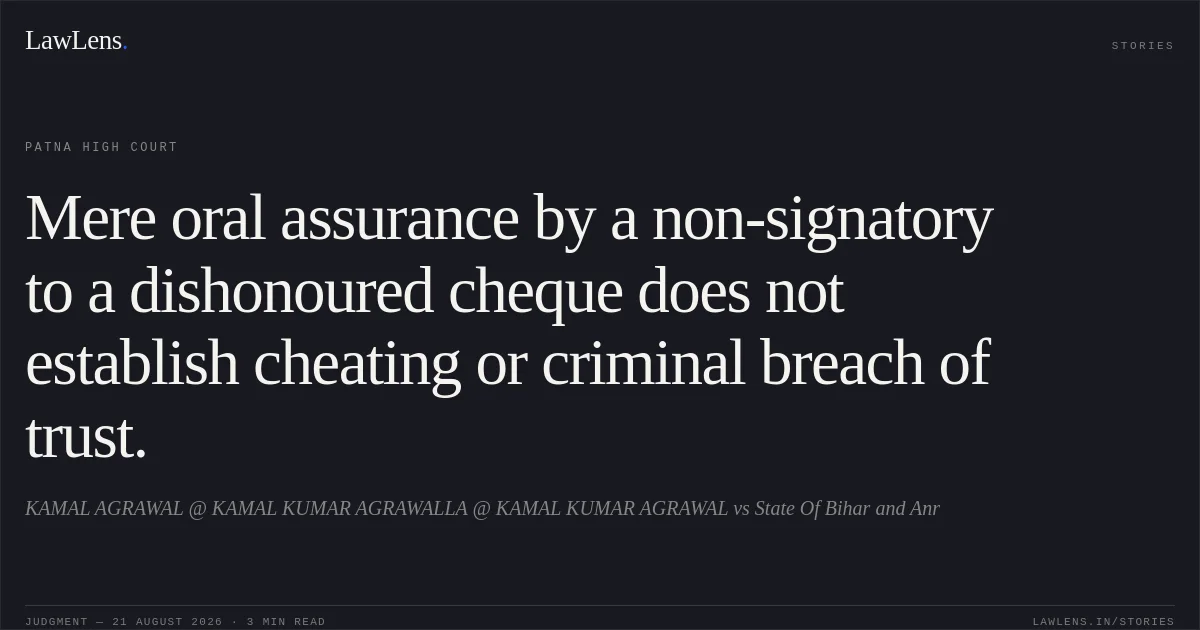
The complainant alleged that Ajit Kumar Mishra purchased iron bars for a project at Madhupur and requested supply against a cheque. The petitioner, described as Balaji’s C&F agent, allegedly gave telephonic assurance regarding payment. Relying on that assurance, the complainant supplied iron bars worth approximately ₹50,06,450 through several trucks. The cheque issued by Ajit Kumar Mishra was dishonoured on 28 July 2012 for insufficiency of funds, after which further assurances of payment were allegedly given
Source reference: pp. 2–3In Complaint Case No. 846 of 2012, the Chief Judicial Magistrate, Lakhisarai, took cognizance against the petitioner under Sections 420, 406 and 120-B of the Indian Penal Code by order dated 23 December 2016. The petitioner approached the High Court under Section 482 of the Code of Criminal Procedure seeking quashing of the cognizance order
Source reference: p. 1, para. 2Issues
Whether the allegations in the complaint disclosed the ingredients of cheating under Section 420 IPC against the petitioner, particularly in the absence of a specific allegation of fraudulent or dishonest intention at the inception of the transaction
Source reference: pp. 4–10, paras. 13–23Whether the petitioner could be prosecuted for criminal breach of trust and conspiracy merely because he allegedly gave an oral or telephonic assurance regarding payment, despite not being the signatory to the dishonoured cheque
Source reference: pp. 4, 11, paras. 4, 8Whether continuation of the criminal proceeding against the petitioner amounted to abuse of the process of court warranting exercise of inherent jurisdiction under Section 482 CrPC
Source reference: pp. 3–4, paras. 4–5Law Applied
The Court applied Sections 415 and 420 IPC, holding that cheating requires deception and fraudulent or dishonest inducement to deliver property, with the dishonest intention existing at the inception of the transaction
Source reference: pp. 4–5, paras. 14–16A subsequent failure to honour a promise or a mere breach of contract does not constitute cheating unless fraudulent intention at the time of the initial promise is shown, as recognised in G.V. Rao v. L.H.V. Prasad, Hridaya Ranjan Prasad Verma v. State of Bihar, Uma Shankar Gopalika v. State of Bihar, V.Y. Jose v. State of Gujarat and Vesa Holdings Pvt. Ltd. v. State of Kerala
Source reference: pp. 5–10, paras. 18–23The Court also relied on the principles in State of Haryana v. Bhajan Lal, 1992 Supp (1) SCC 335, concerning quashing where the allegations do not disclose an offence or where continuation of prosecution would amount to abuse of process
Source reference: p. 3, para. 4The Court followed Minar International Ltd. v. State of Bihar, 2017 (4) PLJR 431, as well as Rabindra Nath Tiwari v. State of Bihar, 2014 (4) PLJR 424 and Vir Prakash Sharma v. Anil Kumar Agarwal, (2007) 7 SCC 373, on the distinction between a civil or contractual dispute and criminal cheating
Source reference: pp. 3–4, para. 5Reasoning
The Court found that the petitioner’s alleged involvement was confined to an oral or telephonic assurance concerning payment. The principal transaction was between the complainant and co-accused Ajit Kumar Mishra, who had issued and signed the cheque; the petitioner was not the cheque signatory and was not shown to have participated in the supply transaction beyond the alleged assurance
Source reference: pp. 4, 11, paras. 4, 8Applying the rule that cheating requires dishonest intention from the beginning, the Court held that the materials did not disclose the petitioner’s fraudulent or dishonest intention at the inception of the transaction. The mere dishonour of the cheque and subsequent non-payment could not, without more, establish cheating, criminal breach of trust or conspiracy against the petitioner. Accordingly, the cognizance order, insofar as it related to the petitioner, was held to be unsustainable and its continuation would constitute an abuse of process
Source reference: pp. 5–10, paras. 17–23; p. 11, para. 8Holding
The High Court allowed the application and quashed the order dated 23 December 2016 taking cognizance in Complaint Case No. 846 of 2012 against the petitioner under Sections 420, 406 and 120-B IPC
The quashing was limited to the petitioner; proceedings against the other co-accused were expressly permitted to continue
Source reference: p. 11, para. 10Acts & Sections Cited
5 provisions across 2 statutes referred to in this judgment. Each provision opens on LawLens.
Indian Penal Code, 18604
Code of Criminal Procedure, 19731
Original Court PDF
KAMAL AGRAWAL @ KAMAL KUMAR AGRAWALLA @ KAMAL KUMAR AGRAWALvsState Of Bihar and Anr
Click to open original judgment
Original judgment, available to read, download and summarize on LawLens.in