Facts
The petitioner held Passport No. P4804091, valid from 28 September 2016 to 27 September 2026, and applied to the Regional Passport Officer, Lucknow, for re-issue of his passport after completing the prescribed formalities.
Source reference: para. 2During police verification, two criminal matters were reported: Case Crime No. 364 of 2018 under Sections 323, 504 and 506 IPC and provisions of the Scheduled Castes and the Scheduled Tribes (Prevention of Atrocities) Act, 1989, and Case Crime No. 2357 of 2013 under Section 13 of the Public Gambling Act.
Source reference: para. 3The Regional Passport Officer issued show-cause notices alleging that the petitioner had suppressed the pendency of these cases.
Source reference: para. 3The petitioner claimed that he had been acquitted in the 2018 case and that no charge-sheet or proceedings had been initiated against him in the Gambling Act case.
Source reference: para. 4The record concerning the Gambling Act case disclosed inconsistent orders: one order dated 8 September 2023 appeared to dispose of the case by composition, whereas another order dated 1 April 2026 recorded the petitioner’s confession, convicted him, and imposed a fine of ₹100.
Source reference: paras. 7–8Issues
Whether mere pendency of a criminal case disqualifies an applicant from obtaining re-issue of a passport under the Passports Act, 1967 and the applicable exemption framework.
Source reference: paras. 9–10Whether the petitioner had deliberately suppressed the pendency of criminal proceedings in his passport application, and whether that question could be decided without verifying the authoritative status of the cases from the concerned criminal courts.
Source reference: para. 10Whether the Passport Authority could insist upon a trial-court no-objection certificate merely because criminal proceedings were pending against the petitioner.
Source reference: paras. 6, 9–10Law Applied
The Court considered Section 6(2)(f) of the Passports Act, 1967, which permits refusal of a passport in specified circumstances involving pending criminal proceedings, read with the exemption-making power under Section 22 and Government Notification GSR 570(E) dated 25 August 1993.
Source reference: para. 9The governing principle is that the restriction is qualified and does not create an absolute bar against holding or renewing a passport merely because criminal proceedings are pending.
Source reference: para. 9The Court relied on Mahesh Kumar Agarwal v. Union of India, 2025 SCC OnLine SC 2887, which distinguishes possession of a passport from the act of travelling abroad: permission to travel is primarily for the criminal court to regulate, while the Passport Authority must determine the appropriate validity period in accordance with law.
Source reference: para. 9The Court further held that suppression requires proof of deliberate non-disclosure with knowledge of the relevant pending proceedings; every non-disclosure is not automatically suppression where the applicant bona fide believed that the case had concluded.
Source reference: para. 10Reasoning
The Court found that the Passport Officer had not yet reliably established the actual status of either criminal case.
Source reference: para. 10The police report concerning the 2018 case was illegible and did not clearly show whether it was a charge-sheet or a final report.
Source reference: para. 5The Gambling Act proceedings were also surrounded by contradictory court orders—one recording composition in 2023 and another recording conviction on confession in 2026—requiring careful scrutiny of the original judicial record.
Source reference: paras. 7–8Consequently, the Court directed the Passport Officer to verify the status of the cases through documentary material obtained from the competent criminal courts, rather than relying solely on unclear police reports.
Source reference: para. 10The Court separately distinguished the question of deliberate suppression from the question of pendency. Even if a case was pending when the application was made, the Authority had to determine whether the petitioner knowingly and intentionally failed to disclose it.
Source reference: para. 10Further, applying Mahesh Kumar Agarwal, the Court held that pendency alone could not justify refusal of passport re-issue or an insistence on a no-objection certificate.
Source reference: para. 9Holding
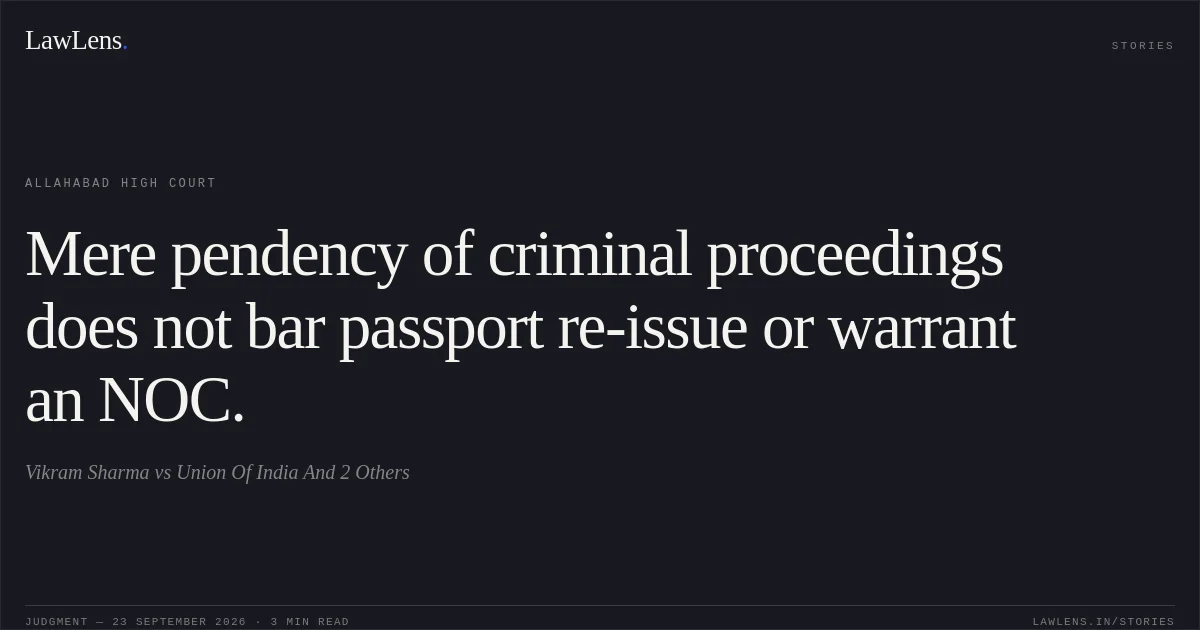
The Court held that mere pendency of a criminal case is not an automatic bar to re-issue of a passport, and that the Passport Authority could not insist upon a trial-court no-objection certificate solely on that ground.
However, the question whether the petitioner deliberately suppressed pending proceedings remained open.
Source reference: para. 10The Regional Passport Officer was directed to conduct a prompt and dependable inquiry, verify the status of both cases from the relevant court records, separately assess any deliberate suppression, and thereafter decide the passport application in accordance with Mahesh Kumar Agarwal and the applicable statutory framework.
Source reference: para. 10The petitioner was directed to appear before the Passport Officer with all relevant documents. The writ petition was accordingly disposed of.
Source reference: paras. 10–11Acts & Sections Cited
8 provisions across 5 statutes referred to in this judgment. Each provision opens on LawLens.
Indian Penal Code, 18603
Scheduled Castes and the Scheduled Tribes (Prevention of Atrocities) Act, 19891
Public Gambling Act, 18671
Code of Criminal Procedure, 19731
Passports Act, 19672
Original Court PDF
Vikram SharmavsUnion Of India And 2 Others
Click to open original judgment
Original judgment, available to read, download and summarize on LawLens.in