Facts
Seventeen accused allegedly ambushed three brothers near their residence, resulting in Virender Singh being shot dead and Santosh Singh (PW1), an injured eyewitness, sustaining lathi injuries.
Source reference: paras. 1–3, pp. 1–3The Trial Court convicted A1, A6, A12 and A13 under the relevant provisions of the IPC, while acquitting the remaining accused; A13 had subsequently been summoned under Section 319 CrPC.
Source reference: para. 3, p. 3The High Court upheld A1’s conviction but acquitted A6, A12 and A13, and affirmed the acquittal of the other accused.
Source reference: paras. 4–6, pp. 4–6The de facto complainant challenged the acquittals before the Supreme Court.
Source reference: no citationIssues
1. Whether A6’s alleged act of holding or dragging the deceased, while A1 fired the fatal shot, established his participation in the offence despite the absence of injuries to A6.
Source reference: paras. 9, 22–23, pp. 7–8, 17–182. Whether A12’s exhortation to shoot, consistently recorded in the First Information Statement and supported by the eyewitness testimony, established common intention or common object under Sections 34 or 149 IPC.
Source reference: paras. 10, 22, 24, pp. 8, 17–193. Whether the evidence establishing A13’s presence and possession of a firearm was sufficient to reverse his acquittal under Sections 302, 148, 149 or 34 IPC.
Source reference: paras. 7–8, 20–21, pp. 6–7, 16–174. Whether the acquittal of the remaining accused could be reversed on the basis of omnibus allegations of presence without proof of participation or specific roles.
Source reference: paras. 25, 28, pp. 19–22Law Applied
The Court applied Sections 302, 148, 149 and 34 IPC: murder is punishable under Section 302; membership of an unlawful assembly armed with a deadly weapon attracts Section 148; Section 149 may impose constructive criminal liability for offences committed in prosecution of the unlawful assembly’s common object; and Section 34 imposes joint liability for acts done in furtherance of common intention.
Source reference: paras. 7–11, pp. 6–9A person need not fire the fatal shot or perform the principal overt act if his participation in the unlawful assembly or common intention is proved from the evidence.
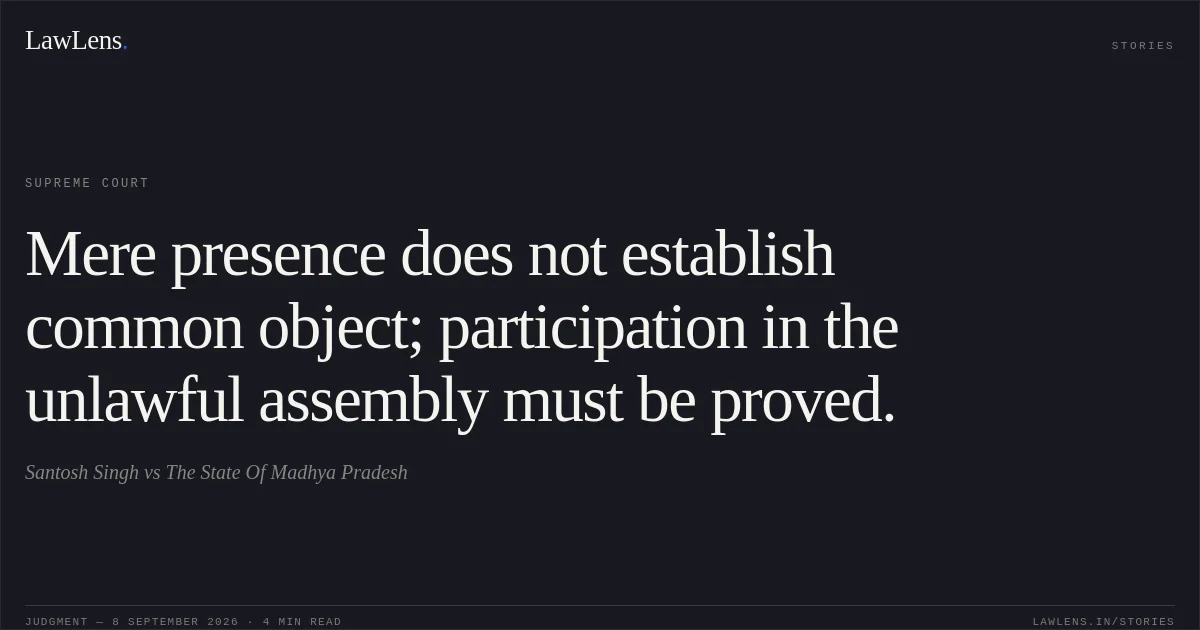
Source reference: para. 8, p. 7However, mere presence or an omnibus allegation is insufficient unless participation in the unlawful assembly is established beyond reasonable doubt.
Source reference: para. 28, pp. 21–22The Court also applied the principle that related witnesses cannot be discarded merely because of their relationship where their presence is natural, and that Indian courts must separate the truthful portion of testimony from exaggerations; the maxim falsus in uno, falsus in omnibus does not apply in India.
Source reference: paras. 19, 25–26, pp. 15–20An acquittal is not to be interfered with lightly, but appellate interference is justified where the acquittal rests on an erroneous appreciation of reliable evidence.
Source reference: para. 16, p. 12; para. 27, p. 21Reasoning
The Court found the prosecution evidence reliable insofar as it established the shooting, PW1’s presence and injury, and the participation of A6 and A12.
Source reference: no citationThe medical evidence was consistent with the eyewitness account and showed that the shot entered and remained within the deceased’s body; consequently, the High Court’s assumption that A6 would necessarily have been injured while holding the deceased was held to be speculative and unsupported by expert evidence.
Source reference: paras. 13–15, 22–23, pp. 10–12, 17–18A6’s act of holding or dragging the deceased during the shooting constituted a clear overt act in furtherance of the common design.
Source reference: para. 23, p. 18A12’s exhortation was recorded in the earliest FIS and consistently supported by the evidence, and the presence of sufficient light and the accused being known to the witnesses dispelled the identification objection; his conduct therefore established common intention under Section 34 IPC, and alternatively liability under Section 149 IPC.
Source reference: paras. 16, 22, 24, pp. 12–14, 17–19In contrast, the evidence against A13 was materially weakened because several witnesses did not mention him until after he was summoned under Section 319 CrPC, while PW10 and PW11 specifically denied his presence; the later testimony regarding his firearm and threats was treated as unreliable and possibly tutored.
Source reference: paras. 20–21, pp. 16–17The remaining accused were implicated only through general allegations of presence, without reliable proof of participation in the unlawful assembly or specific roles, and their acquittals therefore warranted no interference.
Source reference: paras. 25, 28, pp. 19–22Holding
The Supreme Court allowed the appeal against A6 and A12, reversed their acquittals, and restored the convictions and sentences imposed by the Trial Court.
It held that A6’s act of holding or dragging the deceased and A12’s exhortation demonstrated participation in the common intention or common object notwithstanding that A1 fired the fatal shot.
Source reference: paras. 23–24, pp. 18–19The Court sustained A13’s acquittal because the evidence against him was not substantively reliable.
Source reference: paras. 20–21, pp. 16–17It also upheld the acquittal of the remaining accused due to the absence of proof beyond reasonable doubt of their participation in the unlawful assembly.
Source reference: para. 28, pp. 21–22A6 and A12 were granted two weeks to surrender before the Sessions Court, failing which steps were directed to be taken for their apprehension.
Source reference: para. 29, p. 22Acts & Sections Cited
7 provisions across 2 statutes referred to in this judgment. Each provision opens on LawLens.
Code of Criminal Procedure, 19733
Indian Penal Code, 18604
Original Court PDF
Santosh SinghvsThe State Of Madhya Pradesh
Click to open original judgment
Original judgment, available to read, download and summarize on LawLens.in