Facts
The prosecution alleged that accused No. 1, who suspected the deceased Chandpasha of having an illicit relationship with his wife, and accused No. 2 followed the deceased’s autorickshaw and assaulted him with clubs and a stone, causing his death.
Source reference: pp. 4–6The prosecution relied on motive, evidence that the accused were seen following the deceased, recoveries of clubs and accused No. 1’s bloodstained clothes, and forensic evidence.
Source reference: pp. 6–7, 10–12The Sessions Court convicted both accused under Section 302 read with Section 34 IPC and sentenced each to life imprisonment.
Source reference: no citationThey appealed.
Source reference: no citationDuring the appeals, the State reported that accused No. 1 had died; his counsel stated that no legal representative had applied to continue the appeal.
Source reference: p. 4Issues
Whether the circumstantial evidence proved beyond reasonable doubt that accused No. 2 shared a common intention with accused No. 1 to murder the deceased and participated in the crime.
Source reference: pp. 12–14What order should follow in accused No. 1’s appeal after his death, where no legal representative had applied to continue it.
Source reference: p. 4; p. 14Law Applied
The Court considered the charge under Section 302 read with Section 34 IPC: Section 302 concerns punishment for murder, while Section 34 makes participants jointly liable where a criminal act is done in furtherance of their common intention.
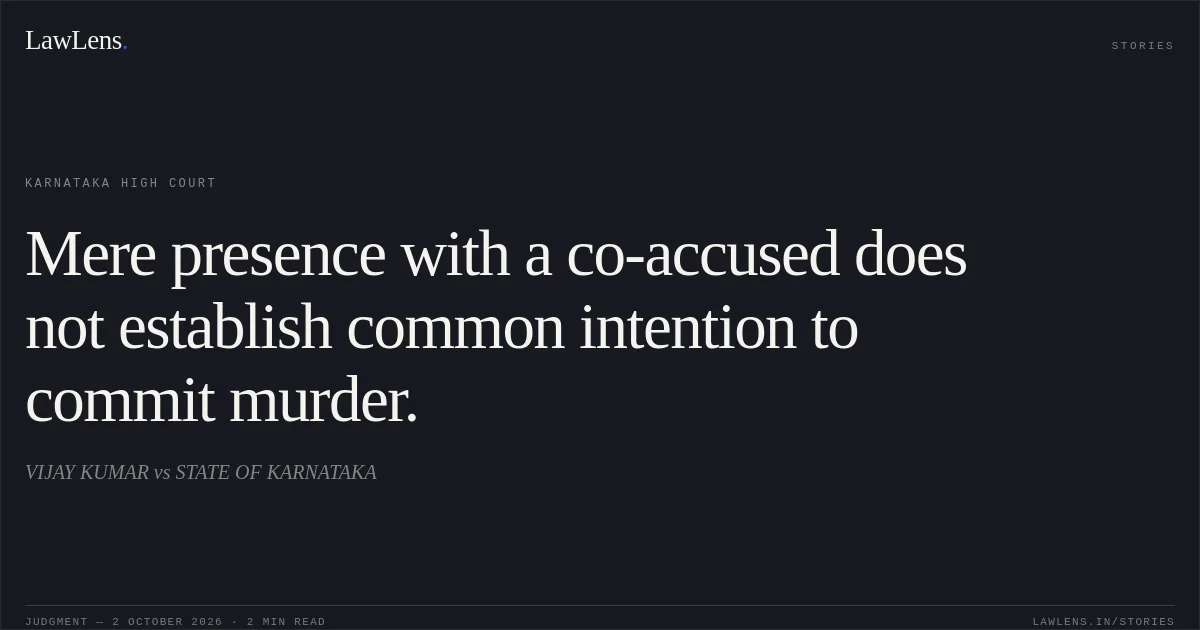
Source reference: pp. 12–14In a case resting on circumstantial evidence, the circumstances relied upon must establish the accused’s guilt beyond reasonable doubt; mere presence or association with another accused does not, without sufficient supporting evidence, establish participation or common intention.
Source reference: pp. 12–14Reasoning
The evidence and forensic findings supported the prosecution case against accused No. 1, including the motive, the recovery of his bloodstained clothes, and blood of the same group on those clothes, the clubs, and the deceased’s clothes.
Source reference: pp. 7–8, 10–12As to accused No. 2, the Court found no alleged motive, no bloodstained clothing or comparable incriminating material, and no evidence beyond his presence in the autorickshaw with accused No. 1.
Source reference: pp. 11–14The shopkeeper said to have sold the clubs had turned hostile, and the circumstances did not prove that accused No. 2 accompanied accused No. 1 to the scene or shared an intention to kill.
Source reference: pp. 11–14The Court therefore gave accused No. 2 the benefit of doubt.
Source reference: pp. 11–14Accused No. 1’s appeal was dismissed after the Court noted his death and the absence of an application by his legal representatives to continue the appeal.
Source reference: p. 4; p. 14Holding
The Court dismissed Crl.A. No. 574 of 2020, concerning accused No. 1, and allowed Crl.A. No. 839 of 2019, concerning accused No. 2.
It set aside accused No. 2’s conviction and sentence under Section 302 read with Section 34 IPC and acquitted him of that offence.
Source reference: pp. 14–15Acts & Sections Cited
3 provisions across 2 statutes referred to in this judgment. Each provision opens on LawLens.
Code of Criminal Procedure, 19731
Indian Penal Code, 18602
Original Court PDF
VIJAY KUMARvsSTATE OF KARNATAKA
Click to open original judgment
Original judgment, available to read, download and summarize on LawLens.in