Facts
The prosecution alleged that, after the Forest Department seized the petitioner’s tipper in connection with the unauthorised removal of soil, he went to the complainant’s office, abused him and obstructed him in performing official duties.
Source reference: para. 2–3, 29The Trial Court convicted the petitioner under Sections 353 and 504 of the Indian Penal Code (IPC) and sentenced him to imprisonment and fines; the Sessions Court dismissed his appeal and affirmed the conviction.
Source reference: para. 7–8The petitioner sought revision, contending, among other things, that the prosecution had not proved the ingredients of either offence.
Source reference: para. 9–10Issues
1. Whether the concurrent findings of conviction suffered from illegality, perversity or material irregularity warranting interference in revision.
Source reference: para. 152. Whether the prosecution proved the essential ingredients of Section 353 IPC, including assault or use of criminal force against a public servant with the requisite intent to prevent or deter the performance of official duty.
Source reference: para. 18–203. Whether the prosecution proved intentional insult with the intention or knowledge required by Section 504 IPC.
Source reference: para. 38Law Applied
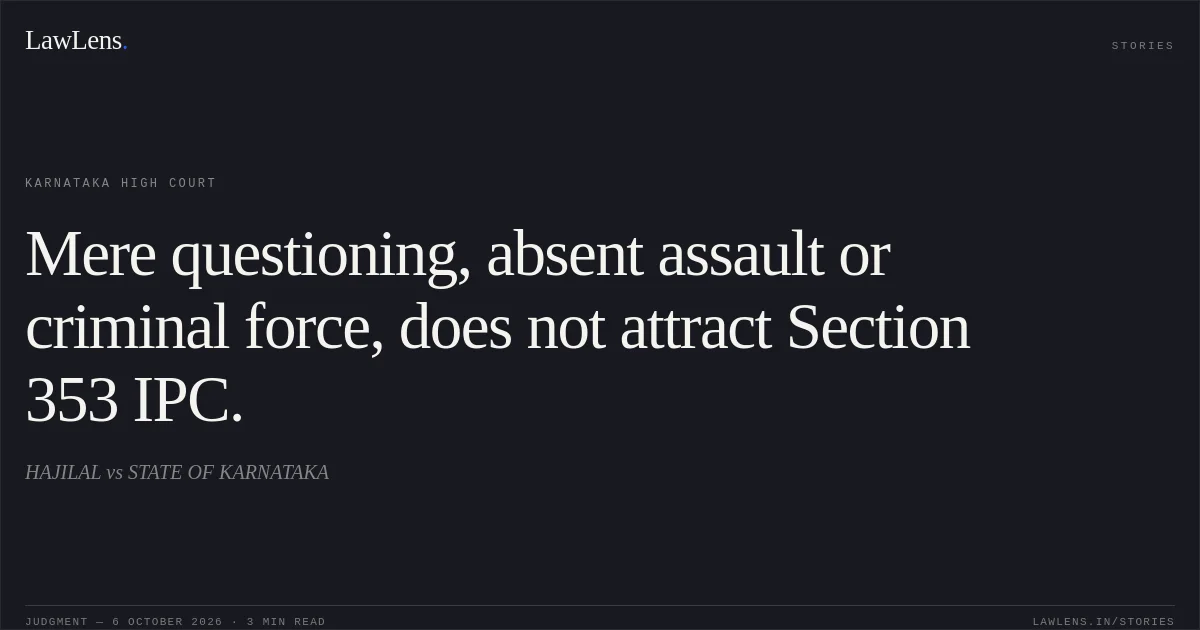
Section 353 IPC requires proof of assault or use of criminal force against a public servant, with the intention of preventing or deterring that person from discharging official duty.
Source reference: para. 18–20“Force” and “criminal force” are defined in Sections 349 and 350 IPC; criminal force requires intentional use of force without consent, with the specified purpose or likelihood of causing injury, fear or annoyance.
Source reference: para. 20Section 504 IPC requires intentional insult accompanied by the intention or knowledge that the provocation is likely to cause a breach of public peace or commission of another offence.
Source reference: para. 38In revision, concurrent findings are ordinarily not disturbed, but interference is warranted where findings are perverse, legally unsustainable or affected by manifest error resulting in miscarriage of justice.
Source reference: para. 36, 41The Court also referred to Mahendra Kumar Sonker v. State of Madhya Pradesh on the need to establish the ingredients of assault or criminal force for Section 353 IPC, and to a Karnataka High Court decision concerning evidence that the complainant was performing official duty at the relevant time.
Source reference: para. 32, 34Reasoning
The complaint and testimony indicated that the petitioner went to the complainant’s office after the vehicle seizure and questioned why his vehicle alone had been seized.
Source reference: para. 29–31The Court found no specific, cogent evidence that the petitioner assaulted the complainant or used criminal force with the intent to prevent or deter official duty; questioning the seizure, without more, did not establish Section 353 IPC.
Source reference: para. 29–31The complainant’s duty at the relevant time was also disputed, and the investigating officer had not verified the attendance register.
Source reference: para. 33–35As to Section 504 IPC, the Court found that the alleged abuse was not established by sufficiently reliable evidence and that the requisite intention or knowledge had not been proved.
Source reference: para. 38–39It therefore held that the convictions were unsustainable and that the deficiencies warranted revisional interference.
Source reference: para. 40–42Holding
The Court answered the revisional point in the affirmative and allowed the petition.
It set aside the Trial Court’s conviction and sentence and the Sessions Court’s affirming judgment, and acquitted the petitioner of the offences under Sections 353 and 504 IPC.
Source reference: no citationAny bail and surety bonds were discharged, and any fine deposited was ordered to be refunded in accordance with law.
Source reference: no citationActs & Sections Cited
7 provisions across 2 statutes referred to in this judgment. Each provision opens on LawLens.
Indian Penal Code, 18604
Code of Criminal Procedure, 19733
Original Court PDF
HAJILALvsSTATE OF KARNATAKA
Click to open original judgment
Original judgment, available to read, download and summarize on LawLens.in