Facts
The appellant, an Incharge Establishment Clerk in the office of the Block Development Officer, Larkipora, was alleged to have demanded ₹300 each from six Helpers for preparing and releasing arrears arising from their in-situ promotions.
Source reference: pp. 2–4The complainant, Bashir Ahmad Dar, lodged a complaint before the Vigilance Organization, Kashmir, alleging a total demand of ₹1,800.
Source reference: pp. 2–4A trap was laid on 10.09.2009; the appellant was allegedly seen accepting the money, which was subsequently recovered from the back pocket of his trousers.
Source reference: pp. 2–4His hands and trouser pocket allegedly turned pink on being washed in sodium carbonate solution.
Source reference: pp. 2–4After investigation and sanction for prosecution, the trial court framed charges under Sections 5(1)(d) read with 5(2) of the J&K Prevention of Corruption Act and Section 161 RPC.
Source reference: pp. 5–8The trial court convicted the appellant and sentenced him to two years’ simple imprisonment and a fine of ₹21,000, with six months’ further imprisonment in default.
Source reference: pp. 5–8The appellant challenged the conviction in the present appeal.
Source reference: no citationIssues
1. Whether the prosecution proved beyond reasonable doubt the initial demand of illegal gratification by the appellant
Source reference: paras. 11–22; pp. 9–152. Whether the alleged demand and acceptance of ₹1,800 during the trap proceedings were proved through reliable and legally sufficient evidence, particularly when the shadow witness did not see the transaction
Source reference: paras. 23–31; pp. 15–213. Whether mere recovery of tainted currency from the appellant’s trouser pocket, in the circumstances of the case, was sufficient to establish the offence of criminal misconduct
Source reference: para. 31; p. 214. Whether the trial court’s judgment was sustainable despite its contradictory and perverse findings regarding demand, acceptance and the evidence of the shadow witness
Source reference: paras. 32–35; pp. 22–25Law Applied
The Court applied Sections 5(1)(d) and 5(2) of the J&K Prevention of Corruption Act, holding that the prosecution must establish the initial demand of illegal gratification, demand and voluntary acceptance during the trap, and recovery of the tainted money.
Source reference: para. 12; p. 9It relied on Mir Mustafa Ali Hashmi v. State of Andhra Pradesh, (2024) 10 SCC 489, for the principle that the trap-laying officer should, wherever practicable, independently verify the alleged demand before initiating trap proceedings, particularly where the complainant may bear a grudge against the accused.
Source reference: paras. 19–22; pp. 13–15Under Prakash Chand v. State (Delhi Administration), (1979) 3 SCC 90, the uncorroborated testimony of a trap witness may be acted upon only where the court is satisfied that the witness is truthful and the circumstances justify reliance.
Source reference: para. 27; p. 18Relying also on M.O. Shamsudhin v. State of Kerala, (1995) 3 SCC 351, Ramesh Kumar Gupta v. State of M.P., (1995) 5 SCC 320, and Neeraj Dutta v. State (Govt. of NCT of Delhi), (2023) 4 SCC 731, the Court held that there is no absolute rule against relying on an uncorroborated complainant, but such evidence must be carefully scrutinised and may require direct or circumstantial corroboration depending on the facts.
Source reference: para. 28; pp. 18–19Reasoning
The Court found the initial demand doubtful because the five Helpers on whose behalf the alleged bribe was said to have been collected denied contributing money and denied that the appellant had demanded any gratification from them.
Source reference: paras. 13–18; pp. 10–13The complainant also contradicted his written complaint by denying that he had collected ₹300 from each associate.
Source reference: paras. 13–18; pp. 10–13The trap-laying officer failed to demonstrate any meaningful pre-trap verification of the alleged demand, despite evidence suggesting prior discord between the complainant and the appellant, including disputes concerning the engagement of the complainant’s brother and an alleged land dispute.
Source reference: paras. 19–22; pp. 13–15The shadow witness remained outside the room, did not see the exchange of money, and could not understand the conversation; the other trap witnesses likewise did not witness the transaction.
Source reference: paras. 24–26; pp. 16–18In view of the complainant’s demonstrated hostility and lack of corroboration, his testimony regarding demand and acceptance was held unsafe for reliance.
Source reference: paras. 29–31; pp. 19–21Once that testimony was disregarded, the recovery of money alone could not establish voluntary acceptance or criminal misconduct, particularly as the appellant had consistently stated that the money had been forcibly thrust into his pocket and had immediately protested false implication.
Source reference: paras. 29–31; pp. 19–21The trial court had itself noted several evidentiary deficiencies but nevertheless convicted the appellant, and its contrary findings regarding the shadow witness and proof of demand and acceptance were held perverse and internally inconsistent.
Source reference: paras. 32–35; pp. 22–25Holding
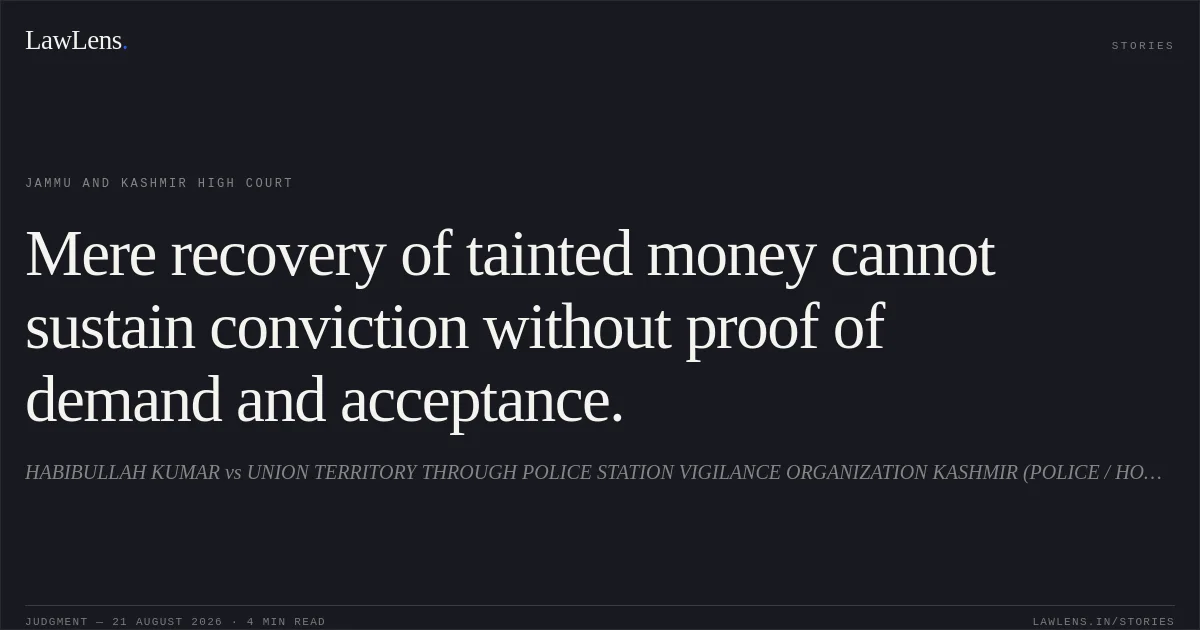
The Court held that the prosecution failed to prove the initial demand, the demand and voluntary acceptance during the trap, and the offence under Sections 5(1)(d) read with 5(2) of the J&K Prevention of Corruption Act beyond reasonable doubt.
The trial court’s judgment of conviction and sentence dated 21.08.2025 was set aside; the charge-sheet was dismissed and the appellant was acquitted.
Source reference: para. 36; p. 25His bail and surety bonds were directed to stand discharged, and the trial court record was ordered to be returned.
Source reference: para. 36; p. 25Acts & Sections Cited
5 provisions across 3 statutes referred to in this judgment. Linked provisions open on LawLens.
Prevention of Corruption Act, Svt. 2006 [Jammu and Kashmir]1
Ranbir Penal Code, 19891
Code of Criminal Procedure, 1989 (1933 A. D.)3
Original Court PDF
HABIBULLAH KUMARvsUNION TERRITORY THROUGH POLICE STATION VIGILANCE ORGANIZATION KASHMIR (POLICE / HOME)
Click to open original judgment
Original judgment, available to read, download and summarize on LawLens.in