Facts
The Appellant/Plaintiff was employed by the Respondent Company from 1993 until her resignation on 25.11.2003
Source reference: para. 3During the 2002-2003 financial year, the Respondent faced financial constraints and implemented a graded reduction in salaries for employees earning above ₹12,000 per month
Source reference: para. 4The Appellant, drawing ₹61,500, saw a 30% reduction (₹20,250/month) from April 2002 to March 2003
Source reference: para. 5She alleged that this was a "deferment" to be repaid by April 2003, along with a one-month "loyalty bonus"
Source reference: para. 6The Respondent contended the arrangement was a permanent "restructuring" of salary necessitated by business losses, not a deferment
Source reference: para. 13-14Following the dismissal of her suit by the Trial Court on 28.03.2024, the Appellant filed this Regular First Appeal
Source reference: para. 1, 23Issues
1. Whether the reduction of the Appellant’s salary during the Financial Year 2002-2003 constituted a "deferment" or a "restructuring" of the salary package.
Source reference: para. 18(iv), 422. Whether there existed a contractually enforceable obligation on the Respondent to pay the alleged deferred amount and a loyalty bonus.
Source reference: para. 18(v), 483. Whether the CEO’s individual correspondence could bind the Company to a financial liability in the absence of a Board Resolution.
Source reference: para. 53Law Applied
The court primarily applied the Code of Civil Procedure, 1908, under Section 96 read with Order XLI regarding the powers of the Appellate Court
Source reference: para. 1The court relied on the corporate law principle that an individual Director or CEO cannot bind a company to novel financial commitments or "contractual arrangements" without specific authorization/Board Resolution, citing Dale & Carrington Invt. (P) Ltd. v. P.K. Prathapan (2005) 1 SCC 212
Source reference: para. 25, 53The court also applied the principle of estoppel by conduct, noting that a full and final settlement executed at the time of resignation without protest precludes subsequent claims for arrears
Source reference: para. 47, 54Reasoning
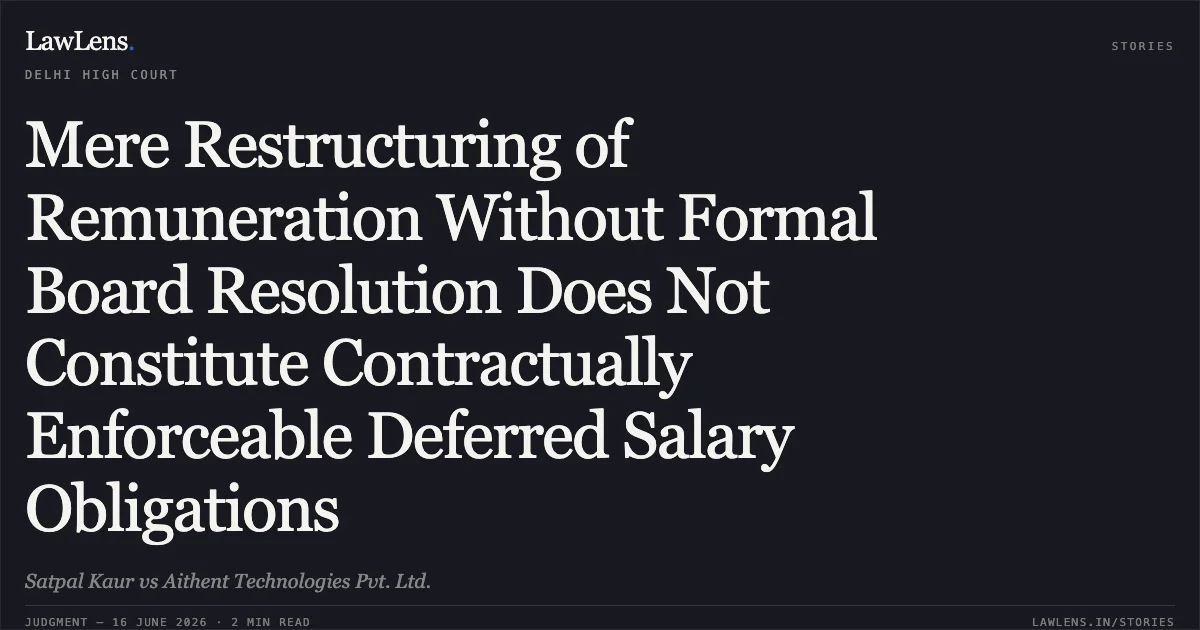
The court observed that while the salary was restored to its original level in April 2003, there was no documented Board Resolution or formal agreement characterizing the prior reduction as a "deferment"
Source reference: para. 44, 48Although the CEO’s letter (Ex. D-3) expressed a "commitment" to clear dues, it failed to quantify the amount or identify the nature of the debt as deferred salary
Source reference: para. 49-50Crucially, the court analyzed the Appellant's resignation documents (Ex. PW-1/D-1 and PW-1/D-2), which detailed the final settlement and were signed by the Appellant without any mention of or protest regarding outstanding deferred dues
Source reference: para. 45-47The court further reasoned that the Appellant’s failure to raise a contemporaneous claim at the time of her departure and the long delay in filing the suit suggested that no formal policy of deferment existed
Source reference: para. 54Holding
The Court answered the issues in the negative, holding that the Appellant failed to establish a contractual right to the recovery of the reduced salary or bonus
The Court held that human resource adjustments made during financial distress, unless backed by specific corporate authorization to repay, do not constitute an enforceable debt. Consequently, the High Court upheld the Trial Court's judgment, finding no merit in the appeal. The appeal was dismissed
Source reference: para. 53, 56Acts & Sections Cited
1 provisions across 1 statute referred to in this judgment. Each provision opens on LawLens.
Code of Civil Procedure, 19081
Original Court PDF
Satpal KaurvsAithent Technologies Pvt. Ltd.
Click to open original judgment
Original judgment, available to read, download and summarize on LawLens.in