Facts
The petitioner-company was issued a show-cause notice dated 15 March 2025 under Section 148A(1) of the Income-tax Act, 1961, proposing reopening of its assessment on the basis of a Suspicious Transaction Report prepared by the Deputy Director of Income Tax (Investigation).
Source reference: para. 2; p. 2The alleged suspicious transactions concerned frequent and repetitive credits and debits in the petitioner’s capital account with M/s Venus Infrabuild, a partnership firm in which the petitioner was a partner.
Source reference: para. 5; p. 4The petitioner replied on 31 March 2025, explaining that the transactions represented capital infusion and withdrawal and produced audited financial statements, partners’ capital accounts, tax-audit reports and other supporting documents.
Source reference: paras. 2, 5–7; pp. 2, 4–5The Assessing Officer nevertheless passed an order under Section 148A(3) dated 26 June 2025, concluding that income chargeable to tax amounting to ₹83,95,84,718 had escaped assessment, and issued a consequential notice under Section 148.
Source reference: paras. 2, 6; pp. 2, 5The petitioner challenged the show-cause notice, the Section 148A(3) order and the Section 148 notice before the Gujarat High Court.
Source reference: no citationIssues
1. Whether the Assessing Officer validly formed an opinion that income chargeable to tax had escaped assessment under Section 148A on the basis of the Suspicious Transaction Report and the transactions between the petitioner and its partner-firm?
Source reference: paras. 3.1–4.1, 7–9; pp. 2–4, 5–62. Whether the Section 148A(3) order was legally sustainable when it failed to properly consider the petitioner’s detailed reply and supporting documentary evidence?
Source reference: paras. 5–7; pp. 4–53. Whether withdrawal of a partner’s capital balance from the partnership firm, absent material showing bogus or accommodation transactions or otherwise taxable income, could constitute escapement of income?
Source reference: paras. 8–9; pp. 5–6Law Applied
The Court applied Sections 147, 148, 148A(1) and 148A(3) of the Income-tax Act, 1961.
Source reference: paras. 2–4, 7; pp. 2–4, 5Sections 147 and 148 permit reassessment only where there is legally sufficient information suggesting that income chargeable to tax has escaped assessment, while Section 148A requires the Assessing Officer to consider the assessee’s response and determine whether issuance of a notice under Section 148 is warranted.
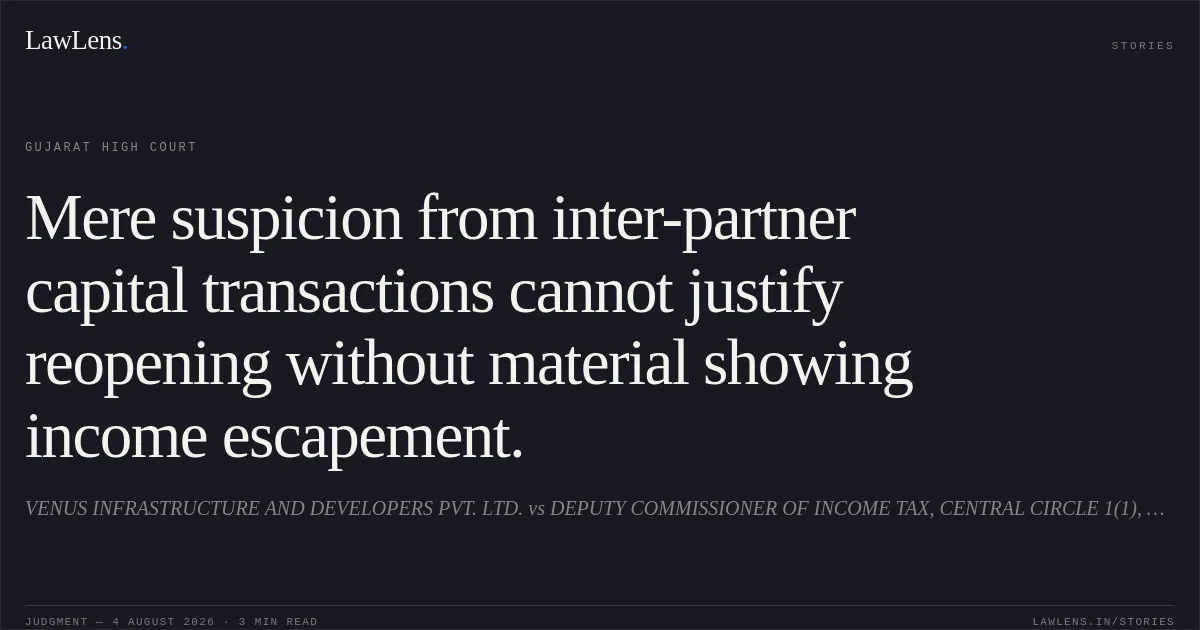
Source reference: paras. 2–4, 7; pp. 2–4, 5The Court applied the principle that mere suspicion, without relevant material demonstrating escapement of taxable income, cannot justify reopening an assessment.
Source reference: para. 9; p. 6It further held that the authority must meaningfully address the assessee’s explanation and documentary evidence, and that bona fide inter se transactions between partners involving withdrawal of capital balance do not, by themselves, constitute escapement of income.
Source reference: paras. 7–9; pp. 5–6Reasoning
The Court found that the Assessing Officer had failed to deal substantively with the petitioner’s reply and documents, merely referring to them while rejecting the explanation.
Source reference: para. 7; p. 5The documentary material showed that the disputed receipts represented withdrawal of the petitioner’s capital balance from the partnership firm, and not loans or unexplained income.
Source reference: para. 8; p. 5The Court further noted that the petitioner had not claimed any interest expenditure in its return in respect of the transactions, undermining the stated basis for alleging escapement of income.
Source reference: para. 8; p. 5Although the Revenue was entitled to investigate suspicious transaction patterns, the STR and the frequency of the transactions constituted only suspicion; there was no material, third-party statement or other evidence indicating that the transactions were bogus, accommodation entries or otherwise resulted in taxable income escaping assessment.
Source reference: para. 9; p. 6Accordingly, the statutory threshold for proceeding under Sections 148 and 148A was not satisfied.
Source reference: no citationHolding
The Gujarat High Court held that the withdrawal of capital balance by the petitioner, a partner of the firm, did not establish escapement of taxable income, particularly in the absence of material showing that the transactions were bogus or accommodation entries.
The Court quashed and set aside the impugned show-cause notices dated 26 June 2025, the orders passed under Section 148A(3), and the consequential notices under Section 148.
Source reference: para. 10; p. 6The connected writ petitions were consequently allowed.
Source reference: para. 10; p. 6Acts & Sections Cited
4 provisions across 1 statute referred to in this judgment. Linked provisions open on LawLens.
Companies Act, 19564
Original Court PDF
VENUS INFRASTRUCTURE AND DEVELOPERS PVT. LTD.vsDEPUTY COMMISSIONER OF INCOME TAX, CENTRAL CIRCLE 1(1), AHMEDABAD
Click to open original judgment
Original judgment, available to read, download and summarize on LawLens.in