Facts
The applicants invoked Section 482 of the Code of Criminal Procedure, 1973, seeking quashing of FIR II-C.R. No. 454 of 2014 registered at Kamrej Police Station, Surat Rural, for alleged offences under Sections 63, 65 and 69 of the Copyright Act, 1957.
Source reference: para. 1; p. 1The informant, an IPR consultant authorised by Taj Television (India) Pvt. Ltd., alleged that the applicants, operating Shivam Cable Network and Dev Shree Cable Network, retransmitted pay channels of Zee and Turner International at Kathor Village without authorisation.
Source reference: paras. 2, 7; pp. 2–3, 7–9The alleged retransmission was recorded during an inspection at a hotel on 26 December 2014, where channels including Cartoon Network, Pogo, HBO, CNN International, Zee Cinema and Ten Cricket were displayed with the Dev Shree Cable Network logo.
Source reference: para. 2; pp. 2–3The applicants contended that they had authority to broadcast the channels and that the dispute concerned only the territorial limits of transmission under the Digital Addressable System (DAS), rather than copyright infringement.
Source reference: paras. 3–6; pp. 3–5The respondent asserted that the applicants’ earlier agreement for Kathor had expired on 31 March 2013 and that subsequent arrangements authorised transmission only within the DAS area of Surat City, not Kathor Village.
Source reference: para. 7; pp. 7–9Issues
Whether the allegations in the FIR and the material placed on record disclosed a prima facie cognizable offence under Sections 63, 65 and 69 of the Copyright Act, 1957.
Source reference: para. 9; p. 10Whether the alleged retransmission of pay channels from the DAS area of Surat City into Kathor Village constituted criminal copyright infringement, or merely a regulatory, contractual or commercial dispute under the Cable Television Networks (Regulation) Act, 1995 and TRAI framework.
Source reference: paras. 10–17; pp. 10–12Whether continuation of the criminal proceedings would amount to an abuse of the process of the Court warranting exercise of inherent jurisdiction under Section 482 Cr.P.C.
Source reference: paras. 9, 15–17; pp. 10–12Law Applied
Section 482 Cr.P.C. empowers the High Court to quash criminal proceedings to prevent abuse of the process of the Court and secure the ends of justice.
Source reference: paras. 1, 9, 15Section 63 of the Copyright Act requires knowing infringement or abetment of infringement and, according to the Court, criminal liability requires deliberate and unauthorised piracy or signal theft, including the requisite mens rea.
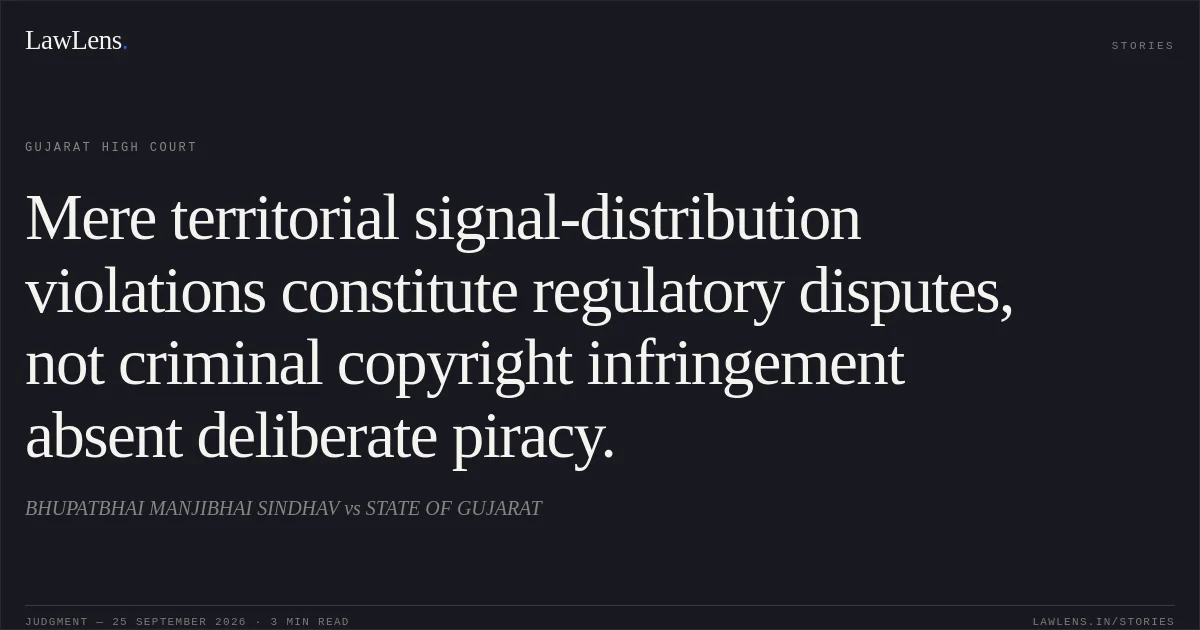
Source reference: para. 13; p. 11The Court distinguished regulatory breaches under the Cable Television Networks (Regulation) Act, 1995 and TRAI/DAS directions from criminal infringement under the Copyright Act, holding that territorial or transmission-limit violations may ordinarily constitute regulatory or contractual disputes rather than criminal copyright piracy.
Source reference: paras. 10–12; pp. 10–11The Court relied on the principles in State of Haryana v. Bhajan Lal, 1992 Supp (1) SCC 335, concerning quashing of proceedings where continuation of prosecution would amount to abuse of process, particularly where the dispute is essentially civil, contractual or commercial.
Source reference: para. 15; p. 12Reasoning
The Court found that the central dispute was whether the applicants were authorised to retransmit the channels in Kathor Village, which lay outside the notified DAS area of Surat City.
Source reference: paras. 10–12; pp. 10–11Broadcasting within Surat City was not disputed; the alleged illegality arose from the claimed territorial spillover into Kathor.
Source reference: paras. 10–12; pp. 10–11In the Court’s view, such a breach of territorial transmission conditions, even if established, was governed principally by the Cable Television Networks regime, TRAI directions and contractual remedies, and did not by itself establish deliberate copyright piracy.
Source reference: paras. 11–14; pp. 10–12The existence of a commercial relationship, prior agreements and payment or acceptance of subscription revenue weakened the allegation of the mens rea required for criminal liability under Section 63.
Source reference: para. 14; p. 12Accordingly, even accepting the FIR allegations at face value, the material disclosed a regulatory and commercial dispute rather than a cognizable offence under Sections 63, 65 and 69 of the Copyright Act.
Source reference: para. 17; p. 12Holding
The Court held that the allegations did not disclose a prima facie criminal copyright offence and that the dispute concerned territorial compliance under the DAS/TRAI framework and related commercial arrangements.
Continuation of the prosecution would therefore constitute an abuse of the process of the Court.
Source reference: para. 17; p. 12The application under Section 482 Cr.P.C. was allowed, and FIR II-C.R. No. 454 of 2014 registered at Kamrej Police Station, Surat Rural, together with all consequential criminal proceedings against the applicants, was quashed and set aside. Rule was made absolute.
Source reference: para. 18; p. 13Acts & Sections Cited
5 provisions across 2 statutes referred to in this judgment. Each provision opens on LawLens.
Code of Criminal Procedure, 19731
Copyright Act, 19574
Original Court PDF
BHUPATBHAI MANJIBHAI SINDHAVvsSTATE OF GUJARAT
Click to open original judgment
Original judgment, available to read, download and summarize on LawLens.in