Facts
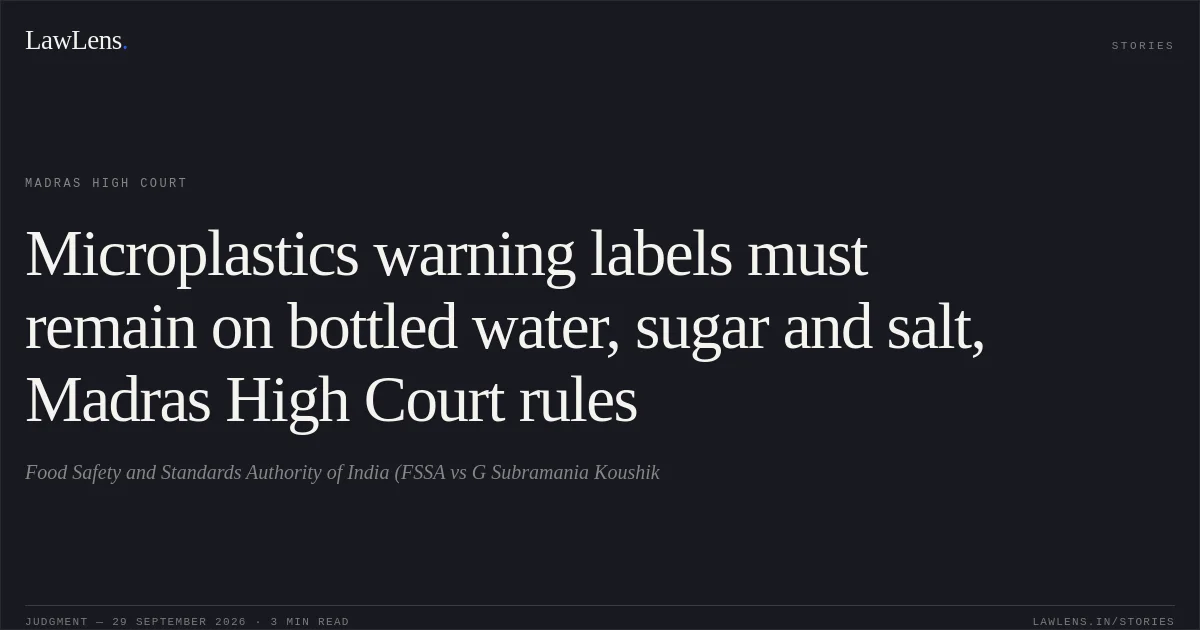
In the underlying writ petition, the Madras High Court directed that labels on plastic/PET-bottled water state, “This water may contain Micro/Nano Plastics,” and that labels on plastic-packaged sugar and salt carry a corresponding warning.
Source reference: para. 2–4The Court also directed the FSSAI to notify manufacturers and enforce the labelling requirement.
Source reference: para. 2–4PACE and the Federation of All India Packaged Drinking Water Manufacturers Association sought recall of the order; the FSSAI sought review.
Source reference: para. 5–7PACE’s special leave petition was withdrawn with liberty to approach the High Court, while the FSSAI’s special leave petition was withdrawn unconditionally.
Source reference: para. 5–7The Court heard the applications together and considered both maintainability and the merits, noting that the underlying matter was a continuing mandamus.
Source reference: para. 8Issues
1. Whether the order requiring micro/nanoplastics warnings on specified food labels should be reviewed or recalled as premature or disproportionate in the absence of conclusive evidence of harm to human health.
Source reference: para. 12–15, 25–372. Whether the presence of micro/nanoplastics in the products, and uncertainty about their source or health effects, justified the interim disclosure requirement.
Source reference: para. 26–343. Whether the FSSAI’s unconditional withdrawal of its special leave petition affected the maintainability of its review application.
Source reference: para. 7Law Applied
The Court considered Article 226 of the Constitution and Order 47 Rule 1 of the Code of Civil Procedure as the procedural bases invoked for review and recall.
Source reference: no citationUnder the Food Safety and Standards Act, 2006, Section 3(1)(u) defines a “hazard” by reference to a biological, chemical or physical agent with the potential to cause an adverse health effect; Sections 3(1)(zm), (zo), (zp) and (zq) address risk, risk assessment, risk communication and risk management.
Source reference: para. 27, 29–33Section 16 concerns the FSSAI’s standard-setting functions, including labelling standards.
Source reference: para. 27, 29–33Section 18 requires health and consumer protection to guide administration of the Act; it permits provisional risk-management measures where possible harm is identified despite scientific uncertainty, requires such measures to be proportionate and reviewed, and provides for public communication of risks and informed consumer choice.
Source reference: para. 27, 29–33The Court also relied on *3S and Our Health Society v. Union of India*, W.P. (Civil) No. 437 of 2024, as guidance for its approach to labelling and further study.
Source reference: para. 37The Court referred to *Satheesh V.K. v. Federal Bank Ltd.*, 2025 SCC OnLine SC 2046, concerning the finality and public-policy implications of abandoning a challenge after withdrawing an SLP.
Source reference: para. 7Reasoning
The Court treated the labelling direction as a disclosure measure, not a finding that bottled water, sugar or salt was unsafe.
Source reference: para. 25It noted that the applicants and the FSSAI did not deny the presence of micro/nanoplastics in the products, and held that uncertainty about their precise source or the extent of health effects did not remove the consumer’s interest in being informed.
Source reference: para. 26, 34Applying Section 18, the Court reasoned that scientific uncertainty did not preclude provisional risk-management action where a potential hazard and reasonable grounds for concern existed; disclosure supported risk communication and informed choice, and was less restrictive than prohibiting the products.
Source reference: para. 28–33, 36–37It therefore rejected the arguments that the measure was premature, disproportionate, or unsupported because other jurisdictions lacked comparable labels.
Source reference: para. 31–37Although it considered the FSSAI’s unconditional SLP withdrawal relevant to maintainability, it proceeded to examine the review on the merits because the underlying proceedings were a continuing mandamus and the connected recall applications were also being considered.
Source reference: para. 7–8Holding
The Court dismissed the FSSAI’s review application and the applications seeking recall of the 6 February 2026 order, finding no ground to review or recall the labelling directions.
The original directions remained subject to further hearings and continued scientific studies; there was no order as to costs, and the connected miscellaneous petitions were closed.
Source reference: para. 37–38Acts & Sections Cited
3 provisions across 1 statute referred to in this judgment. Each provision opens on LawLens.
Food Safety and Standards Act, 20063
Original Court PDF
Food Safety and Standards Authority of India (FSSAvsG Subramania Koushik
Click to open original judgment
Original judgment, available to read, download and summarize on LawLens.in