Facts
The appellant held a Scheduled Caste certificate issued in Uttar Pradesh in 1980, identifying her caste as Chamar.
Source reference: para. 2After marrying and migrating to Madhya Pradesh, she received a temporary certificate for the Ahirwar caste in 2007 but was refused a permanent certificate.
Source reference: para. 2The authorities found that her paternal family did not reside in Madhya Pradesh in 1950 and that she had migrated to the State; the Additional Collector upheld the refusal.
Source reference: para. 2, 9The Single Judge dismissed her writ petition, and she appealed, arguing that Chamar in Uttar Pradesh was equivalent to Ahirwar in Madhya Pradesh and that her migration followed marriage, not a pursuit of education or employment.
Source reference: para. 1, 3–6Issues
1. Whether a person who migrates from Uttar Pradesh to Madhya Pradesh upon marriage is entitled to an SC certificate in Madhya Pradesh on the basis of her caste status in Uttar Pradesh.
Source reference: para. 92. Whether that entitlement arises where the caste is claimed to be equivalent to a caste notified as SC in the State of migration.
Source reference: para. 5, 12–17Law Applied
Articles 341 and 342 of the Constitution provide for State- and Union Territory-specific Presidential lists of Scheduled Castes and Scheduled Tribes; those lists cannot be altered except by Parliament.
Source reference: para. 10–17In Marri Chandra Shekhar Rao v. Seth G.S. Medical College, (1990) 3 SCC 130, and Action Committee on Issue of Caste Certificate to SCs/STs v. Union of India, (1994) 5 SCC 244, Constitution Benches held that SC/ST status and its associated benefits are ordinarily confined to the State in relation to which the caste is notified; the same caste name in another State does not itself confer entitlement there.
Source reference: para. 10–17The Court also relied on Bir Singh v. Delhi Jal Board, (2018) 10 SCC 312, and on the three-Judge decision in Ranjana Kumari v. State of Uttarakhand, (2019) 15 SCC 664, which specifically held that a migrant is not entitled to recognition as an SC of the destination State merely because the same caste is notified there.
Source reference: para. 10–17Bhadar Ram v. Jassa Ram, (2022) 4 SCC 259, reaffirmed the application of this principle beyond education and employment.
Source reference: para. 10–17Reasoning
The Court treated the appellant’s move from Uttar Pradesh to Madhya Pradesh as inter-State migration and applied the rule that a person’s SC status in the State of origin does not carry over as status in the State of migration.
Source reference: para. 13–18It considered the appellant’s argument that Chamar and Ahirwar were equivalent, but held that even if the asserted equivalence were assumed, it would not establish entitlement to an Madhya Pradesh SC certificate.
Source reference: para. 13–18The Court relied particularly on Ranjana Kumari, which addressed the same-caste-in-both-States argument, and concluded that the appellant’s reason for migrating—marriage—and her stated intention to contest elections did not alter the governing rule.
Source reference: para. 13–18Holding
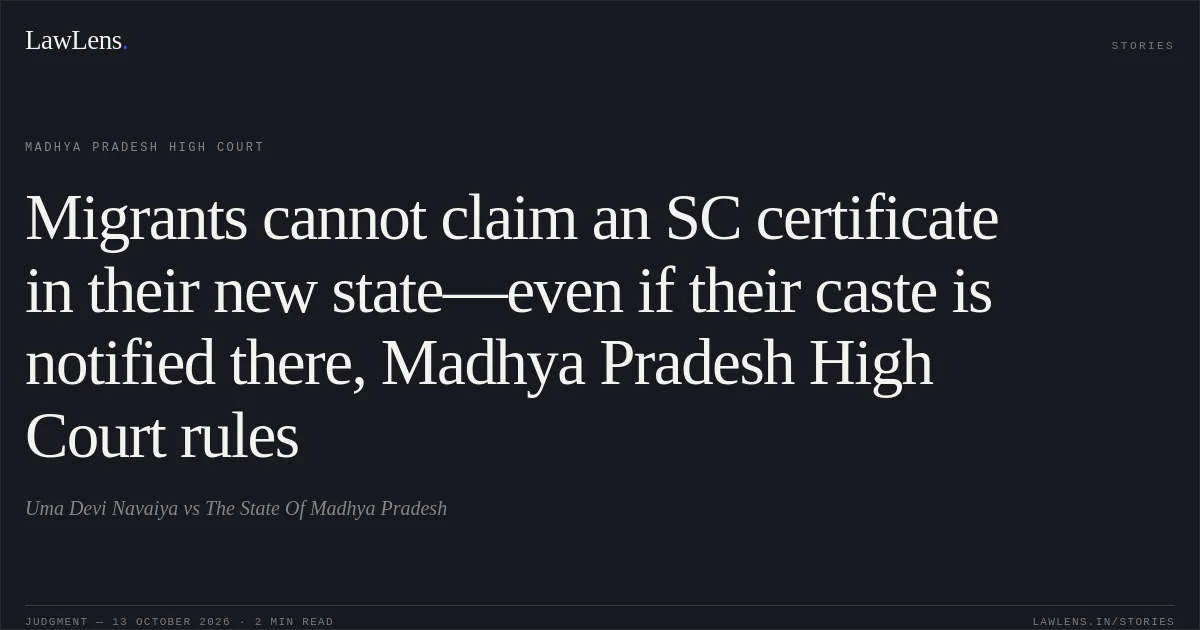
The Court held that the appellant was not entitled to an SC certificate in Madhya Pradesh based on her Uttar Pradesh status, even assuming the two caste names were equivalent.
Finding no illegality in the authorities’ refusal or perversity in the Single Judge’s order, it dismissed the writ appeal.
Source reference: para. 18–19Acts & Sections Cited
1 provisions across 1 statute referred to in this judgment. Linked provisions open on LawLens.
M.P. Uchcha Nyayalaya (Khand Nyayapeeth Ko Appeal) Adhiniyam, 20051
Original Court PDF
Uma Devi NavaiyavsThe State Of Madhya Pradesh
Click to open original judgment
Original judgment, available to read, download and summarize on LawLens.in