01Facts
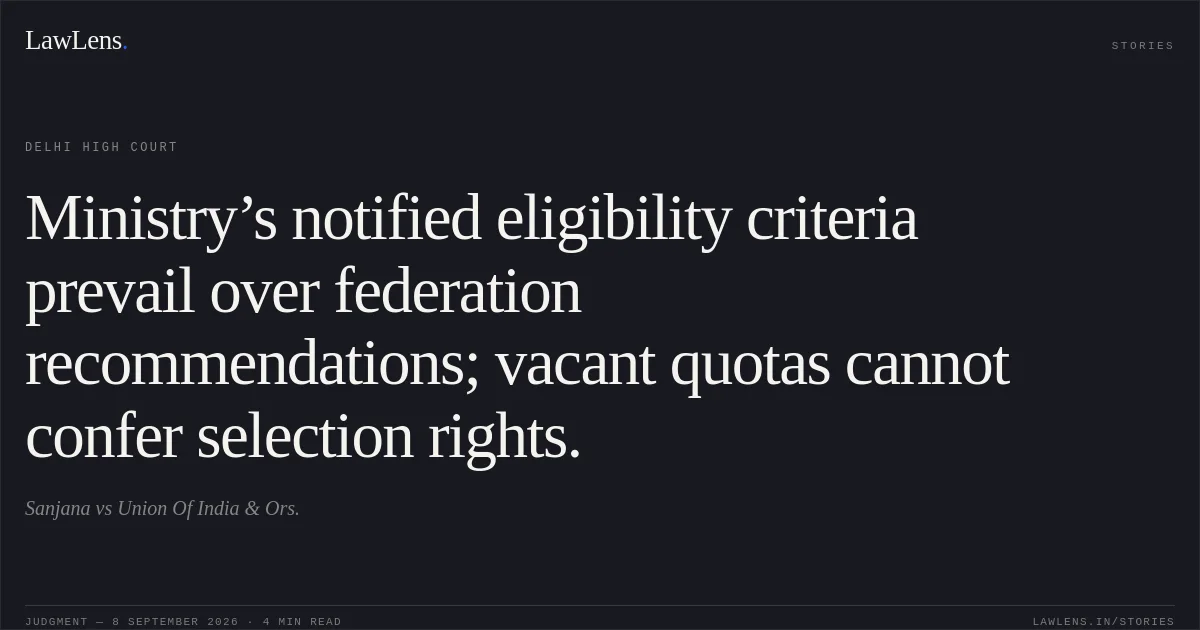
The petitioner, an Indian weightlifter competing in the Women’s 77 kg category, challenged the Ministry of Youth Affairs & Sports’ notification dated 22.08.2026, by which the Indian contingent for the 20th Asian Games, Aichi-Nagoya 2026, was approved without including her name.
¶ 1–4 · pp. 1–3The Ministry’s Selection Criteria dated 24.09.2025 required athletes in measurable individual events to meet prescribed performance benchmarks, with a special ranking cut-off where participation at the relevant Asian Championships was low.
¶ 10–13 · pp. 7–9The IWF’s sport-specific policy prescribed a benchmark total of 214 kg for the Women’s 77 kg category. The petitioner lifted 220 kg at the 2026 AWF Asian Senior Weightlifting Championships, securing third position, and was recommended by the IWF Selection Committee as one of five female athletes.
¶ 3, 14–15 · pp. 2–3, 9–10However, only five athletes participated in the relevant category, attracting the Ministry’s “top two” cut-off under Clause 6. The top two performances were 265 kg and 260 kg, whereas the petitioner’s total was 220 kg.
¶ 17–18 · pp. 11–12She therefore sought quashing of the notification and directions for forwarding and including her name in the final Asian Games contingent.
¶ 1 · p. 102Issues
i.Whether the petitioner satisfied the Ministry’s Selection Criteria for nomination to the Asian Games despite meeting the IWF’s sport-specific benchmark and receiving the IWF’s recommendation.
¶ 9 · p. 7ii.Whether Clause 6 of the Ministry’s Selection Criteria, prescribing a top-two cut-off where fewer than six countries participated, applied to the petitioner’s performance in the Women’s 77 kg category.
¶ 12–13, 17–20 · pp. 8–13iii.Whether the petitioner had an enforceable right to nomination because the IWF recommended five female athletes and one female slot remained unfilled.
¶ 21 · p. 13iv.Whether the Ministry’s exclusion of the petitioner was arbitrary, discriminatory, or otherwise amenable to interference under Article 226 of the Constitution.
¶ 22–24 · pp. 14–1603Law Applied
The Court applied Article 226 of the Constitution, under which judicial review of expert or executive selection decisions is limited to examining arbitrariness, irrationality, mala fides, discrimination, or violation of governing rules, and does not permit the Court to substitute its assessment for that of the competent authorities.
¶ 23 · pp. 14–15Clause 4.1(I)(b) of the Ministry’s Selection Criteria required an athlete, where an event was not contested at the preceding Asian Games but was held at the Senior Asian Championships within the preceding twelve months, to match or better the sixth-place performance at that Championship.
¶ 10–11 · pp. 7–8Clause 6 modified the applicable ranking cut-off in cases of low participation: where fewer than six countries participated, only a top-two finish would qualify for Asian Games eligibility.
¶ 12–13 · p. 8The Court treated the IWF’s sport-specific benchmark as operating at a separate stage from the Ministry’s criteria for national nomination.
¶ 14, 16, 19 · pp. 9–12It also relied on Yamini Mourya v. Indian Olympic Association, 2023 SCC OnLine Del 6213, for the principle that a writ court should not sit as an appellate authority over reasonable, good-faith decisions based on expert selection criteria.
¶ 23 · pp. 14–1504Reasoning
The Court held that the Women’s 77 kg event was not contested at the preceding Asian Games, making Clause 4.1(I)(b), rather than Clause 4.1(I)(a), applicable.
¶ 17 · p. 11Since fewer than six countries participated in the event at the 2026 Senior Asian Championships, Clause 6 required a top-two finish. The petitioner finished third with 220 kg, while the second-place athlete lifted 260 kg; accordingly, the petitioner did not meet the applicable Ministry benchmark.
¶ 18 · p. 12Her achievement of the IWF’s 214 kg benchmark and the IWF’s recommendation could not override the separate and mandatory Ministry criteria governing nomination to a multidisciplinary event.
¶ 19 · p. 12The Court harmoniously construed Clause 6 as a specific provision operating within the broader framework of Clause 4.1(I)(b), rather than as an independent or irrelevant provision.
¶ 20 · pp. 12–13The vacant fifth slot likewise did not create eligibility or an automatic right to selection, and the petitioner produced no evidence that similarly situated ineligible athletes had been nominated.
¶ 21–22 · pp. 13–14Applying the limited scope of judicial review, the Court found the Ministry’s application of the criteria rational, uniform, and consistent with the notified policy.
¶ 23–24 · pp. 14–1605Holding
The Court answered the issues against the petitioner.
It held that she did not satisfy the Ministry’s applicable eligibility criteria because she finished third in an event where the required cut-off was the top two, and that the IWF benchmark and recommendation did not displace the Ministry’s selection requirements.
¶ 18–20 · pp. 12–13The unfilled female slot did not confer an enforceable right to nomination, and no arbitrariness, discrimination, or other ground for interference under Article 226 was established.
¶ 21–26 · pp. 13–16The writ petition was accordingly dismissed, and no direction was issued to forward or include the petitioner’s name in the Asian Games contingent.
¶ 26–28 · p. 16Original Court PDF
SanjanavsUnion Of India & Ors.
Click to open original judgment
Original judgment, available to read, download and summarize on LawLens.in