Facts
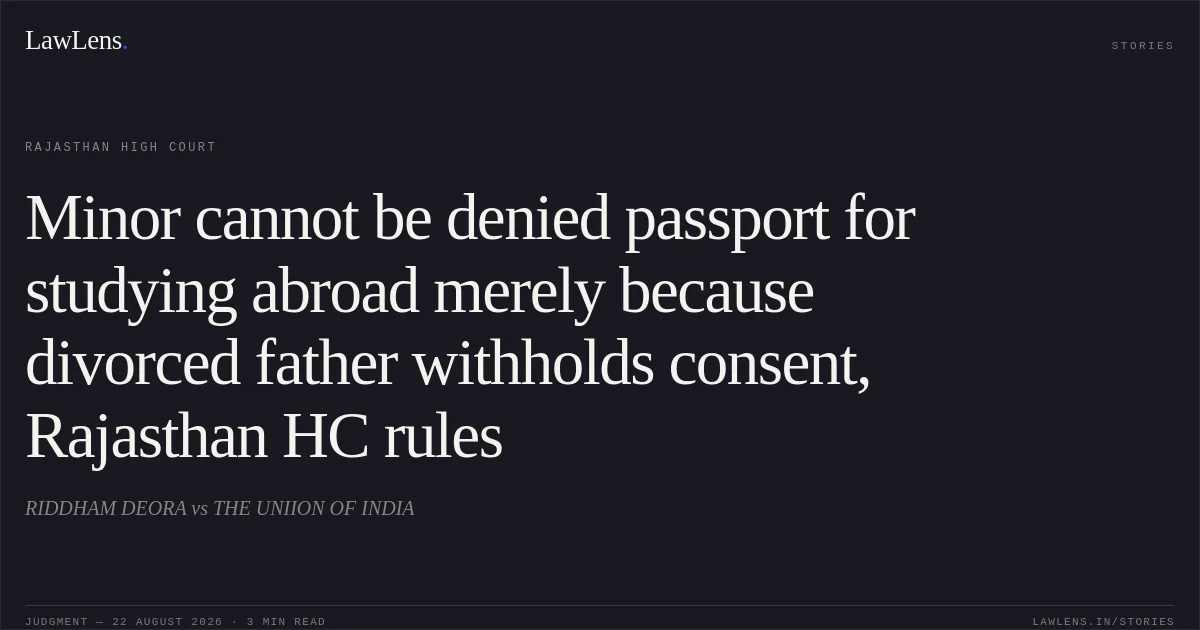
The minor petitioner, aged 17 years, applied through his mother for issuance of a passport to pursue studies abroad.
Source reference: paras. 3, 6His parents’ marriage was dissolved by the Family Court, Pali, on 9 June 2022, after the father’s petition for restitution of conjugal rights under Section 9 of the Hindu Marriage Act, 1955, was dismissed and the mother’s divorce petition under Section 13 was allowed.
Source reference: paras. 3, 6The petitioner had continuously remained in his mother’s custody; the father had neither sought custody under the Guardians and Wards Act, 1890 nor applied for visitation rights.
Source reference: para. 7The passport authorities refused to issue the passport because the father’s consent was not submitted, contending that the divorce decree did not expressly determine custody and that consent of both parents was therefore required.
Source reference: para. 4The petitioner challenged that refusal under Article 226 of the Constitution.
Source reference: paras. 1–2Issues
Whether the passport authorities could refuse to issue a passport to a minor merely because the consent of the non-custodial father was not furnished, despite the child being in the lawful custody of his mother?
Source reference: paras. 9–12Whether the petitioner’s right to personal liberty and to travel abroad for education under Article 21 could be denied on the technical ground that there was no specific judicial custody order or consent from both parents?
Source reference: paras. 12–15, 19Whether submission of an affidavit in the prescribed Annexure-C format could enable issuance of a minor’s passport where consent of the other parent could not be obtained?
Source reference: para. 15; L. Deepika extract quoted in para. 16Law Applied
The Court applied Article 21 of the Constitution, holding that the right to personal liberty includes the right to travel abroad and that such right may be restricted only by a just, fair and reasonable procedure established by law.
Source reference: para. 13The Court relied on the Passport Rules, 1980, particularly Schedule III and the prescribed Annexure-C affidavit, under which the parent applying for a minor’s passport may submit an undertaking where consent of the other parent cannot be obtained, without an inflexible requirement of prior court permission or consent from both parents.
Source reference: para. 15The Court followed L. Deepika v. Union of India, 2022 SCC OnLine TS 2481, which held that a passport could be issued to a minor upon submission of Annexure-C where the other parent’s consent was unavailable and no custody or guardianship proceedings had been initiated.
Source reference: para. 16The Court further applied the principle that parents are guardians and not owners of their children and that the child’s independent legal and constitutional interests cannot be subordinated to a parent’s refusal of consent.
Source reference: opening observation; paras. 17–19Reasoning
The Court found that the petitioner had been living with and was in the lawful custody of his mother, while the father had taken no legal steps to claim custody or visitation.
Source reference: para. 7The absence of an express custody direction in the divorce decree could not justify denial of the passport, particularly when the factual custody position was undisputed and the father had not pursued any competing claim.
Source reference: paras. 9–11Since the passport was required for the petitioner’s further education abroad, refusal on the sole ground of missing paternal consent would unjustifiably impair his Article 21 right to travel and his educational prospects.
Source reference: paras. 12–14, 17, 19The Passport Rules did not require the applicant to obtain a separate court order merely because the other parent withheld consent; Annexure-C provided the prescribed mechanism for proceeding without that consent.
Source reference: paras. 15–16Accordingly, insisting on the father’s signature constituted an overly technical and mechanical approach inconsistent with the constitutional right and the applicable passport procedure.
Source reference: paras. 17–19Holding
The Court held that the petitioner could not be denied a passport merely because his divorced father had not provided consent or because the Family Court had not passed a separate custody order.
The writ petition was allowed, and the passport authorities were directed to issue the petitioner’s passport forthwith without further delay.
Source reference: para. 20Pending applications, if any, were disposed of.
Source reference: para. 21Acts & Sections Cited
2 provisions across 1 statute referred to in this judgment. Each provision opens on LawLens.
Hindu Marriage Act, 19552
Original Court PDF
RIDDHAM DEORAvsTHE UNIION OF INDIA
Click to open original judgment
Original judgment, available to read, download and summarize on LawLens.in