Facts
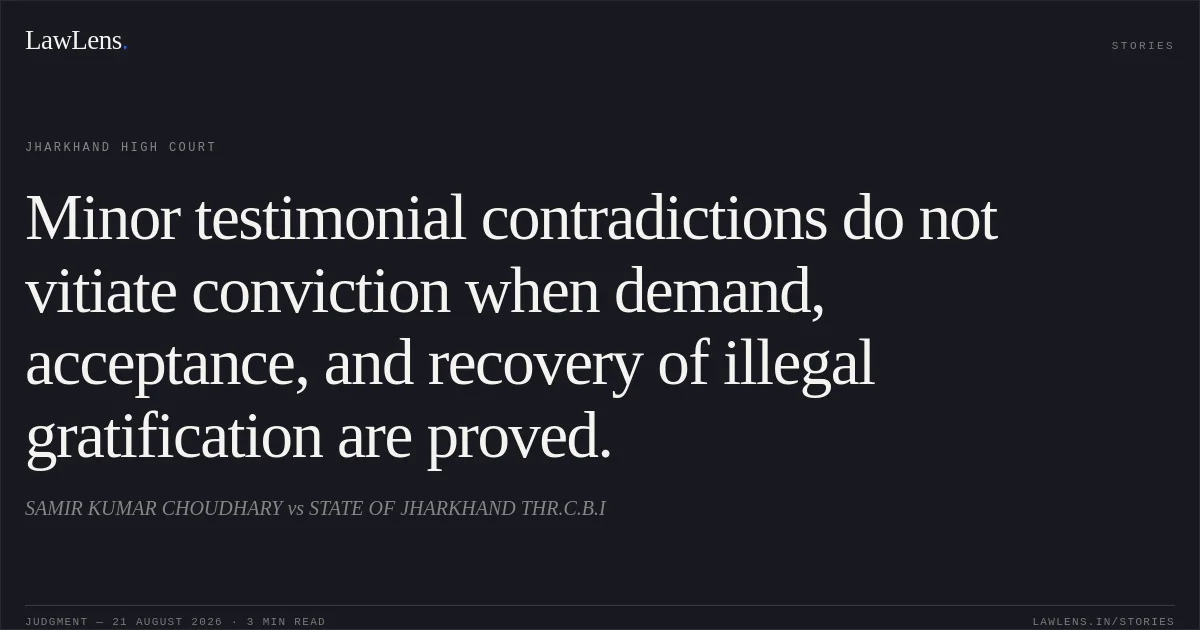
The appellant, a Fund/PF Clerk at Basudeopur Colliery, BCCL, was accused of demanding ₹300 from Ramdhari Harijan, an ex-Minor Loader, for processing and forwarding his CMPF arrear claim.
Source reference: pp. 1–4The CBI verified the complaint, registered RC Case No. 4(A)/1993(D), and arranged a trap on 22 March 1993. The prosecution alleged that the appellant demanded and accepted the tainted ₹300 and kept it in the drawer of his office table; the notes were subsequently recovered, and the appellant’s hand-wash samples tested positive for phenolphthalein and sodium carbonate.
Source reference: pp. 1–4After investigation and sanction for prosecution, the appellant was charged under Sections 7 and 13(1)(d) read with Section 13(2) of the Prevention of Corruption Act, 1988.
Source reference: p. 4The trial court convicted him and sentenced him to rigorous imprisonment for two years under each provision, with a consolidated fine of ₹1,000, the sentences to run concurrently.
Source reference: p. 5The appellant challenged the conviction and sentence in the present appeal.
Source reference: no citationIssues
1. Whether the prosecution proved beyond reasonable doubt that the appellant demanded and accepted ₹300 as illegal gratification and that the tainted money was recovered from his possession, thereby establishing offences under Sections 7 and 13(1)(d) read with Section 13(2) of the Prevention of Corruption Act, 1988.
Source reference: para. 13; pp. 10–122. Whether the contradictions in the prosecution evidence, the hostile testimony of one witness, the recovery from the table drawer, and the alleged deficiencies in proving sanction created reasonable doubt warranting acquittal.
Source reference: paras. 10, 153. Whether, assuming the conviction was sustainable, the sentence required modification in view of the appellant’s limited custody, the age of the occurrence, and the prolonged period of litigation.
Source reference: para. 16Law Applied
The court applied Sections 7 and 13(1)(d) read with Section 13(2) of the Prevention of Corruption Act, 1988, which criminalise acceptance or obtaining of illegal gratification by a public servant and abuse of official position for obtaining a pecuniary advantage.
Source reference: no citationThe prosecution was required to establish the material circumstances of demand, acceptance and recovery of the gratification; once foundational facts were proved, the statutory presumption under Section 20 of the Act operated against the accused unless rebutted by a credible explanation.
Source reference: para. 11The court also considered the evidentiary value of trap witnesses, recovery of tainted currency, and chemical examination confirming the presence of phenolphthalein and sodium carbonate.
Source reference: pp. 10–12On sentencing, the court noted the minimum sentence prescribed under Section 7, the appellant’s custody, the absence of prior criminal antecedents, the 1993 date of occurrence, and the prolonged trial and appeal.
Source reference: para. 16Reasoning
The court found that the testimony of the complainant, the trap witnesses, and the investigating officer consistently established that the appellant demanded ₹300 for processing the CMPF arrear claim, accepted the marked currency, and kept it in the drawer of his office table.
Source reference: pp. 10–12The recovery witnesses’ inconsistencies, including the hostile testimony of P.W.-4, were treated as non-substantive because the currency notes recovered from the drawer matched the denominations and numbers recorded in the pre-trap memorandum.
Source reference: pp. 10–12, para. 15The positive CFSL report corroborated the prosecution’s account by confirming phenolphthalein and sodium carbonate in the hand-wash samples.
Source reference: pp. 11–12The court therefore held that the alleged contradictions did not affect the core prosecution case and that the appellant had failed to provide a satisfactory explanation sufficient to rebut the statutory presumption under Section 20.
Source reference: paras. 11, 15Although the conviction was upheld, the court considered the occurrence to be more than three decades old, the relatively small gratification amount, the appellant’s one month and one day of custody, absence of previous criminal antecedents, and payment of ₹7,000 in fines/deposit amounts as mitigating circumstances for sentence modification.
Source reference: para. 16Holding
The appeal was dismissed on merits, and the appellant’s conviction under Sections 7 and 13(1)(d) read with Section 13(2) of the Prevention of Corruption Act, 1988, was affirmed.
However, the substantive sentence was reduced to the period already undergone, while retaining the applicable fine and the ₹5,000 amount deposited as a condition for confirmation of provisional bail.
Source reference: para. 16As the appellant was on bail, he was discharged from the liabilities of his bail bond and his sureties were discharged.
Source reference: para. 18Acts & Sections Cited
3 provisions across 1 statute referred to in this judgment. Each provision opens on LawLens.
Prevention of Corruption Act, 19883
Original Court PDF
SAMIR KUMAR CHOUDHARYvsSTATE OF JHARKHAND THR.C.B.I
Click to open original judgment
Original judgment, available to read, download and summarize on LawLens.in