Facts
The appellant sought compensation for the death of her husband, alleging that he was travelling from Bakhtiyarpur Junction to Anand Vihar on Train No. 12505 with a valid second-class ticket and fell from the moving train.
Source reference: pp. 2–3The Railway Claims Tribunal dismissed the claim, relying on the non-recovery of a ticket and discrepancies in the timings recorded in railway and police documents.
Source reference: pp. 2–3The Delhi High Court condoned a 257-day delay in filing the appeal, noting the appellant’s circumstances and the beneficial nature of the legislation.
Source reference: pp. 1–2The appeal challenged the Tribunal’s findings that the deceased was not proved to be a bona fide passenger and that his death did not result from an untoward incident.
Source reference: pp. 3–4Issues
Whether the deceased was a bona fide passenger despite non-recovery of the journey ticket.
Source reference: pp. 4–5Whether the deceased’s death resulted from an “untoward incident” under Section 123(c)(2) of the Railways Act, 1989, having regard to the Station Master’s memo and discrepancies in later records.
Source reference: pp. 5–6Law Applied
Section 23 of the Railway Claims Tribunal Act, 1987 provides for an appeal from a decision of the Tribunal.
Source reference: p. 2Under Section 123(c)(2) of the Railways Act, 1989, a passenger’s accidental fall from a train may constitute an “untoward incident”.
Source reference: p. 5Under Union of India v. Rina Devi, the mere absence of a ticket on the deceased does not, by itself, defeat a claim; the claimant may discharge the initial burden by establishing relevant facts and circumstances, after which the Railways must rebut the claim with cogent evidence.
Source reference: pp. 4–5The Court noted that this principle was reiterated in Lata v. Union of India and Sukhabhai Nanjibhai Makwana v. Union of India.
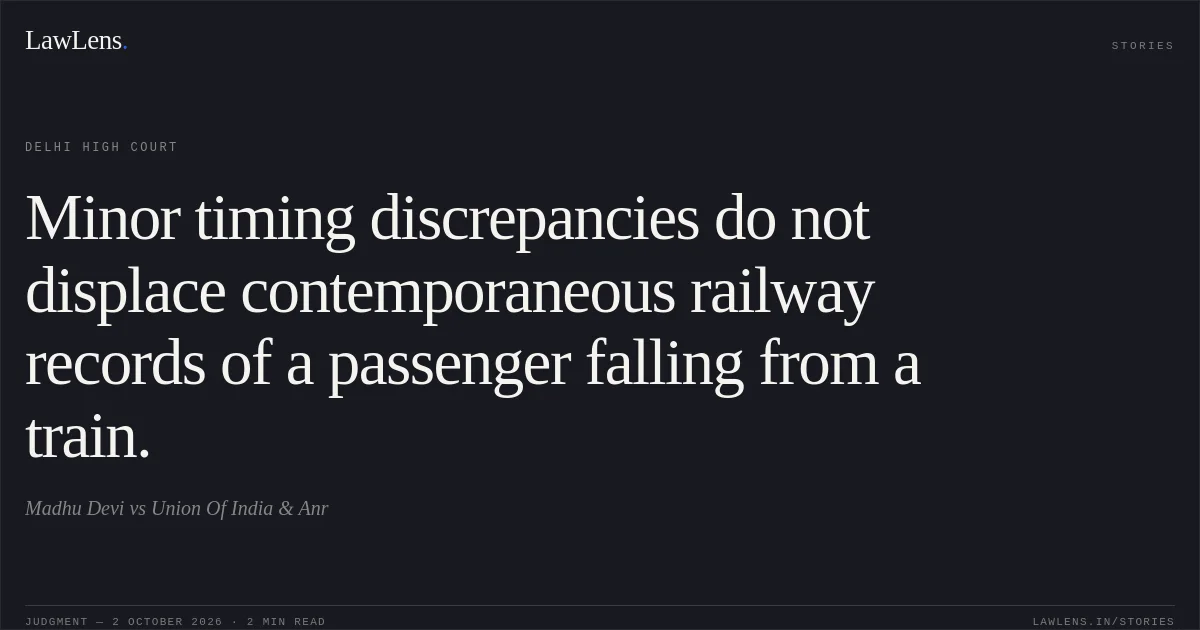
Source reference: p. 5The occurrence is assessed on the touchstone of preponderance of probabilities, and minor discrepancies in subsequent records do not necessarily displace an earlier contemporaneous record.
Source reference: pp. 5–6Reasoning
The appellant specifically pleaded that the deceased had bought a valid ticket and that it was lost in the incident; the Railways did not displace that assertion with cogent evidence.
Source reference: p. 5The Court therefore held that non-recovery of the ticket could not, in isolation, outweigh the other circumstances supporting the alleged journey.
Source reference: p. 5As to the fall, the Station Master’s memo—the earliest contemporaneous railway record—recorded information that a passenger had fallen from Train No. 12505.
Source reference: p. 5Although later documents recorded differing timings, the Court considered those variations peripheral and insufficient to disprove the occurrence recorded in the memo or to establish fabrication, particularly in the absence of direct evidence of a contrary account.
Source reference: pp. 5–6The Tribunal had therefore erred in treating those discrepancies as decisive.
Source reference: p. 6Holding
The Court set aside the Tribunal’s judgment and allowed the appeal.
It remanded the matter to the Tribunal to assess compensation in accordance with law and directed the authorities concerned to disburse it within two months of receiving the order; the matter was directed to be listed before the Tribunal on 13 November 2026.
Source reference: pp. 6–7Acts & Sections Cited
2 provisions across 2 statutes referred to in this judgment. Each provision opens on LawLens.
Railway Claims Tribunal Act, 19871
Railways Act, 19891
Original Court PDF
Madhu DevivsUnion Of India & Anr
Click to open original judgment
Original judgment, available to read, download and summarize on LawLens.in